


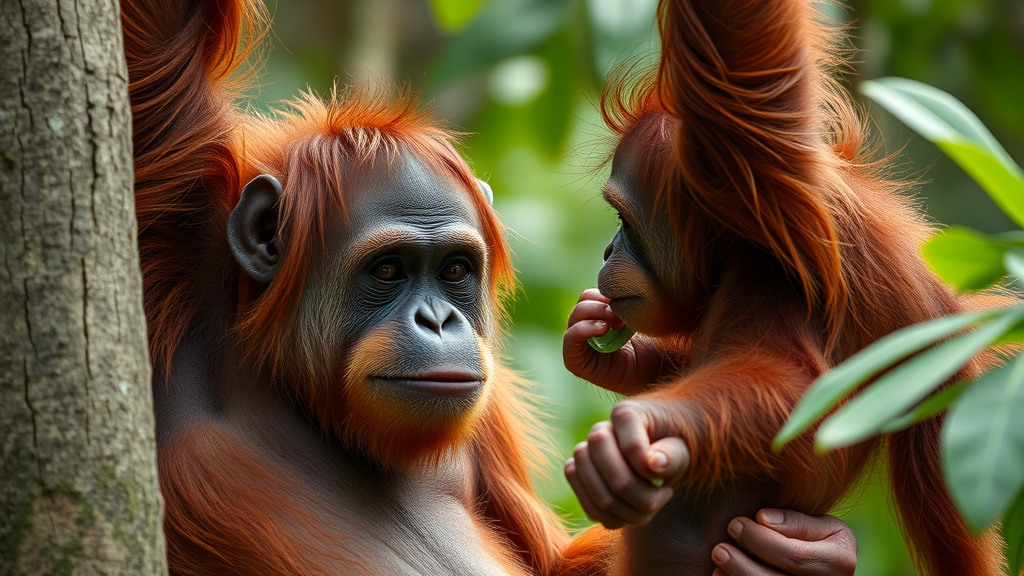
In the tangled rainforests of Sumatra, a young orangutan faces one of the longest apprenticeships in the animal kingdom. For roughly eight and a half years, an infant clings to its mother, watching everything she eats, everything she avoids, and every careful technique she uses to pry nutrition out of a forest that is full of traps. Then, almost overnight, the safety net disappears. Orangutans leave their mothers and must fend for themselves entirely alone, choosing from thousands of potential food items in a habitat where the wrong choice can be toxic or even lethal. A new study published in Science shows that how well a young orangutan navigates this transition depends on something remarkably personal: its own individual learning style.
The research, led by Dr. Revathe Thillaikumar, a Marie Sklodowska-Curie Actions Postdoctoral Fellow at the Max Planck Institute of Animal Behavior, together with senior author Dr. Caroline Schuppli and colleagues at Universitas Nasional in Indonesia, is the first to demonstrate that social and individual forms of learning interact over many years to build broad, survival-relevant ecological skills in a wild great ape. Until now, scientists have debated to what extent animals acquire their survival skills by watching others or by experimenting on their own, but the long developmental timelines of great apes have made it extraordinarily difficult to connect learning events to concrete outcomes. This study closes that gap with an unusually detailed dataset and a statistical approach that treats each animal as its own developmental story.
The scale of the challenge facing a young orangutan is hard to overstate. An adult orangutan’s diet consists of nearly 250 distinct food items, selected from thousands of different options scattered across the rainforest maze. Some of those options are potentially poisonous. Beyond simply knowing what to eat, an independent orangutan must master how each food should be processed, and when and where each item can be found in the forest. As Thillaikumar asks, how do infants master this complex diet curriculum during their first years of life? Humans offer a clue, because throughout our evolutionary history we too had to learn an immense set of survival skills across many years of development, drawing on a complex interplay of social and individual learning. But whether wild animals use the same combination of learning forms to build their own survival skills had remained unknown.
To answer the question, the team drew on long-term data from the Suaq Balimbing research station in Gunung Leuser National Park, Indonesia, where an international team of researchers and field assistants follows wild Sumatran orangutans across their entire lives. For this study, the researchers analyzed data from 21 immature orangutans recorded from birth until independence at around 8.5 years of age. Across 4,700 hours of observation, they tracked three key behaviors: when the youngsters closely observed their mothers and other nearby orangutans through a behavior known as peering, which serves as a behavioral indicator of social learning; when they explored different items in their habitat, indicating individual learning; and which food items they successfully ate without help from their mothers, a direct measure of ecological competence.
The analytical challenge was formidable. Because orangutans develop so slowly, there is a multi-year lag between a learning event and any measurable change in behavior, as Schuppli explains. To bridge that gap, Thillaikumar worked with theoretical statistician Professor Paul-Christian Bürkner of TU Dortmund University to analyze just under seven thousand records of social and individual learning, keeping each animal’s history separate. This individual-level modeling was, in her words, a linchpin of the study, because it finally allowed the researchers to link the two parts that had previously been unbridgeable: learning and skill development. Rather than averaging across the population, the team could trace how each animal’s own learning tendencies shaped its own eventual diet.
The first major finding is that orangutan infants have genuinely individual learning styles. Over their long development, the immatures differed substantially from one another in how frequently they engaged in social versus individual learning. Thillaikumar admits the team was astonished by how different the infants were from one another in their tendencies to learn. Yet despite this variation, a clear pattern emerged across the group: all immatures engaged in social learning more frequently than individual learning, on average as much as five times more often. The explanation, Schuppli suggests, lies in the economics of risk. Learning purely through individual exploration can be dangerous for a naive orangutan, especially for immatures who are still growing and cannot afford to miss out on feeding opportunities. The safer option may simply be to watch and learn from knowledgeable role models, such as their mothers.
Social learning, it turns out, does far more than provide a safe alternative to exploration. When an infant engaged in social learning, it triggered subsequent exploration for as long as two and a half hours afterward. Each time an infant peered at its mother or another orangutan, it produced a prolonged ripple effect on its own subsequent explorations, priming the youngster to investigate items it had just seen handled by someone else. To disentangle the contributions of the two processes, the authors focused on explorations that were independently initiated, allowing them to test how social and individual learning worked together rather than merely replacing one another.
The answer is that the two forms of learning operate in tandem across the entire developmental period. Infants that engaged in high rates of both social and individual learning ended up with the broadest diet profiles by the time they became independent. Conversely, when both forms of learning were low, individuals ended up with the narrowest diets, producing a striking three-fold difference in diet breadth between the highest and lowest learners. Perhaps most intriguingly, increased social learning could partially compensate for low individual learning, improving diet breadth even when independent exploration was infrequent. As Thillaikumar puts it, social learning stepped in to do the heavy lifting, a result that underlines just how significant it is in the lives of great apes.
For Schuppli, the findings demand a more nuanced appreciation of the mechanisms underlying great ape cultures. It is about more than just social or individual learning, she says; it is about the interplay of complex learning mechanisms that has driven the development of a broad, highly survival-relevant cultural competence in one of our closest living relatives in the wild. That interplay, she argues, suggests that the sophisticated cultural learning seen in humans may have deep evolutionary roots, predating the split between our lineages by many millions of years. In other words, the recipe for human culture, a blend of attentive observation and hands-on experimentation sustained over a long childhood, may already have been simmering in the forests where our ape relatives live today.
Questions remain. The study shows that heightened learning produces broader diets, but exactly how this advantage arises is still open. Are high-learning orangutans simply accumulating knowledge about more items, or are they actually getting better at learning itself? The team now plans to look beyond diet breadth to determine whether greater learning also improves energy intake, and ultimately whether it translates into measurable differences in survival and reproduction. As co-author Dr. Sri Suci Utami-Atmoko of Universitas Nasional notes, questions like these can only be answered by watching animals in their natural environment from birth to death, because long-term field studies provide the time and space to follow long-lived animals across their whole histories. For orangutans, she says, these studies offer a window into how culture and survival have become intertwined over evolutionary time. For the rest of us, they offer a humbling reminder that the path to competence, in the rainforest as in our own species, is neither purely taught nor purely discovered, but built patiently from both.
Subject of Research: How social and individual learning styles shape ecological skill development in wild orangutans
Article Title: Learning style predicts survival skills in young orangutans
Article References: Learning style predicts survival skills in young orangutans. (n.d.). Original publication
Image Credits: AI Generated
DOI: Not provided
Keywords: orangutans, social learning, individual learning, animal culture, Sumatra, diet breadth, great apes, childhood development, ecological competence, field study, Science journal, Max Planck Institute
Cite Scienmag News
Courtney Benton. (September 24, 2026). Watch, then try: how orangutan learning styles decide who survives alone. Scienmag. https://scienmag.com/watch-then-try-how-orangutan-learning-styles-decide-who-survives-alone/
Courtney Benton. "Watch, then try: how orangutan learning styles decide who survives alone." Scienmag, 24 September 2026, https://scienmag.com/watch-then-try-how-orangutan-learning-styles-decide-who-survives-alone/. Accessed 24 September 2026.
Courtney Benton. "Watch, then try: how orangutan learning styles decide who survives alone." Scienmag. September 24, 2026. https://scienmag.com/watch-then-try-how-orangutan-learning-styles-decide-who-survives-alone/


