


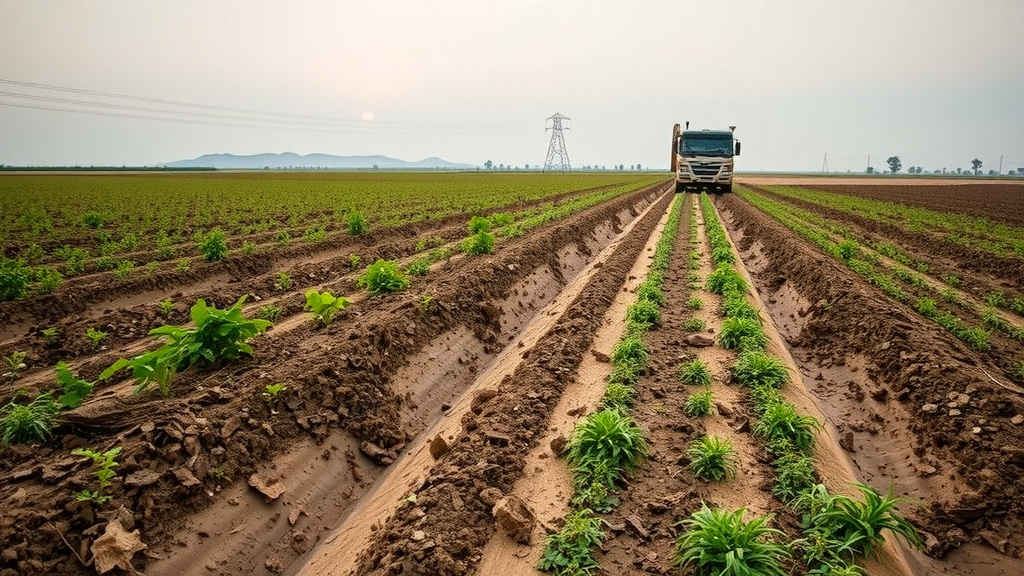
War has always destroyed harvests, but a sweeping new analysis published in Nature Food shows just how systematically armed conflict strips the planet of its farmland. By combining annual, high-resolution cropland maps covering the years 2000 to 2020 with a database of more than 460,000 recorded conflict events across 155 countries, a team of researchers led by Guangdong Li of the Chinese Academy of Sciences has produced the most comprehensive global accounting yet of what bullets and bombs do to the fields that feed us. Their conclusion is stark: conflict does not merely disrupt farming for a season or two. It permanently erases cropland, and the scale of that erasure is large enough to have fed a quarter of a billion people every year.
The study’s starting point is a striking geographic coincidence. Although areas lying within five kilometres of a conflict event covered only about three percent of the global land surface by 2020, those same buffer zones contained roughly six percent of the world’s cropland. In other words, agricultural land is disproportionately likely to sit in the line of fire. This is no accident of geography alone. Throughout human history, settlements and their surrounding fields have clustered in river valleys, coastal plains and other fertile, accessible terrain, and it is precisely these productive, densely populated landscapes that rival factions contest. The result is a systematic overlap between violence and cultivation that holds across continents and decades.
To move beyond correlation, the researchers deployed a difference-in-differences design, a statistical technique borrowed from economics that compares changes over time in conflict-exposed areas against changes in otherwise similar areas that escaped violence. This approach controls for the many factors that drive cropland change everywhere, from urban expansion to commodity prices, and isolates the effect attributable to conflict itself. The estimates show that conflict exposure caused an average annual cropland loss of 14.46 hectares per buffer-year, equivalent to a three percent decline in cropland area within affected zones. Spatial matching analyses, which pair each conflict-affected location with its statistically closest non-conflict counterpart, reinforced the finding: cropland loss was 23.7 percent greater in places touched by armed conflict than in comparable peaceful areas.
The regional pattern is as revealing as the global average. Losses were concentrated in West Africa, Eastern Africa and Southeast Asia, regions where smallholder agriculture dominates, state institutions are often fragile, and rural populations depend directly on the land they till. In such settings, the mechanism of loss differs from that of a shell crater. Farmers flee violence and abandon fields that are never reclaimed; irrigation systems fall into disrepair; land mines and unexploded ordnance render soil untouchable for years; and contested ownership discourages anyone from reinvesting in the land. The study’s technical framing recognises these channels, incorporating data on refugee displacement from the UNHCR, night-time lights as a proxy for economic activity, and population density to account for the demographic upheaval that accompanies fighting.
Behind the headline numbers lies a methodological achievement worth appreciating. The cropland data came from the GLC_FCS30D dataset, a global land-cover product generated at 30-metre resolution from dense time series of Landsat satellite imagery using continuous change-detection algorithms. That means the researchers could watch individual parcels of land, each about the size of a baseball diamond, transition in and out of cultivation year by year. Conflict events were drawn from two independent sources, the Armed Conflict Location and Event Data project and the Uppsala Conflict Data Program’s Georeferenced Event Dataset, providing more than 460,000 geolocated incidents. Weather controls came from high-resolution temperature and precipitation records, and crop yield information from the Spatial Production Allocation Model, allowing the team to translate lost hectares into lost dietary energy.
That translation yields the study’s most sobering figure. Had the conflict-driven cropland losses between 2000 and 2020 been prevented, the researchers calculate, the resulting production could have supplied sufficient dietary energy for 255.54 million people annually. To put that in perspective, it is more than the population of Germany, France and the United Kingdom combined, going hungry every single year because of farmland erased by war. Food insecurity was measured in the study using the prevalence of severe food insecurity as reported in the World Bank’s World Food Security Outlook, linking the physical loss of cropland directly to human deprivation rather than treating them as separate problems.
The findings arrive at a moment when the world’s food system is under unprecedented strain. Previous research has documented conflict-agriculture interactions in specific places: satellite studies revealed cropland abandonment in South Sudan, cultivation collapses in territory once held by the Islamic State, war-induced agricultural damage in Ukraine and Gaza, and civil-war-driven production losses in Syria. Earlier work in Nature Food also showed that violent conflict exacerbated drought-related food insecurity across sub-Saharan Africa between 2009 and 2019. What distinguishes the new study is its global scope and causal rigor. Where prior analyses documented single conflicts, this one quantifies the aggregate, worldwide effect, and where earlier work described associations, the difference-in-differences and matching designs allow stronger claims about causation.
The study also examines what moderates the damage. Governance quality, captured through three World Bank indicators covering government effectiveness, regulatory quality and the rule of law, enters the analysis as a potential buffer. The underlying logic is intuitive: capable institutions can protect farmers, maintain input supply chains, and support post-conflict land rehabilitation, whereas weak governance leaves rural communities exposed. The moderation analysis, presented among the paper’s central figures, situates cropland loss within a broader web of economic, demographic and institutional variables, underscoring that war’s agricultural toll is not uniform but shaped by the resilience of the societies it touches.
For policymakers, the implications cut in two directions. First, humanitarian and development agencies increasingly recognise that food crises and armed conflict are inseparable; the Global Report on Food Crises has repeatedly identified conflict as a leading driver of acute hunger. This study gives that recognition a hard quantitative footing, suggesting that protecting cropland during hostilities, for example through demining programmes, support for displaced farmers, and rapid post-ceasefire land rehabilitation, should be treated as food security policy of the first order. Second, the calorie calculations provide a way to weigh the costs of conflict prevention against its benefits. If preventing agricultural losses in conflict zones could feed a quarter of a billion people annually, then investments in peacebuilding acquire an economic and nutritional dividend that conventional security analyses rarely count.
There are, as with any study, limits to keep in mind. Satellite-derived cropland maps classify land cover but cannot fully distinguish a weedy abandoned field from an actively cultivated one, nor capture the intensity of management on land that remains in production. Conflict databases depend on reporting that may be incomplete in the most chaotic settings. And the five-kilometre buffer, while grounded in literature on the distance constraints of peasant farming, is a simplification of how violence radiates across landscapes. Yet the convergence of two independent statistical strategies, the difference-in-differences and the spatial matching, on consistent estimates lends the central conclusion considerable weight. Armed conflict, the evidence now shows, is not just a humanitarian emergency measured in casualties and refugees. It is a slow-motion catastrophe for the land itself, one whose hectares, once lost, take decades to recover, and whose absent calories are felt on plates far from the battlefield.
Subject of Research: The impact of armed conflict on global cropland loss and food insecurity
Article Title: Armed conflict accelerates cropland loss and food insecurity worldwide
Article References: Li, G., Qi, W., Sun, S., Liu, X., & Wang, Z. (2026). Armed conflict accelerates cropland loss and food insecurity worldwide. Nature Food. https://doi.org/10.1038/s43016-026-01436-8
Image Credits: AI Generated
DOI: 10.1038/s43016-026-01436-8
Keywords: armed conflict, cropland loss, food security, remote sensing, difference-in-differences, land use change, Nature Food, global hunger, conflict zones, agriculture, satellite data, humanitarian crisis
Cite Scienmag News
Ophelia Keating. (September 24, 2026). War Leaves a Lasting Scar on the World’s Farmland, Global Study Finds. Scienmag. https://scienmag.com/war-leaves-a-lasting-scar-on-the-worlds-farmland-global-study-finds/
Ophelia Keating. "War Leaves a Lasting Scar on the World’s Farmland, Global Study Finds." Scienmag, 24 September 2026, https://scienmag.com/war-leaves-a-lasting-scar-on-the-worlds-farmland-global-study-finds/. Accessed 24 September 2026.
Ophelia Keating. "War Leaves a Lasting Scar on the World’s Farmland, Global Study Finds." Scienmag. September 24, 2026. https://scienmag.com/war-leaves-a-lasting-scar-on-the-worlds-farmland-global-study-finds/

