


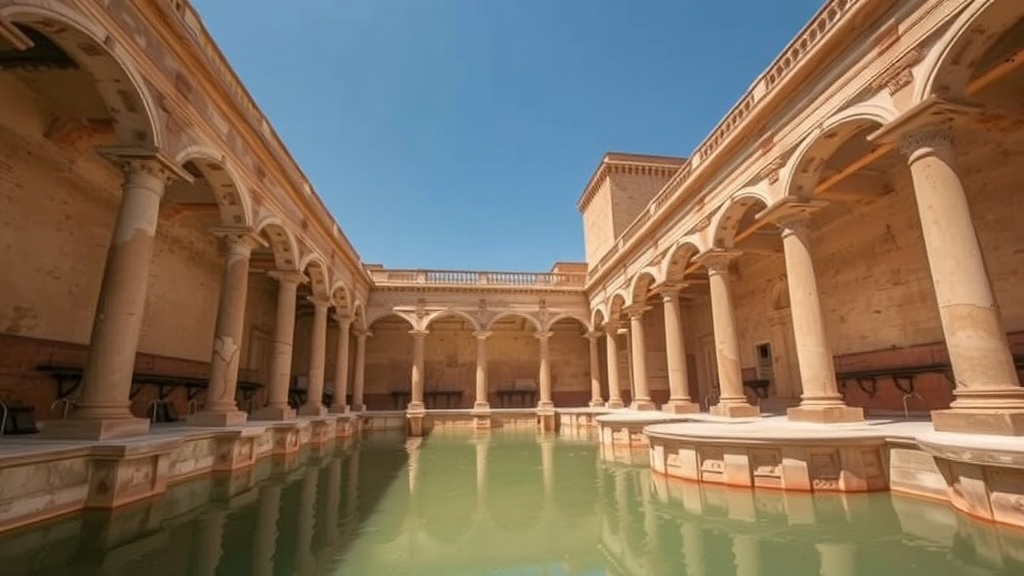
Beneath the weathered ruins of Thuburbo Majus, one of the most important Roman cities of ancient North Africa, a team of researchers has been decoding the building secrets of a monumental bath complex that stood for centuries in the hot plains of what is now Tunisia. Their study, published in Archaeological and Anthropological Sciences, presents the first comprehensive scientific characterization of the stones and mortars used in the city’s so-called Winter Baths, and the results reveal a construction enterprise far more sophisticated than the ruins’ battered appearance suggests. By combining optical microscopy, X-ray diffraction, X-ray fluorescence, scanning electron microscopy and thermal analysis, the researchers reconstructed not only what the builders used, but why they used it, where the materials came from, and in some cases when each wall rose.
Thuburbo Majus lies roughly sixty kilometers southwest of Tunis, near the modern town of El Fahs, in a fertile agricultural zone that helped the city flourish from the first through the seventh centuries CE. Granted civic status probably under Augustus and later elevated to the rank of honorary colony under Commodus in 188 CE, the city accumulated temples, a forum, a Capitolium and public baths. The Winter Baths, covering approximately 1,600 square meters in the urban core, grew through an asymmetrical layout born of repeated additions and renovations. An inscription studied in earlier scholarship allowed archaeologists to attribute the original construction to the first half of the third century CE, with major restoration phases in the late fourth to early fifth centuries and again in the early sixth century, before the building’s eventual abandonment.
The research team, led by Aida Zaddem and Karima Zoghlami with colleagues including Rafael Fort of the Institute of Geosciences in Madrid, sampled nine distinct stone lithotypes and thirty-two mortar specimens from walls across the complex. Petrographic thin sections, stained to distinguish calcite from dolomite, revealed the full petrographic identity of each rock: a nummulite-rich Oligocene packstone, travertine, ferriferous recrystallized micrite, a dense Jurassic limestone marketed even today as Aziza-type marble, a porous bioclastic calcarenite, speleothem calcite, an Eocene biomicrite, a Jurassic pelsparite and a glauconitic grainstone. Each of these was matched to a specific architectural role, and the match turned out to be strikingly deliberate.
The analysis exposed a procurement strategy of remarkable economy and precision. Nummulitic limestone and travertine, quarried within a radius of less than twenty kilometers, formed the monumental framework, minimizing transport costs while providing the mechanical strength the main structures required. The heating system told an even sharper story. The vault of the main furnace, the praefurnium, was built exclusively of fired bricks bonded with cocciopesto mortar, a technical imperative given that flames there could reach between 800 and 1,000 degrees Celsius, hot enough to decarbonate and disintegrate any carbonate stone. Yet the support pillars and the cheeks of the flue channels, made of glauconitic limestone and ferriferous micrite, remained intact, demonstrating that builders understood empirically that temperatures at those positions stayed below the limestone destruction threshold of roughly 600 to 800 degrees.
Specialization extended to the prestigious elements. Highly porous calcarenite, with porosity reaching 25 to 27 percent, was reserved for arches and voussoirs where lightness mattered, while marbles were chosen for columns, where hardness and visual prestige dominated. The mortars, meanwhile, fell into two great families: lime-based and gypsum-based. The lime mortars split into three subgroups that map directly onto Roman hydraulic science. The first type, moderately hydraulic, mixed a lime binder with siliceous and carbonate aggregates likely drawn from the sands of the nearby Oued Miliane and Oued Medjerda rivers; their hydraulicity came from clay impurities in marly limestone calcined into the binder itself, forming calcium silicate and aluminate hydrates without any added ceramics.
The second type was entirely different in purpose: non-hydraulic air-lime coatings built in multiple layers, their aggregates composed of crushed marble and vein calcite, with grain size progressively decreasing from the wall inward toward the finished surface. These white to beige plasters carried the highest calcium oxide contents of the entire assemblage, averaging around 57 percent, and their chemistry shows almost no silica, alumina or iron, confirming a purely aerial binder. Fascinatingly, one intermediate layer in some samples shows a faint reddish hue and weak hydraulic character, hinting that builders may have sprinkled finely ground ceramic powder, an artificial pozzolana, into that single stratum to fine-tune its properties. This kind of marble-dust coating echoes the plaster recipes that Vitruvius described for polished wall finishes.
The third lime type is the showpiece: highly hydraulic cocciopesto, loaded with ceramic fragments up to a centimeter across, used to waterproof the frigidarium pool and a decantation basin. Thermal analysis sealed the classification. The ratio of carbon dioxide to water lost during heating, a standard proxy for hydraulicity, dropped below 5 percent for these mortars, the signature of strongly hydraulic systems in which pozzolanic reactions between lime and fired clay generate abundant calcium silicate hydrates. Trace elements told the same story from another angle: cocciopesto samples carried the highest concentrations of niobium, rubidium, zirconium, zinc, chromium and vanadium, the geochemical fingerprint of silicate-rich ceramic aggregate. A fourth family of gypsum-based mortars, dominated by sulfate phases with sulfur trioxide averaging over 63 percent, came from the abandonment phase, when builders opportunistically exploited abundant local Triassic gypsum deposits even in structural roles that gypsum was traditionally never asked to play.
Perhaps the most consequential findings are chronological. Mortar fingerprinting forced a re-evaluation of the building’s accepted construction sequence. A joint mortar from the latrines, previously assigned to the first renovation phase of the late fourth century, proved compositionally indistinguishable from the original third-century mortars, raising the possibility that the latrines were part of the initial design and only internally modified later. A coating from the corridor wall, attributed to the original phase on architectural grounds, instead matches the crushed-marble plasters of the late-fourth-century renovation. Most strikingly, the bottom of the decantation basin, built with original-phase cocciopesto, contrasts with its upper walls of gypsum-bonded rubble, suggesting the basin’s base belongs to the first construction campaign while its upper portion was added during abandonment, a functional repurposing of the water system. The authors caution that these reinterpretations remain preliminary until confirmed by absolute dating methods such as optically stimulated luminescence or isotopic analysis.
The study also carries a warning for conservation. Soluble salts, including halite, syngenite and secondary gypsum, pervade the mortars. The gypsum largely results from the dissolution and recrystallization of older gypsum binders migrating through the masonry; the halite, at an inland site, most likely rose capillary-ward from saline groundwater or came from unwashed, evaporite-rich local sands; and syngenite forms when gypsum reacts with potassium from atmospheric deposition or fertilizers. These salts crystallize and swell with humidity, and their behavior directly explains the poor state of preservation visible across the complex today. Any modern repair mortar that ignored this chemistry would accelerate rather than arrest the decay.
In the end, the Winter Baths emerge as a case study in how Roman builders married imperial engineering knowledge to local geology, balancing logistics against performance with a precision that thermal modeling has only now made legible. By treating mortars not merely as glue but as chronological and technological documents, the research provides both a corrected timeline for the monument’s evolution and a rigorous template for designing compatible restoration materials, one based on the very recipes Roman craftsmen mixed nearly eighteen centuries ago. For a site whose excavated area still covers only a fraction of its ancient footprint, the stones and mortars of Thuburbo Majus are proving to be its most eloquent historians.
Subject of Research: Archaeometric characterization of Roman building stones and mortars from the Winter Baths of Thuburbo Majus, Tunisia
Article Title: Multi-analytical characterization of construction materials from the ‘Winter Baths’ of Thuburbo Majus (Tunisia): Implications for architectural chronology and conservation
Article References: Zaddem, A., Zoghlami, K., Fort, R., Romdhane, H. B., Coralini, A., & Gasmi, M. (2026). Multi-analytical characterization of construction materials from the ‘Winter Baths’ of Thuburbo Majus (Tunisia): Implications for architectural chronology and conservation. Archaeological and Anthropological Sciences, 18(10), Article 205. https://doi.org/10.1007/s12520-026-02563-w
Image Credits: AI Generated
DOI: 10.1007/s12520-026-02563-w
Keywords: Thuburbo Majus, Roman baths, archaeometry, mortars, hydraulic lime, cocciopesto, petrography, X-ray diffraction, Tunisia, conservation, building chronology, gypsum mortar
Cite Scienmag News
Denise Maddox. (September 24, 2026). Roman Baths in Tunisia Reveal Sophisticated Hydraulic Engineering Through Their Stones and Mortars. Scienmag. https://scienmag.com/roman-baths-in-tunisia-reveal-sophisticated-hydraulic-engineering-through-their-stones-and-mortars/
Denise Maddox. "Roman Baths in Tunisia Reveal Sophisticated Hydraulic Engineering Through Their Stones and Mortars." Scienmag, 24 September 2026, https://scienmag.com/roman-baths-in-tunisia-reveal-sophisticated-hydraulic-engineering-through-their-stones-and-mortars/. Accessed 24 September 2026.
Denise Maddox. "Roman Baths in Tunisia Reveal Sophisticated Hydraulic Engineering Through Their Stones and Mortars." Scienmag. September 24, 2026. https://scienmag.com/roman-baths-in-tunisia-reveal-sophisticated-hydraulic-engineering-through-their-stones-and-mortars/


