


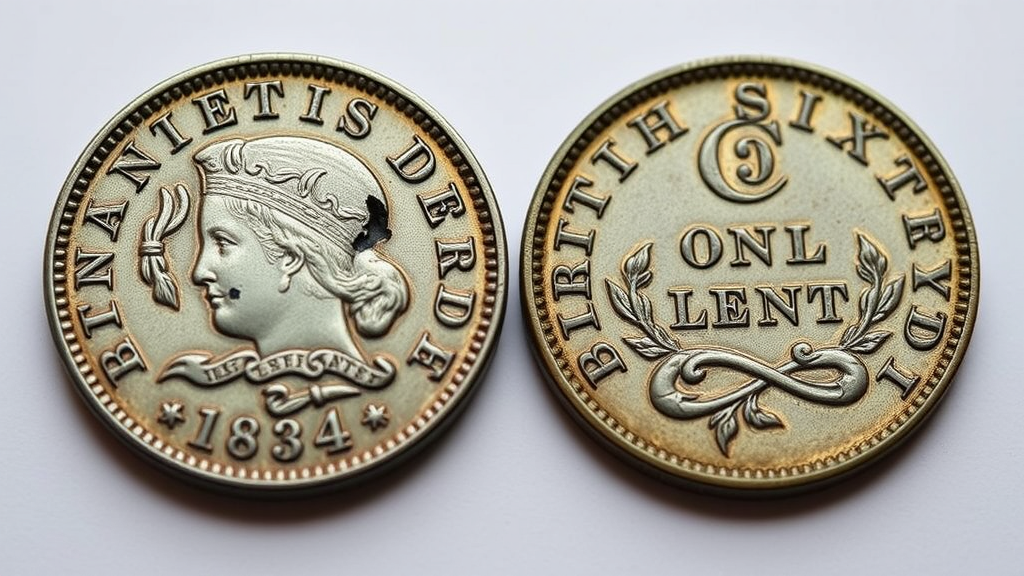
A severely deformed British silver sixpence struck in 1834, during the reign of King William IV, has become the subject of an unusual scientific investigation that combines heritage science, non-destructive laboratory analysis and carefully supervised computational reasoning. The coin, whose obverse surface is dramatically disrupted while much of its rim and edge milling survives comparatively intact, has long defied easy explanation. Now a study published in the journal npj Heritage Science by A. Ikraam, founder of the independent research initiative IA STUDIO, reports that the physical evidence preserved in the metal is most consistent with severe deformation occurring during the minting process itself, rather than with ordinary wear, corrosion or a single unconstrained later impact. The finding matters because severe striking failures were normally caught during mint inspection and remelted, particularly for precious-metal coinage, making a surviving example a rare material record of a transient abnormal event inside an early mechanised manufacturing process.
The story of the coin begins not in a museum vault but at a car boot sale in Greater Manchester, where the sixpence was individually marked £8 in a mixed coin album. Importantly, the album was later acquired as a job lot, so the coin was not purchased separately for that price, a detail that underscores how extraordinary objects can surface in the most ordinary settings. Even so, its extraordinary deformation could not be confidently explained through visual examination alone. Historic metal objects that have undergone extensive deformation present a notoriously difficult interpretive problem: was the damage inflicted during manufacture, accumulated during use, produced by chemical attack over decades, or caused by a later accident? Each explanation carries different implications for historians of technology, for numismatists and for conservators responsible for the object’s care.
To address that problem systematically, the investigation turned to non-destructive analytical techniques capable of interrogating the coin without altering or sampling it. The study combined scanning electron microscopy with energy-dispersive X-ray spectroscopy, a pairing usually abbreviated SEM-EDX, together with optical surface profilometry. SEM-EDX allows researchers to image a surface at very high magnification while simultaneously identifying the chemical elements present, whereas optical profilometry builds a detailed three-dimensional map of surface height, capturing relief changes far too subtle or too complex for the eye to judge reliably. These services were independently commissioned from the Experimental Techniques Centre at Brunel University of London and the Oxford Materials Characterisation Service, part of the Department of Materials at the University of Oxford, ensuring that the primary measurements came from laboratories with no stake in the study’s interpretation.
The chemical results told a nuanced story about the coin’s surface. In comparatively intact regions, SEM-EDX identified a silver-copper substrate, the expected composition of a sterling silver coin of the period. In the damaged areas, however, the measured silver levels were lower, copper was elevated, and additional chemical signatures appeared that are consistent with corrosion products and surface contamination concentrated within the mechanically disturbed depressions. These findings primarily describe changes to the coin’s surface chemistry rather than its bulk structure. Although corrosion and contamination are clearly present, the study concluded that neither adequately explains the extent or the geometry of the deformation. In other words, chemistry recorded the coin’s later environmental history, but it could not account for the dramatic reshaping of the metal itself.
It was the three-dimensional surface measurements that proved most decisive. Optical profilometry revealed abrupt changes in relief across the most severely affected areas, along with steep-sided troughs, raised shoulders, terraced deformation and overlapping displacement structures. The author analysed height-grid data supplied by the Oxford Materials Characterisation Service and identified approximately 750 micrometres, or 0.75 millimetres, of vertical relief variation within the damaged central portrait region on the obverse. Equally significant was what had survived: the severe disruption was concentrated in the central fields of the coin, while substantial portions of the rim and edge milling remained comparatively well preserved. That spatial pattern, substantial central displacement alongside preserved peripheral features, is more compatible with repeated constrained compression than with the gradual smoothing associated with circulation wear or the progressive loss of material through corrosion.
Taken together, the chemical, microscopic and topographic findings point toward severe localised deformation involving repeated high-pressure loading under at least partial lateral constraint. The study therefore favours a mint-stage striking anomaly over the competing explanations of ordinary wear, corrosion or a single unconstrained later impact. The context makes this interpretation historically resonant. The sixpence was struck in 1834, during the steam-press era of British coinage, when mechanised production had transformed minting but had not eliminated the possibility of spectacular failures. Because such failures were ordinarily identified during mint inspection and remelted, particularly in the production of precious-metal coins, a surviving deformed example may preserve unusual physical evidence of a transient abnormal event within an early mechanised manufacturing process, a moment of industrial malfunction that quality control was designed to erase.
The methodological architecture of the study is as noteworthy as its conclusion. Before any laboratory measurements became available, the investigation began with high-resolution imagery and a structured visual review of the coin’s unusual features. This initial examination helped establish several possible explanations for the deformation and identified the specific physical evidence needed to distinguish between them. Human-supervised computational tools, including large language models, were used to organise observations, structure alternative hypotheses, support comparative reasoning and develop questions that could subsequently be tested through laboratory analysis. Crucially, the working hypotheses and analytical notes were documented before the independent laboratory measurements were available, creating a clear evidential sequence in which predictions preceded data.
The explanations formally considered included circulation wear and corrosion, later mechanical damage, later constrained compression, and deformation during minting. These possibilities were then evaluated against the non-destructive measurements independently produced by the Brunel and Oxford facilities. Following laboratory testing, computational tools were also used to help organise the independently produced measurements and compare them with the earlier hypotheses. The important sequence, as the author emphasised, was hypothesis first, independent laboratory measurement second. The models could support the reasoning process, but they could not decide what happened to the coin, and they did not generate the laboratory measurements or determine the study’s conclusion. The independently produced laboratory datasets remained the primary scientific evidence, while responsibility for interpreting the results and reaching the final judgement rested with the author alone.
Beyond the fate of a single coin, the research demonstrates a transferable, non-destructive approach to investigating metallic heritage objects whose unusual features cannot be confidently attributed to manufacture, use, corrosion or later damage through visual examination alone. The strategy of examining substrate composition, surface alteration and deformation geometry separately before bringing the findings together to weigh competing explanations offers a template that conservators, archaeologists and museum scientists could apply to other contested artefacts. It also illustrates a disciplined model for integrating artificial intelligence into heritage science: computational tools help structure hypotheses and organise evidence, while independent physical measurement and human judgement retain the final authority. The involvement of the commissioned analytical facilities does not imply institutional authorship or endorsement of the study’s interpretation, conclusions or computational methodology, and the author declares no competing financial or non-financial interests.
For now, the 1834 William IV sixpence stands as a small but eloquent witness to the stresses of early industrial coin production, its scarred obverse preserving in silver and copper the fingerprint of a high-pressure event that quality control at the mint was meant to catch. The study, published in npj Heritage Science under the title Laboratory investigation of a deformed 1834 William IV sixpence, shows how modern microscopy, chemical analysis and three-dimensional surface measurement can read evidence written into metal nearly two centuries ago, and how a structured, hypothesis-driven workflow can turn a puzzling car boot sale curiosity into a documented case study in the material history of mechanised minting.
Subject of Research: Materials analysis of a deformed 1834 British silver sixpence to determine the cause of its deformation
Article Title: Materials analysis sheds light on minting mystery of 1834 British sixpence
Article References: Materials analysis sheds light on minting mystery of 1834 British sixpence. (n.d.). Original publication
Image Credits: AI Generated
DOI: Not provided
Keywords: 1834 sixpence, William IV, heritage science, minting anomaly, SEM-EDX, optical profilometry, non-destructive analysis, numismatics, npj Heritage Science, coin deformation, British coinage, IA STUDIO
Cite Scienmag News
Courtney Benton. (September 24, 2026). Deformed 1834 British Sixpence Reveals Rare Evidence of Minting Anomaly. Scienmag. https://scienmag.com/deformed-1834-british-sixpence-reveals-rare-evidence-of-minting-anomaly/
Courtney Benton. "Deformed 1834 British Sixpence Reveals Rare Evidence of Minting Anomaly." Scienmag, 24 September 2026, https://scienmag.com/deformed-1834-british-sixpence-reveals-rare-evidence-of-minting-anomaly/. Accessed 24 September 2026.
Courtney Benton. "Deformed 1834 British Sixpence Reveals Rare Evidence of Minting Anomaly." Scienmag. September 24, 2026. https://scienmag.com/deformed-1834-british-sixpence-reveals-rare-evidence-of-minting-anomaly/


