


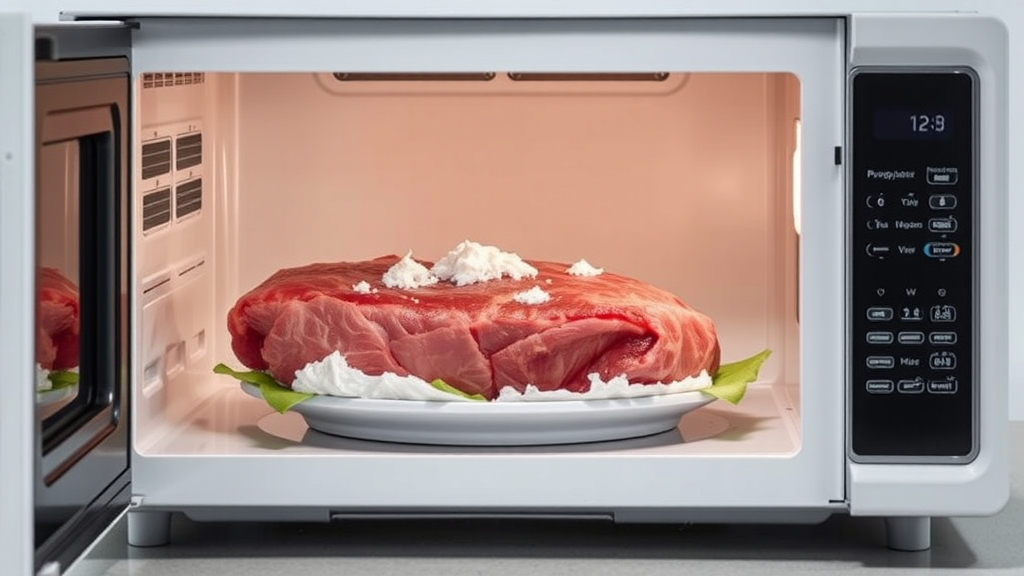
Microwave thawing of meat can slash defrosting times by up to one hundred-fold compared with refrigeration methods, yet the technology remains one of the most divisive topics in food science. That is the central paradox emerging from a comprehensive qualitative review published in Food Science of Animal Resources, in which an international team led by Igor Tomasevic of the University of Belgrade and the German Institute of Food Technology synthesized findings from dozens of empirical studies on pork, beef, and poultry. The review, conducted according to the PRISMA framework, screened 1,150 records and ultimately included 25 publications from the 2010 to 2025 period, drawing on databases such as Scopus and Web of Science. The result is a nuanced portrait of a technology that can either preserve meat quality almost indistinguishably from fresh product or devastate it, depending on seemingly small choices in power level and endpoint temperature.
The physics behind microwave thawing explains both its promise and its peril. A magnetron converts electrical energy into electromagnetic radiation at a frequency of 2.45 gigahertz, which agitates polar molecules—chiefly water—inside the food, generating heat volumetrically rather than conducting it slowly from the surface inward. This is why microwaves are so dramatically faster: thawing time can shrink by factors of ten to one hundred depending on sample size and applied power. But the same volumetric heating creates a fundamental problem. Ice and liquid water have dramatically different dielectric properties, meaning microwave energy preferentially heats regions that have already thawed while frozen cores remain cold. This produces the infamous hot spots and cold spots, including the edge effect, in which energy concentrates at the corners and edges of a meat pack, triggering thermal runaway that damages delicate muscle proteins even as the center remains solidly frozen.
The molecular consequences of this uneven heating are now well documented at the protein level. Using differential scanning calorimetry and Raman spectroscopy, researchers found that microwave thawing significantly lowered the denaturation temperatures of myosin and actin in pork longissimus dorsi muscle, indicating partial denaturation and reduced thermal stability. Raman measurements revealed increased beta-sheet content and decreased alpha-helix content, hallmarks of protein unfolding and aggregation. The activity of calcium-ATPase, an enzyme marker for the integrity of myosin heads, dropped significantly compared with fresh or refrigeration-thawed meat. Protein oxidation tells a similar story: one study measured a sulfhydryl decline from 35.71 to 30.96 nanomoles per milligram of protein—roughly a 13.3 percent loss relative to fresh meat—reflecting the oxidation of thiol groups and formation of disulfide bonds that alter protein conformation.
Microstructural imaging makes the damage visible. Scanning electron microscopy of microwave-thawed pork showed irregular fiber arrangement, widened interfibrillar spaces, and protein aggregation, in stark contrast to the relatively intact fibers of refrigeration-thawed samples. In beef, microwave treatment produced fragmented muscle fibers and disrupted myofibrillar structure, and in one study of meat fiber integrity, shrinkage, fiber separation, and disruption of the endomysium—the connective sheath surrounding individual fibers—were all observed, with damage worsening at higher power levels. These structural injuries translate directly into economic losses, because the drip that leaks from damaged tissue carries away water-soluble nutrients, yield, and the juiciness consumers prize.
The numbers on drip loss are striking, though not always consistent. Compared with refrigeration thawing, microwave thawing increased drip loss by roughly 116 percent in one pork study and by approximately 255 percent in beef in another. In chicken breast, the most extreme case, microwave thawing produced a nearly six-fold increase in drip loss relative to cold water thawing, reaching 7.65 percent against just 1.27 percent. Yet other studies found the opposite: after electromagnetic freezing, microwave-thawed beef showed drip loss reductions of about 20 percent relative to refrigeration thawing and up to 21 percent versus water thawing, with water-holding capacity in loin and round cuts actually exceeding conventional methods. The review argues these contradictions likely stem from differences in freezing history, microwave power, endpoint temperature, sample geometry, and species—competing mechanisms that make the relationship between thawing rate and moisture loss distinctly non-linear.
Lipid oxidation emerges as another consistent casualty. Microwave-thawed pork showed thiobarbituric acid reactive substance values of 0.30 milligrams of malondialdehyde per kilogram, a rise of roughly 65 to 70 percent over fresh meat, while beef studies recorded increases of about 0.13 milligrams per kilogram relative to fresh controls. The mechanism involves localized temperature spikes, disruption of cellular compartments that releases pro-oxidant iron from heme proteins, and possibly microwave-induced free radical generation. Encouragingly, even the highest reported values remained below the 1.0 milligram per kilogram sensory threshold at which trained panelists detect rancidity, meaning the chemical damage, while real, does not necessarily reach the consumer’s palate.
Texture results are perhaps the most contradictory of all. Some studies found microwave-thawed meat to be the toughest of all treatments: in Tibetan pork, shear force reached approximately 1,700 newtons under microwave thawing, some 200 newtons above refrigeration thawing and 350 newtons above ultrasound-assisted thawing, with sarcomere shortening and structural damage blamed for the extra cutting resistance. Yet other experiments found the reverse. In chicken breast, microwave thawing at 250 watts produced shear forces around 18 newtons, significantly lower than the roughly 22 newtons of refrigeration-thawed samples, suggesting improved tenderness at moderate power. In pork, microwave thawing alone decreased shear force to 28.77 newtons versus 31.08 newtons for fresh meat. The review suggests these discrepancies reflect differences in measurement methodology and, critically, in whether the protocol was optimized to minimize protein denaturation and drip loss.
Nutritional and sensory data add further nuance. Because minerals and water-soluble vitamins dissolve in the sarcoplasmic fluid, drip volume serves as a direct proxy for nutritional depletion, and the brief thawing period of microwaves can actually preserve mineral content: broiler breast thawed by microwave retained 1.31 percent ash after one month of frozen storage, edging out air and water methods. Trained sensory panels and consumer tests have found microwave-thawed beef and pork frequently matching or exceeding conventional methods for overall acceptability, particularly after electromagnetic freezing, though apparent juiciness scores suffered in some trials and prolonged frozen storage erased most advantages regardless of method. On safety, the limited available data indicate that properly conducted microwave thawing does not compromise microbiological quality and may even reduce microbial loads—one chicken study recorded total viable counts of 2.28 log colony-forming units per gram for microwave samples versus 3.45 for refrigeration, with no E. coli or Salmonella detected in any sample—because the rapid passage through the 4 to 60 degree Celsius danger zone starves microbes of growth time. The review cautions, however, that these findings come from laboratory settings with good initial hygiene, and that pathogen survival data for organisms such as Listeria monocytogenes and Campylobacter remain critically absent.
The way forward, the authors argue, lies in hybrid systems and smarter protocols. Combining microwaves with air convection preserved gel strength and microstructure comparable to fresh meat, infrared-microwave alternating thawing kept lipid oxidation near fresh levels, and a microwave-air convection combination achieved a total color difference of just 1.18—barely perceptible to the human eye. Emerging solid-state microwave technology recorded the mildest lipid oxidation of any method tested, at 0.10 milligrams per kilogram. The review’s practical recommendation is a two-stage approach: use the microwave as a tempering tool to carry meat through the latent heat of fusion zone where most damage occurs, then finish with a conventional method to the final endpoint temperature, ideally kept low, near negative 2 degrees Celsius. Poultry appears more vulnerable than beef or pork, likely because its larger-diameter glycolytic white fibers and lower connective tissue content interact differently with electromagnetic waves. What the field still lacks, the authors conclude, is industrial-scale validation, species- and cut-specific optimization, systematic study of freezing-thawing interactions, and full life cycle assessments of energy and environmental trade-offs. Until then, microwave thawing stands as a powerful but unforgiving technology—one that rewards precision and punishes shortcuts.
Subject of Research: Effects of microwave thawing on the quality, safety, and nutritional value of pork, beef, and poultry meat
Article Title: Microwave thawing of meat: a concise qualitative review
Article References: Tomasevic, I., Maggiolino, A., Sun, W., Zhang, W., Tomasevic, I., Djordjevic, V., & Heinz, V. (2026). Microwave thawing of meat: a concise qualitative review. Food Science of Animal Resources, 46(1), Article 84. https://doi.org/10.1007/s44463-026-00087-4
Image Credits: AI Generated
DOI: 10.1007/s44463-026-00087-4
Keywords: microwave thawing, meat quality, protein denaturation, drip loss, lipid oxidation, food safety, pork, beef, poultry, hybrid thawing, water holding capacity, solid-state microwave
Cite Scienmag News
Caitlin Barrett. (September 24, 2026). The microwave paradox: why defrosting meat at lightning speed is both a breakthrough and a gamble. Scienmag. https://scienmag.com/the-microwave-paradox-why-defrosting-meat-at-lightning-speed-is-both-a-breakthrough-and-a-gamble/
Caitlin Barrett. "The microwave paradox: why defrosting meat at lightning speed is both a breakthrough and a gamble." Scienmag, 24 September 2026, https://scienmag.com/the-microwave-paradox-why-defrosting-meat-at-lightning-speed-is-both-a-breakthrough-and-a-gamble/. Accessed 24 September 2026.
Caitlin Barrett. "The microwave paradox: why defrosting meat at lightning speed is both a breakthrough and a gamble." Scienmag. September 24, 2026. https://scienmag.com/the-microwave-paradox-why-defrosting-meat-at-lightning-speed-is-both-a-breakthrough-and-a-gamble/


