


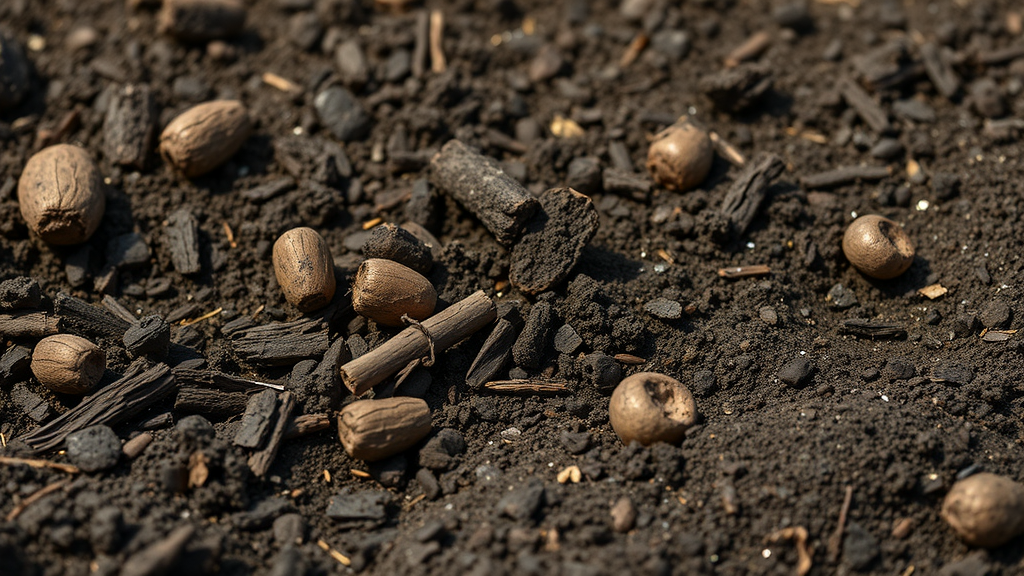
Biochar has been heralded as one of agriculture’s most seductive fixes: a charcoal-like material that locks carbon into the ground for centuries, buoys soil fertility, and echoes the legendary Amazonian Terra Preta soils that sustained ancient civilizations. But a three-year field experiment on a Kentucky silt loam, published in Discover Soil, delivers a sobering and nuanced verdict. When researchers at Kentucky State University applied pine sawdust biochar annually at 12 tonnes per hectare to an already fertile, structurally stable soil under soybean production, most measured physical and chemical soil properties barely budged. Only two signals emerged from the statistical noise: a rise in labile, biologically active carbon and an increase in plant-available manganese. The findings matter because they puncture the assumption that biochar works miracles everywhere, and they sharpen a critical question for soil scientists: when, and in which soils, should farmers actually invest in it?
The stakes are considerable. Soil degradation now affects roughly one-third of the global land surface, driven by intensive cultivation and a changing climate. In the United States, farmland acreage has contracted from 900 million acres in 2017 to about 876 million in 2024, while an estimated one-third of the topsoil in the Corn Belt has been eroded over the past century, cutting regional crop yields by around six percent even under heavy fertilization. Against this backdrop, biochar, produced by heating biomass such as wood, crop residues, or manure under limited oxygen in a process called pyrolysis, has attracted intense interest. Its high porosity, vast internal surface area, and typically alkaline chemistry can theoretically improve aeration, water retention, cation exchange capacity, and nutrient availability, all while sequestering carbon that would otherwise return to the atmosphere as carbon dioxide.
Yet the evidence base is heavily skewed. Most biochar studies have been conducted on degraded soils or in greenhouses and laboratories, where dramatic improvements in pH, nutrient supply, and structure are comparatively easy to demonstrate. Field trials in productive, temperate agricultural soils lasting three or more years remain rare. The Kentucky team set out to fill that gap with an unusually rigorous design: a split-split plot randomized complete block experiment with four replications at the Harold Benson Research and Demonstration Farm in Frankfort. The site sits on McAfee silt loam, a slightly acidic soil with 71.47 percent silt, 18.63 percent clay, and baseline total carbon of 1.74 percent, previously managed under long-term perennial hay production, a history that would prove decisive for the results.
The biochar itself was a commercial product made from southern yellow pine sawdust pyrolyzed at 650 degrees Celsius for ten minutes. This high-temperature treatment produced an extremely carbon-dominant material, 90.90 percent carbon with an alkaline pH of 9.88, low volatile matter, and minimal ash. The researchers spread it with a manure spreader and incorporated it to 15 centimeters one month before planting, repeating the application annually over two years at 12 tonnes per hectare, a rate chosen to balance practical feasibility and farmer economics. Plots were planted with two soybean cultivars, a maturity group 2 and a maturity group 4 variety, to test whether different root and phenological cycles would interact with the amendment. Soil samples were then taken at two depths, 0 to 10 and 10 to 20 centimeters, both at planting and after harvest in the third year.
The analytical arsenal was thorough. Bulk density came from undisturbed steel cores dried at 105 degrees Celsius; compaction was probed with a penetrometer to a resistance of 300 psi; water-stable aggregates were measured by wet sieving; and surface area and pore volume were quantified with nitrogen adsorption and the Brunauer-Emmett-Teller equation. Chemistry was assessed for pH, electrical conductivity, cation exchange capacity, permanganate oxidizable carbon, and a full suite of macro- and micronutrients extracted with Mehlich-3 solution and read by inductively coupled argon plasma. All data flowed through a linear mixed-effects model in R, with treatment, maturity group, depth, and their interactions as fixed effects and replication structure as random effects, with Type III ANOVA and Tukey-adjusted comparisons at a significance threshold of 0.05.
The verdict on physical properties was emphatic: biochar changed almost nothing. Bulk density, water-stable aggregates, water holding capacity, critical compaction depth, specific surface area, and total pore volume were statistically indistinguishable between amended and control plots at both sampling times. What did differ, dramatically and repeatedly, was depth. The subsurface 10 to 20 centimeter layer carried a bulk density of 1.63 to 1.69 grams per cubic centimeter against 1.43 to 1.45 in the surface, and pore volume favored the surface layer at 0.028 versus 0.026 cubic centimeters per gram. The authors attribute the muted biochar response to the soil’s inherent structural maturity: decades of perennial hay and root activity had already built stable aggregates, leaving little room for improvement. This aligns with prior work showing that biochar’s density-reducing effects are largely a dilution phenomenon, strongest in coarse-textured soils at high application rates.
Chemistry told a similar story of stability. Soil pH, buffer pH, electrical conductivity, and cation exchange capacity showed no significant response to biochar or soybean variety at either sampling. The absence of a pH shift is telling: wood-derived biochar pyrolyzed at high temperature contains little ash and few soluble salts, so unlike herbaceous feedstocks it rarely moves electrical conductivity, and the soil’s stable exchange system buffered any liming effect. Depth again dominated, with the subsoil consistently slightly less acidic and, after harvest, paradoxically richer in cation exchange capacity at 13.81 versus 14.43 centimoles per kilogram in the surface, a pattern the researchers link to clay mineralogy and pH-dependent charge on mineral surfaces. Rhizosphere effects from the different soybean cultivars, meanwhile, were simply too spatially confined to register in bulk soil samples.
Nutrients largely stratified by depth rather than responding to amendment. Potassium and sulfur concentrated in the surface layer, consistent with residue decomposition and biological activity near the top of the profile, while phosphorus and calcium ran higher in the subsoil, likely a legacy of the site’s pasture history and phosphatic limestone parent material. Among micronutrients, zinc, copper, and boron accumulated in the surface, iron in the subsurface. But two genuine biochar signals broke through after harvest. Permanganate oxidizable carbon, a proxy for the labile fraction of soil organic matter that microbes and crops can access quickly, rose from 686.02 to 706.63 milligrams per kilogram under biochar. Available manganese climbed from 70.95 to 88.16 milligrams per kilogram, possibly reflecting ash-derived inputs and microbial redox cycling around aging biochar particles. Notably, total organic matter, total carbon, and total nitrogen did not move at all.
That dissociation is scientifically intriguing. The recalcitrant biochar contained small labile fractions that appear to have primed microbial turnover, boosting the active carbon pool without measurably expanding total soil organic carbon. Because labile carbon responds to new inputs far faster than the slow, mineral-protected pools, the POXC increase may be the earliest fingerprint of a longer transformation, invisible in the slower-responding metrics. The researchers argue that in already fertile, well-structured soils, biochar’s value may lie less in immediate improvement and more in prevention, a defensive strategy to sustain soil health before degradation takes hold, particularly since even productive soils lose carbon under continuous cultivation.
The broader lesson is that biochar is not a universal elixir but a context-dependent tool whose performance hinges on feedstock, pyrolysis temperature, application rate, baseline fertility, soil texture, and time. For degraded, acidic, sandy, or low-carbon soils, the literature still supports substantial benefits. For a fertile Kentucky silt loam with stable aggregates and decent organic matter, three years of annual pine biochar achieved little beyond nudging active carbon and manganese upward. The team calls for longer-term trials to determine whether these early signals foreshadow meaningful gains in fertility, carbon stabilization, and resilience, or whether biochar’s celebrated promise simply fades in soils that never needed rescuing in the first place.
Subject of Research: Medium-term effects of pine sawdust biochar on the physical and chemical properties of a fertile Kentucky silt loam soil under soybean production
Article Title: Medium term assessment of soil properties in a biochar amended Kentucky silty loam soil
Article References: Kandel, S., Baral, B., Paudel, P., Obura, P., Gebremedhin, M., & Chiluwal, A. (2026). Medium term assessment of soil properties in a biochar amended Kentucky silty loam soil. Discover Soil, 3(1), Article 158. https://doi.org/10.1007/s44378-026-00317-7
Image Credits: AI Generated
DOI: 10.1007/s44378-026-00317-7
Keywords: biochar, soil health, silt loam, soil organic carbon, permanganate oxidizable carbon, soybean, bulk density, cation exchange capacity, soil nutrients, pyrolysis, Kentucky, soil fertility
Cite Scienmag News
Alan Morgan. (September 24, 2026). Three Years of Biochar Left a Fertile Kentucky Soil Mostly Unchanged. Scienmag. https://scienmag.com/three-years-of-biochar-left-a-fertile-kentucky-soil-mostly-unchanged/
Alan Morgan. "Three Years of Biochar Left a Fertile Kentucky Soil Mostly Unchanged." Scienmag, 24 September 2026, https://scienmag.com/three-years-of-biochar-left-a-fertile-kentucky-soil-mostly-unchanged/. Accessed 24 September 2026.
Alan Morgan. "Three Years of Biochar Left a Fertile Kentucky Soil Mostly Unchanged." Scienmag. September 24, 2026. https://scienmag.com/three-years-of-biochar-left-a-fertile-kentucky-soil-mostly-unchanged/


