


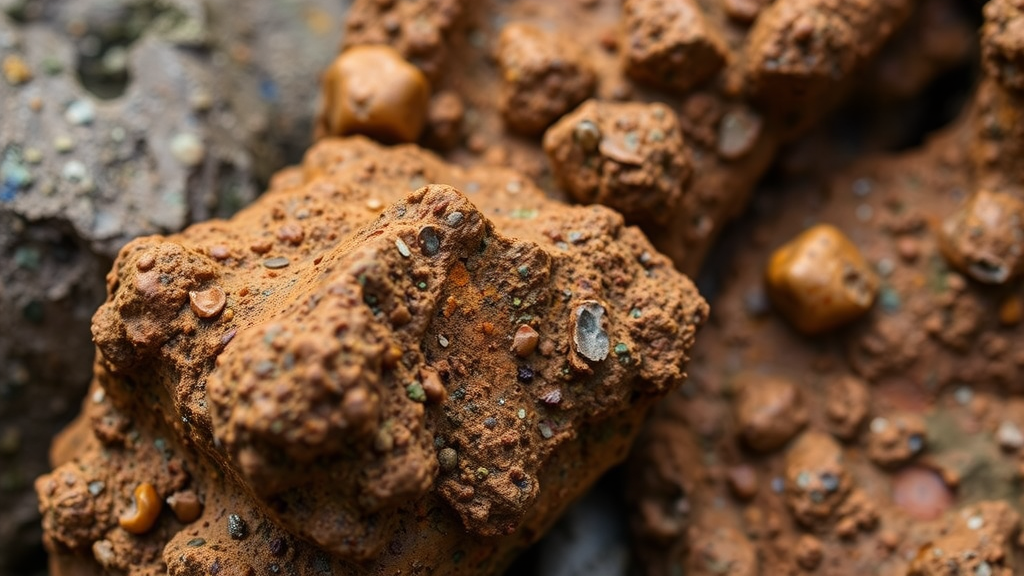
Deep in the ochre-stained streams that drain abandoned mines, an unassuming mineral is quietly doing environmental heavy lifting. Schwertmannite, a rusty, sulfate-bearing iron oxyhydroxide that forms naturally in acid mine drainage, is one of the most effective natural scavengers of oxyanion-forming contaminants in acidic waters. But this mineral is only a temporary custodian. Over time it ages, dissolving and recrystallizing into more stable iron phases, most notably goethite, and that transformation can unlock or re-lock the pollutants it holds. A new study published in Environmental Geochemistry and Health by Chunyu Yang, Rui Huang, and Huihui Du of Hunan Agricultural University now shows that tungsten, an increasingly concerning contaminant, does not simply ride along passively during this mineral makeover. Instead, it actively reshapes the transformation process itself, revealing a subtle, stage-dependent dance between a metal and the mineral that traps it.
Tungsten has long been treated as an environmentally benign metal, prized industrially for making tool steels harder and light bulb filaments glow. That reputation has eroded in recent years. Epidemiological studies have associated elevated tungsten exposure with cardiovascular and kidney effects, and laboratory work has raised questions about its toxicity and possible carcinogenicity. In the environment, tungsten typically travels as the tungstate oxyanion, a chemical form that behaves in some ways like chromate, arsenate, and molybdate, species well known for binding strongly to iron minerals. In acid mine drainage systems, where iron-rich, sulfate-laden waters create ideal conditions for schwertmannite precipitation, tungsten can be captured efficiently by this nanocrystalline mineral through a combination of surface adsorption and exchange with sulfate held in its tunnel-like structure.
The problem is that schwertmannite is metastable. Its poorly crystalline structure, rich in sulfate held in both outer-sphere and inner-sphere positions, represents a transient waypoint in iron geochemistry. Under natural conditions, particularly as temperatures rise, pH shifts, or microbial activity accelerates dissolution, schwertmannite gradually converts to goethite, a more thermodynamically stable iron oxyhydroxide. Earlier research has established that during this dissolution-reprecipitation process, contaminants formerly held by schwertmannite can be released into solution, incorporated into the growing goethite lattice, or redistributed between newly formed phases. What remained unclear, and what motivated the new investigation, is what happens specifically to tungsten when schwertmannite loaded with tungsten undergoes aging, and whether the tungsten itself influences the course of the mineral transformation.
To answer these questions, the team conducted controlled batch aging experiments at pH 3.5 and 60 degrees Celsius, conditions designed to accelerate the natural transformation of schwertmannite so that processes unfolding over years in the field could be observed within weeks. They compared two systems side by side: a tungsten-free schwertmannite suspension and an identical suspension in which the mineral had been loaded with tungsten. Over a month of monitoring, the researchers tracked sulfate release into solution, the development of iron mineral phases, and the partitioning of tungsten between the solid and dissolved pools. The accelerated design does not replicate every nuance of field chemistry, but it provides a geochemically grounded window into the trajectories that contaminated sediments in acid mine drainage environments may follow.
The headline finding is that tungsten loading altered the transformation in a distinctly stage-dependent manner. In the early stage of aging, the tungsten-bearing system released approximately 15 percent more sulfate into solution than the tungsten-free control, and goethite-related features developed noticeably earlier. This suggests that tungsten, held within or on the schwertmannite structure, promoted the initial destabilization of the host mineral, accelerating the sulfate-exchange and dissolution reactions that kick-start conversion to goethite. In effect, the contaminant acted as a chemical accomplice in its own mineral host’s restructuring during the opening phase of the transformation.
The story then reversed in the later stage. Rather than continuing to accelerate, the development of crystalline goethite in the tungsten-loaded system was attenuated, lagging behind what occurred in the tungsten-free suspension. The presence of tungsten appeared to interfere with the growth and crystallization of well-ordered goethite, consistent with a growing body of evidence that oxyanion surface complexes and structural incorporation can hinder nucleation and crystal growth of iron oxide phases. Tungsten’s strong affinity for iron oxide surfaces and its capacity to substitute into iron oxide structures appear to have imposed a drag on the recrystallization front, leaving the solid phase less crystalline than it would otherwise have been.
Meanwhile, the tungsten itself executed a striking round trip. During the early phase of transformation, as schwertmannite dissolved and sulfate flooded out, tungsten was released into solution, raising the prospect that aging sediments could temporarily export tungsten to downstream waters. But as the experiment progressed, dissolved tungsten was reassociated with the solid phase, migrating back onto and into the evolving iron minerals. Sequential extraction analysis showed that the residual tungsten fraction, the most strongly bound and least mobile pool, climbed to approximately 38 percent of the total tungsten by day 30. The later redistribution of tungsten coincided with the attenuated development of crystalline goethite, linking the contaminant’s immobilization to its own disruption of crystal growth, likely through incorporation into defect-rich, poorly crystalline iron phases and strong surface complexes.
The implications cut in two directions. On one hand, the initial pulse of tungsten release during early aging is a warning sign: sediments rich in schwertmannite in acid mine drainage streams, mine tailings impoundments, and mining lakes could episodically deliver tungsten to overlying waters as environmental conditions drive mineral transformation, threatening water quality in the same systems where the metal had been sequestered. On the other hand, the substantial long-term reassociation of tungsten with the solid phase, and its growing sequestration in residual pools, indicates that aging iron mineral assemblages can ultimately retain much of the tungsten they capture. The net outcome for tungsten mobility therefore depends critically on where in the transformation sequence a given sediment sits, a nuance that simple equilibrium models of adsorption would miss entirely.
For environmental managers and risk assessors, the study supplies a geochemical basis for evaluating tungsten retention and mobility in acid mine drainage related systems. It suggests that monitoring programs should track not only dissolved tungsten but also the mineralogical state of iron precipitates, since the transition from schwertmannite to goethite marks periods of elevated release risk followed by renewed immobilization. The work also adds tungsten to the list of contaminants, alongside arsenic, chromium, and antimony, whose fates are governed by the dynamic transformation behavior of schwertmannite rather than by static adsorption constants. As global demand for tungsten continues to grow, along with the mining and industrial exposures that accompany it, understanding how this metal interacts with the ephemeral minerals of acidic mine waters becomes an increasingly urgent piece of the environmental puzzle. The researchers note that the findings define a stage-dependent relationship between mineral transformation and tungsten partitioning under accelerated aging conditions, a framework that can now be tested and refined across the wide range of temperatures, pH values, and competing ions that characterize real acid mine drainage environments.
Subject of Research: Tungsten redistribution during the aging and transformation of schwertmannite in acid mine drainage
Article Title: Tungsten-induced alteration of schwertmannite transformation and its implications for tungsten mobility in acid mine drainage
Article References: Yang, C., Huang, R., & Du, H. (2026). Tungsten-induced alteration of schwertmannite transformation and its implications for tungsten mobility in acid mine drainage. Environmental Geochemistry and Health, 48(15), Article 593. https://doi.org/10.1007/s10653-026-03496-y
Image Credits: AI Generated
DOI: 10.1007/s10653-026-03496-y
Keywords: tungsten, schwertmannite, goethite, acid mine drainage, mineral transformation, sulfate release, iron oxyhydroxides, oxyanion adsorption, trace metal mobility, geochemistry, environmental contamination, batch aging experiments
Cite Scienmag News
Sloane Callahan. (September 23, 2026). How a Rust-Colored Mineral May Trap Tungsten Pollution in Acid Mine Waters. Scienmag. https://scienmag.com/how-a-rust-colored-mineral-may-trap-tungsten-pollution-in-acid-mine-waters/
Sloane Callahan. "How a Rust-Colored Mineral May Trap Tungsten Pollution in Acid Mine Waters." Scienmag, 23 September 2026, https://scienmag.com/how-a-rust-colored-mineral-may-trap-tungsten-pollution-in-acid-mine-waters/. Accessed 23 September 2026.
Sloane Callahan. "How a Rust-Colored Mineral May Trap Tungsten Pollution in Acid Mine Waters." Scienmag. September 23, 2026. https://scienmag.com/how-a-rust-colored-mineral-may-trap-tungsten-pollution-in-acid-mine-waters/


