


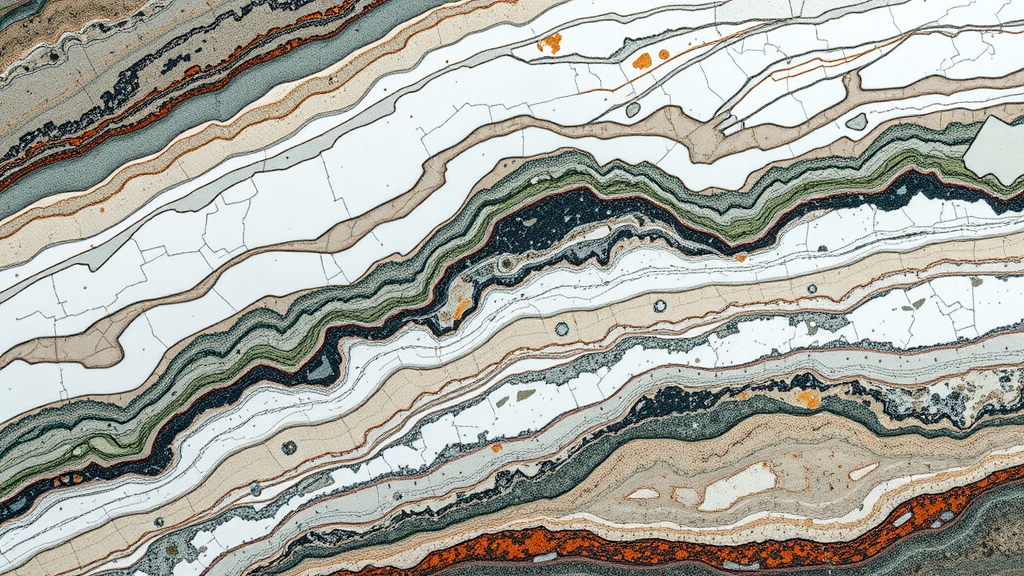
Carbonatites are among the strangest rocks on Earth: igneous bodies composed of more than half carbonate minerals, yet generated like granites from molten material rising from depth. They are the world’s principal hosts for rare earth elements, niobium, phosphate and a suite of critical metals on which modern technology depends, and they also represent the most concentrated expression of carbon cycling from the planet’s interior to its crust. For decades, the standard model has held that carbonatites are fundamentally mantle-derived, their carbonate melts generated by low-degree partial melting of carbonated mantle peridotite and then ascending rapidly to shallow crustal levels. A new study published in Communications Earth & Environment challenges that orthodoxy by documenting an unusual anatectic marble that carries a geochemical fingerprint strikingly similar to many crustal carbonatites, and by arguing that some, and perhaps many, carbonatite bodies may instead be born from the melting of sedimentary carbonate rocks trapped deep within orogenic belts.
The rock at the center of the investigation is a marble that has undergone anatexis, or partial melting, at conditions hot enough to generate carbonate-rich melts in situ. Marbles of this kind are not rare in high-grade metamorphic terranes, but their geochemistry is usually dismissed as a curiosity of crustal processing rather than a window into carbonatite petrogenesis. What makes this particular marble exceptional is its extreme depletion in rare earth elements, a feature that at first glance would seem to disqualify it as a carbonatite analogue, since carbonatites are famously enriched in these elements. The research team, however, recognized that the depletion itself is the key: it preserves a snapshot of the primary melt composition before the rare earth enrichment that characterizes economic carbonatites is acquired during later stages of magmatic evolution.
The authors assembled a comprehensive geochemical dataset combining whole-rock major and trace element concentrations, mineral chemistry, and isotopic systematics from the anatectic marble, and compared these against global compilations of carbonatites and experimental melts of carbonate-bearing sediments. The comparison revealed systematic parallels. The marble-derived melts share the characteristic enrichment in strontium and barium, the depletion in high-field-strength elements such as niobium, tantalum, zirconium and hafnium, and the elevated strontium and neodymium isotopic ratios typical of so-called crustal or S-type carbonatites found in several orogenic belts worldwide. In contrast, they differ markedly from the geochemical signature expected of mantle-derived carbonatite melts, which typically carry higher contents of compatible trace elements and isotopic compositions reflecting long-depleted mantle reservoirs.
Rare earth element systematics proved especially diagnostic. Primary carbonate melts generated by partial melting of pure limestone or dolomite are inherently poor in rare earth elements because these elements are hosted mainly in accessory phases such as monazite, allanite and apatite, which dissolve inefficiently at the temperatures and pressures of crustal anatexis. The REE-depleted marble therefore records the pristine composition of a crustal carbonate melt. When the researchers modeled the subsequent evolution of such melts, they found that interaction with wall rocks, fractional crystallization of calcite and dolomite, and the segregation of immiscible fluids can all concentrate rare earth elements by factors of tens to hundreds, transforming an initially barren melt into the REE-rich compositions observed in many mined carbonatite complexes. The implication is that REE enrichment in carbonatites is not a primary mantle signature but a secondary crustal overprint, and that using REE patterns to argue for a mantle origin may have misled the field for generations.
The study also addresses the long-standing volume problem of carbonatite petrogenesis. Low-degree partial melting of the mantle produces carbonatite melts in vanishingly small quantities, and the survival and ascent of such low-viscosity, low-volume melts through tens of kilometers of crust has always required special pleading, involving rapid ascent along deep faults, volatile fluxing, or repeated melt aggregation. Crustal anatexis of marble offers a more parsimonious alternative in orogenic settings. During continental collision, thickened crust reaches temperatures exceeding 800 degrees Celsius at mid-crustal depths, well within the stability field of carbonate melts in the calcite-dolomite-quartz system. Sedimentary carbonates interlayered with pelites and greywackes in subducted or deeply buried passive-margin sequences can therefore generate substantial volumes of carbonate melt without any input from the mantle, and these melts can pond, segregate and intrude at crustal levels through ordinary magmatic processes.
Experimental petrology supports this pathway. Decades of melting experiments on carbonate-silicate mixtures have shown that carbonate-rich melts are stable to surprisingly high temperatures and can coexist with silicate melts as immiscible liquids. The compositions of experimentally produced carbonate melts from sedimentary starting materials match the trace element patterns of the anatectic marble studied here almost element for element. The researchers also note that the oxygen and carbon isotopic compositions of many crustal carbonatites, long interpreted as evidence of crustal contamination of mantle melts, can be explained more directly as inherited from marine carbonate protoliths that never passed through the mantle at all. In this reading, isotopic heterogeneity within single carbonatite complexes reflects heterogeneous sedimentary sources rather than variable degrees of contamination during ascent.
The implications ripple outward into several fields. For economic geology, the recognition that crustal carbonate melts can evolve into REE-rich carbonatites reframes exploration strategy. Exploration models built exclusively on mantle plume or rift-related settings may overlook fertile targets in collisional orogens, where deeply buried marble sequences have experienced the high-temperature metamorphism required for anatexis. Several REE deposits in orogenic belts already show geological features, such as spatial association with regional metamorphic domes, marble host sequences and absence of coeval mantle magmatism, that fit the new model better than the classical mantle plume framework. Re-evaluating these deposits through the lens of crustal anatexis could open entirely new search spaces for critical mineral resources at a time when global demand for rare earth elements is accelerating.
For deep carbon science, the study suggests that the crust is a more active participant in the long-term carbon cycle than commonly assumed. Carbonate sediments subducted or buried in orogens do not necessarily return their carbon to the mantle or release it entirely through decarbonation reactions; a significant fraction may instead be remobilized as carbonate melt within the crust itself, sequestering carbon in granitic and carbonatitic intrusions for hundreds of millions of years. This crustal carbon reservoir, fed by the melting of ancient ocean-floor and platform carbonates, could help explain the episodic and spatially clustered distribution of carbonatite magmatism through Earth history, which has long puzzled geologists because it does not correlate cleanly with mantle plume activity or supercontinent cycles alone.
The authors are careful to state that their findings do not overturn the mantle origin of all carbonatites. Many of the world’s largest and most economically important complexes, particularly those in stable cratonic settings with clear links to rift magmatism and coeval alkaline silicate rocks, remain best explained by mantle-derived melts. Rather, the study expands the genetic spectrum of carbonatites, establishing crustal anatexis of marble as a legitimate and potentially widespread pathway. The REE-depleted anatectic marble serves as a natural experiment, a frozen sample of what carbonatite melts look like at birth, before enrichment processes erase the memory of their source. By reading that memory, geologists may now be able to disentangle which carbonatites rose from the mantle and which were distilled from the crust, a distinction that matters for understanding Earth’s carbon engine and for finding the critical metal deposits of the future.
Future work will focus on dating the melting events preserved in the marble, tracing the isotopic evolution of its carbonate melts through mineral-scale analysis, and searching other high-grade terranes for comparable REE-depleted carbonate rocks that could serve as fingerprints of crustal carbonatite sources. If such rocks prove common, the textbook image of carbonatites as messengers from the mantle will need a substantial revision, and the boundary between sedimentary and igneous carbon in Earth’s crust will become considerably more blurred than anyone anticipated.
Subject of Research: Geochemical evidence that crustal anatexis of marble can generate carbonatite melts
Article Title: REE-depleted anatectic marble reveals the primary source of crustal carbonatites
Article References: Maroni, A., Tursi, F., Groppo, C., Piccoli, F., Festa, V., Gies, N. B., Castelli, D., Green, E. C. R., Rolfo, F., & Spiess, R. (2026). REE-depleted anatectic marble reveals the primary source of crustal carbonatites. Communications Earth & Environment. https://doi.org/10.1038/s43247-026-04048-z
Image Credits: AI Generated
DOI: 10.1038/s43247-026-04048-z
Keywords: carbonatites, anatectic marble, rare earth elements, crustal anatexis, carbonate melts, geochemistry, critical minerals, deep carbon cycle, metamorphic petrology, orogenic belts, REE deposits, Communications Earth & Environment
Cite Scienmag News
Violet Maxwell. (September 22, 2026). Ancient Marble Without Rare Earths Points to Crustal Origin of Carbonatites. Scienmag. https://scienmag.com/ancient-marble-without-rare-earths-points-to-crustal-origin-of-carbonatites/
Violet Maxwell. "Ancient Marble Without Rare Earths Points to Crustal Origin of Carbonatites." Scienmag, 22 September 2026, https://scienmag.com/ancient-marble-without-rare-earths-points-to-crustal-origin-of-carbonatites/. Accessed 22 September 2026.
Violet Maxwell. "Ancient Marble Without Rare Earths Points to Crustal Origin of Carbonatites." Scienmag. September 22, 2026. https://scienmag.com/ancient-marble-without-rare-earths-points-to-crustal-origin-of-carbonatites/


