


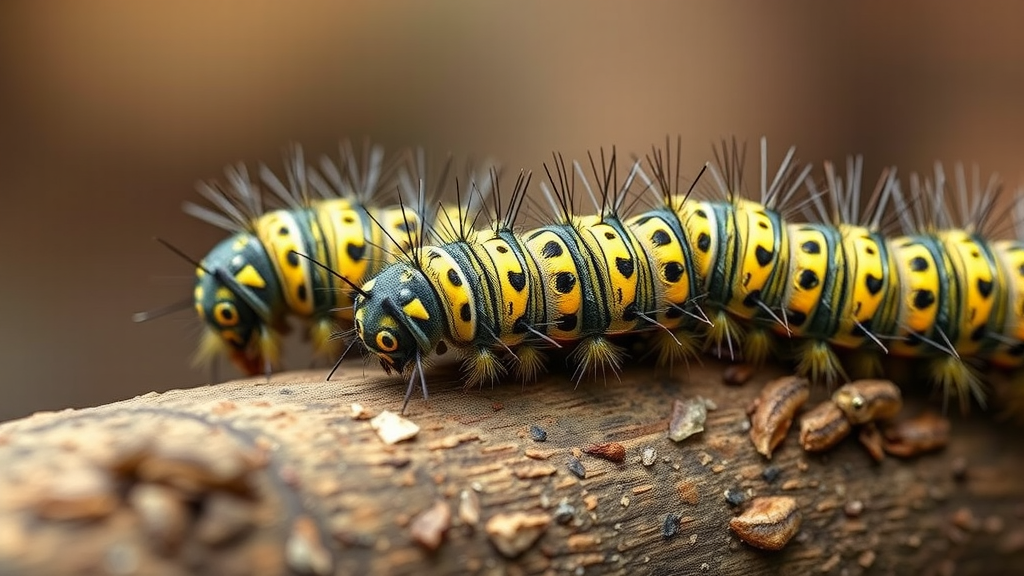
In the sun-baked landscapes where the swallowtail butterfly Battus polydamas archidamas makes its home, caterpillars huddle together in clusters on their host plants, a behavior scientists have long associated with staying warm. For cold-blooded animals whose body temperature tracks their surroundings, grouping up on a chilly morning seems like an obvious strategy: many small bodies pressed together lose heat more slowly and can soak up warmth more efficiently than a lone larva. But a new field study flips the script on this familiar story, reporting that when air temperatures rise into the warmer end of the gradient, grouped caterpillars actually end up cooler than the air around them. The finding, published in the journal The Science of Nature, suggests that the thermoregulatory payoff of gregarious living runs in both directions, helping larvae shed heat under warm conditions just as it helps them gain heat under cool ones.
The research, conducted by Mónica F. Cisternas, an independent researcher based in Stephenville, Texas, and Ernesto Gianoli of the Department of Biological Sciences at Tarleton State University, took advantage of a rare opportunity to measure thermal biology where it actually happens: in the field, under natural sunlight, wind, and fluctuating temperatures, rather than in the controlled conditions of a laboratory. The team compared solitary and grouped caterpillars of the gregarious butterfly species, asking a deceptively simple question: how does the difference between a caterpillar’s body temperature and the surrounding air temperature change as air temperature changes? The answer, it turns out, depends strongly on whether the larva lives alone or in a group.
The core metric the researchers examined is known as the body–air temperature differential, essentially the gap between how hot or cold an animal’s body is and how hot or cold the air is. For ectotherms like caterpillars, this differential is shaped by a tug-of-war between heat gained from solar radiation, heat exchanged with the surrounding air, and heat generated or absorbed through metabolism and evaporative water loss. When the differential is positive, the animal is warmer than its environment, which can be beneficial on a cool morning but dangerous during a heat spike. When it is negative, the animal is cooler than the air, a state that may protect tissues from thermal stress. The researchers measured this differential across a natural gradient of air temperatures for both solitary larvae and members of aggregations, then analyzed how the two groups differed.
The results were striking in their asymmetry. Grouped caterpillars showed an overall relationship between their body–air temperature differential and air temperature, meaning their thermal status relative to the environment shifted systematically as conditions warmed. Solitary caterpillars, by contrast, showed no such overall association. Most notably, gregarious caterpillars registered significantly lower temperatures than the surrounding environment in the warmer regions of the temperature gradient. In other words, when the day heated up, the larvae in groups were literally cooler than the air around them, a relative cooling effect that solitary individuals did not display. The researchers note that the evidence for the opposite pattern, grouped caterpillars exceeding air temperature under cooler conditions, was comparatively weak in their dataset, hinting that the cooling benefit of aggregation may be more pronounced in the field than the warming benefit.
Digging deeper into the structure of the aggregations themselves, the team ran an analysis incorporating the number of larvae in each group, and here the story became even more interesting. The interaction between group size and air temperature was statistically significant even after accounting for population-level differences and the intensity of solar radiation at each microsite. The direction of the effect was clear: as air temperature increased, the thermal excess, the amount by which a caterpillar’s body temperature surpassed air temperature, declined more steeply in larger groups. Bigger aggregations, in other words, shed their relative warmth faster as the environment heated up. This suggests that the collective thermal properties of a group, such as the way many bodies alter airflow, shading, and evaporative surfaces, scale with the number of participants, amplifying the cooling effect precisely when it matters most.
Solar radiation at the microsites the caterpillars occupied also emerged as a significant predictor of thermal excess, a reminder that body temperature in small ectotherms is never determined by air temperature alone. A caterpillar basking in direct sun can be many degrees warmer than the air, while one sheltered in shade may be cooler. By including radiation in their models, the researchers could separate the genuine effect of grouping from the simple fact that groups might occupy sunnier or shadier spots. The persistence of the group-size effect after this adjustment strengthens the case that aggregation itself, not just microsite selection, drives the relative cooling. Still, the authors caution that the mechanistic basis of the pattern remains to be worked out, whether it stems from reduced convective heat exchange within clusters, shared shading, evaporative cooling, or some combination of these physical processes.
Perhaps the most conceptually intriguing result concerns the solitary caterpillars. The analysis showed that solitary individuals, but not grouped ones, behaved as thermoconformers, meaning their body temperatures closely tracked ambient temperature with little deviation. Thermoconformity is often considered the default state for small ectotherms lacking physiological or behavioral means of temperature control, but the gregarious larvae broke free of it. By clustering, they effectively decoupled their body temperatures from the ambient thermal environment, gaining a degree of thermal autonomy that a lone larva cannot achieve. From an adaptive standpoint, this decoupling could matter enormously, because enzyme function, growth rates, feeding behavior, and survival in insects are all tightly temperature dependent, and staying within a favorable thermal window can be the difference between thriving and wilting on a hot afternoon.
The study situates itself within a rich literature on the thermal ecology of social caterpillars. Earlier work on eastern tent caterpillars documented synchronized group foraging and tent-based thermoregulation tied to microclimate, while research on emperor moth caterpillars assessed the thermal and water-relations benefits of aggregation. Studies of forest tent caterpillars and processionary moths have explored how colony size shapes larval performance, and comparative work on nettle-feeding nymphalid butterflies contrasted the thermal ecologies of gregarious and solitary larvae. What sets the new study apart is its explicit field test of the cooling hypothesis. As the authors point out, prior evidence showed that aggregation in caterpillars may enhance heat gain under cool conditions, but whether it also facilitates cooling under warm conditions had remained unknown. Their data now supply that missing half of the picture, and they do so under authentic field conditions rather than in artificial settings.
The implications extend beyond one butterfly species. Larval gregariousness is widespread in the swallowtail family, Papilionidae, and previous work by the same team has shown that this lifestyle is more prevalent outside the tropics and influences traits such as larval melanism and defensive reactions. If grouping provides a two-way thermal buffer, warming cold bodies and cooling warm ones, it could help explain why gregarious living has evolved repeatedly across Lepidoptera and why it persists even when it carries costs, such as making clusters more conspicuous to predators. In an era of increasing climatic variability, a behavior that moderates thermal extremes could carry real fitness consequences, a possibility the authors flag as a priority for future research, alongside the need to evaluate how the observed cooling translates into caterpillar performance and survival.
For now, the study stands as a vivid reminder that even the humblest animals employ sophisticated physical strategies to manage their body temperatures, and that some of those strategies only make sense when many bodies act together. A single caterpillar sweltering on a leaf has few options beyond conforming to the heat. A cluster of them, by contrast, builds a collective thermal microenvironment, one that grows more effective at shedding excess heat as it grows larger. The next time a cluster of striped larvae pulses gently on a sunlit stem, consider that they may not be huddling for warmth at all. They may be air-conditioning themselves, together, one body at a time.
Subject of Research: Field evidence that larval aggregation provides relative cooling under warm conditions in gregarious caterpillars.
Article Title: Field evidence of relative cooling under warm conditions in grouped caterpillars
Article References: Field evidence of relative cooling under warm conditions in grouped caterpillars. (n.d.). https://doi.org/10.1007/s00114-026-02169-1
Image Credits: AI Generated
DOI: 10.1007/s00114-026-02169-1
Keywords: caterpillars, thermoregulation, aggregation, gregariousness, Lepidoptera, body temperature, ectotherms, thermal ecology, group living, swallowtail butterfly, solar radiation, field study
Cite Scienmag News
Gavin Prescott. (September 22, 2026). Grouped caterpillars stay cooler than the air when temperatures climb. Scienmag. https://scienmag.com/grouped-caterpillars-stay-cooler-than-the-air-when-temperatures-climb/
Gavin Prescott. "Grouped caterpillars stay cooler than the air when temperatures climb." Scienmag, 22 September 2026, https://scienmag.com/grouped-caterpillars-stay-cooler-than-the-air-when-temperatures-climb/. Accessed 22 September 2026.
Gavin Prescott. "Grouped caterpillars stay cooler than the air when temperatures climb." Scienmag. September 22, 2026. https://scienmag.com/grouped-caterpillars-stay-cooler-than-the-air-when-temperatures-climb/


