


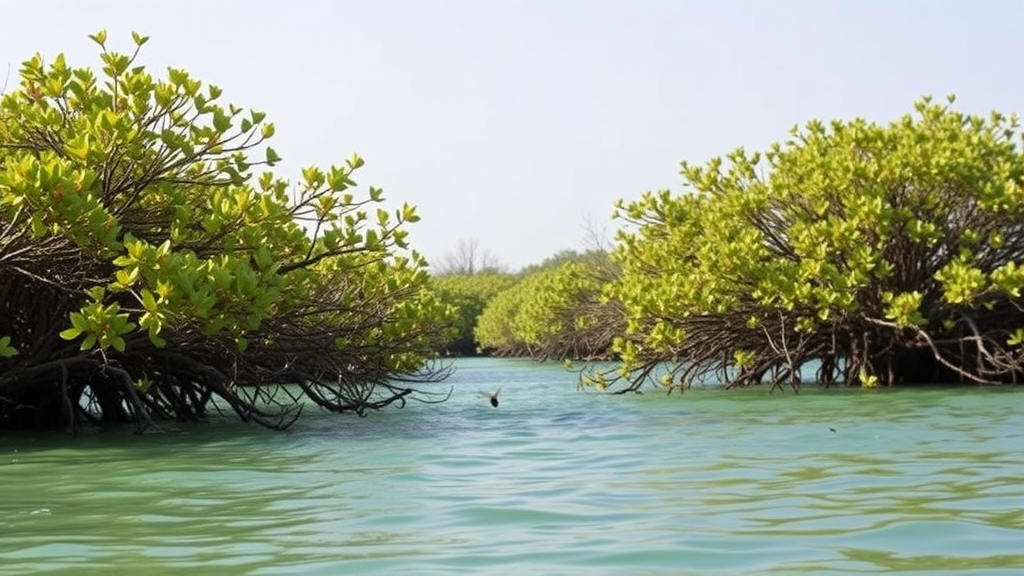
On the arid northwestern coast of Saudi Arabia, where mangroves cling to the very edge of their global range, an unexpected ally has entered the story of one of the world’s most threatened ecosystems: the honeybee. A new field study conducted along the Red Sea coast suggests that managed colonies of the western honeybee, Apis mellifera carnica, may substantially enhance pollen delivery and fruit production in two mangrove species, Avicennia marina and Rhizophora mucronata, offering a tantalizing glimpse of how pollination support could strengthen restoration efforts in these fragile coastal forests. The research, published in the journal Discover Oceans, provides one of the first empirical baselines of mangrove reproductive ecology in the Arabian Peninsula, a region where empirical data on mangrove pollination have been almost entirely absent.
Mangroves rank among the most productive and valuable ecosystems on Earth. These transitional forests, straddling land and sea across tropical and subtropical coastlines, shelter fish, birds, invertebrates and reptiles, buffer shorelines against flooding and erosion, and sequester atmospheric carbon up to five times more efficiently than tropical or boreal forests. They also sustain the livelihoods of hundreds of millions of people, supplying firewood, food and other resources. Yet they are in steep decline. Between 1980 and 2000, roughly 35 percent of the world’s mangrove forests disappeared, and the Food and Agriculture Organization reports that the global mangrove area shrank by 1.04 million hectares between 1990 and 2020. Coastal development, aquaculture, pollution, erosion and climate-driven extreme weather continue to erode what remains. Although nearly 2,000 square kilometers of mangroves have been replanted worldwide over the past four decades, regrowth rates remain insufficient to offset historical losses.
What has been largely missing from restoration science, the authors argue, is attention to reproduction itself. Most mangrove research has focused on seed and seedling dispersal, while floral biology, pollinator interactions and pollination efficiency have received far less scrutiny. That gap matters because mangroves, like many terrestrial plants, often depend on animal pollinators to produce fruits and propagules. When pollen is scarce, reproduction falters, and even the most ambitious planting schemes may fail to build self-sustaining populations. Recent studies have hinted that Apis mellifera opportunistically visits many mangrove species and can, in some contexts, pollinate Avicennia marina more effectively than wild insect communities, even where the bee is exotic. That possibility inspired the research team, led by Emiliano Pioltelli and Nicola Tommasi of the University of Milano-Bicocca, together with colleagues at Red Sea Global and partner institutions, to take advantage of a local beekeeping initiative unfolding in the mangroves of the Red Sea Zone.
The study took place at two sites along the northwestern Red Sea coast of Saudi Arabia, both embedded in harsh arid conditions at the northernmost limit of mangrove distribution on the peninsula. The first, a mainland coastal forest of roughly 0.6 hectares, hosted a mixed stand of both A. marina and R. mucronata. The second, an island of about six hectares lying only half a kilometer offshore, was composed exclusively of A. marina. Fieldwork ran from August to December 2024, spanning the peak flowering and fruiting period. On September 4, 2024, researchers documented the introduction of 46 honeybee colonies at the coastal site as part of an ongoing community beekeeping feasibility program; the hives remained until October 4. The island site, where no honeybees were ever introduced, served as a natural comparison.
Before the hives arrived, the team surveyed the wild flower-visitor community using sweep nets along free transects, monitoring mangrove canopies in ten-minute sessions every hour from dawn to dusk over three consecutive days at each site. Collected insects were identified morphologically and, for a subset, genetically, by sequencing a standard mitochondrial COI barcode region and comparing the results against public databases. The survey yielded 153 specimens assigned to 23 distinct taxonomic groups spanning the orders Hymenoptera, Diptera and Hemiptera. Hymenoptera dominated with 123 individuals, followed by 26 flies and four true bugs. Most specimens, 135 in total, were collected from A. marina flowers, while only 18 were found near R. mucronata. Notably, the community lacked large-bodied bees capable of long-range flight, with the solitary exception of the carpenter bee Xylocopa sulcatipes, seen only at the island site. The most frequently recorded species, the sweat bee Ceylalictus variegatus and the colletid bee Hylaeus albonotatus, visited both mangrove species, indicating overlapping rather than specialized floral relationships, likely a consequence of the resource-poor, environmentally extreme nature of these habitats.
To quantify pollination outcomes, the researchers established three experimental treatments: flowers bagged in nylon mesh to force self-pollination, flowers that had already become unreceptive before the hives arrived and could only have been pollinated by wild insects or wind, and flowers directly observed being visited by honeybees. Pollination efficiency was estimated by counting germinated pollen tubes on pistils, a well-established proxy for conspecific pollen deposition and seed production, with pistils preserved in the field, stained with basic fuchsin and examined under a stereomicroscope. The results were striking. During the period of honeybee presence at the coastal site, pollen deposition on A. marina stigmas rose approximately sixfold, and on R. mucronata nearly threefold, compared with the earlier sampling period. Honeybees themselves were significantly more abundant on A. marina, averaging 4.2 individuals per standardized quadrat versus 2.6 on R. mucronata, and they visited 29 percent of A. marina flowers compared with 14.9 percent of R. mucronata flowers, consistent with the scented, nectar-rich blossoms of the former and the scentless, nectar-poor, wind-adapted flowers of the latter.
Fruit production told a parallel story. For R. mucronata, flowers exposed to open pollination during the honeybee period produced roughly twenty times more fruit than flowers subjected to either self-pollination or open pollination before the hives arrived. For A. marina, whose tiny, sequentially opening flowers make individual tagging impractical, the team used canopy plots and terminal flower-cluster counts. Fruit set at the coastal site in December, after the honeybee period, was the highest recorded during the study and significantly exceeded both the island site and the coastal site’s own September baseline. Self-pollination proved almost entirely futile: bagged A. marina clusters produced zero fruits out of 30 bags at the coastal site and just one fruit out of 70 at the island site, reinforcing earlier findings that this species depends overwhelmingly on animal-mediated pollen transfer and suffers inbreeding depression when self-fertilized.
Perhaps equally revealing were the differences between the two sites. Even before the hives arrived, pollen deposition at the coastal site was significantly higher than at the island, where open-pollinated flowers received pollen at rates comparable to the self-pollination treatment. The island’s isolation, though less than a kilometer from the mainland, appears to thin the local pollinator community, a pattern consistent with broader evidence that habitat fragmentation and isolation reduce pollinator diversity, abundance and plant reproductive success even at very local scales. The survey itself captured this disparity: 142 of the 153 insect specimens came from the coastal site, and only 11 from the island. The authors suggest that isolated mangrove populations, poorly connected to suitable pollinator habitat, may be especially vulnerable to pollen limitation, a condition that could foster inbreeding and depress population fitness over time.
The researchers are careful about causation. The study’s temporal and spatial replication was limited, seasonal phenology and site-specific factors may have contributed to the observed fruit increases, and fruit production at the honeybee-free island site also rose between September and December. The findings are therefore framed as descriptive baseline data and preliminary field-based indications rather than proof of a honeybee effect. The team also flags potential ecological trade-offs that demand investigation before managed bees are promoted as a conservation tool: introduced honeybees might compete with native insects for floral resources, disrupt plant-pollinator network structure, or transmit pathogens to wild pollinators, with effects that vary according to habitat structure, resource availability and local pollinator assemblages. Future work, they propose, should employ controlled designs with multiple comparable sites, longer monitoring, differential honeybee treatments and exclusion experiments such as net-enclosed trees, alongside efforts to boost native pollinators through nature-based solutions.
Still, the implications are considerable. Within the Red Sea Zone, mangrove enhancement and pollination support are explicit targets of Red Sea Global’s SIIG model for measurable conservation gains, and the work aligns with the Saudi Green Initiative and mangrove programs run by the National Center for Vegetation Cover Development and Combating Desertification in collaboration with the FAO. Beekeeping could also deliver socioeconomic dividends, offering coastal communities an alternative income stream that transforms them into stewards of the very forests they harvest honey from. If subsequent, more controlled studies confirm that managed honeybees reliably lift fruit set and propagule production, pollination support could become a practical lever for restoring mangroves at their climatic limits, where every seed counts and where the survival of these carbon-rich, storm-buffering forests may hinge on the tiny wings of insects, wild and managed alike.
Subject of Research: Mangrove pollination ecology and the effect of managed honeybee introduction on reproductive success in Red Sea mangrove forests
Article Title: Mangrove reproductive dynamics and the role of honeybee introduction in the vulnerable ecosystems of the Northwestern Arabian Peninsula
Article References: Mangrove reproductive dynamics and the role of honeybee introduction in the vulnerable ecosystems of the Northwestern Arabian Peninsula. (n.d.). https://doi.org/10.1007/s44289-026-00172-y
Image Credits: AI Generated
DOI: 10.1007/s44289-026-00172-y
Keywords: mangroves, pollination, honeybees, Avicennia marina, Rhizophora mucronata, pollen deposition, fruit set, DNA barcoding, Red Sea, beekeeping, mangrove restoration, flower visitors
Cite Scienmag News
Gavin Prescott. (September 22, 2026). Honeybees May Give Struggling Red Sea Mangroves a Reproductive Boost. Scienmag. https://scienmag.com/honeybees-may-give-struggling-red-sea-mangroves-a-reproductive-boost/
Gavin Prescott. "Honeybees May Give Struggling Red Sea Mangroves a Reproductive Boost." Scienmag, 22 September 2026, https://scienmag.com/honeybees-may-give-struggling-red-sea-mangroves-a-reproductive-boost/. Accessed 22 September 2026.
Gavin Prescott. "Honeybees May Give Struggling Red Sea Mangroves a Reproductive Boost." Scienmag. September 22, 2026. https://scienmag.com/honeybees-may-give-struggling-red-sea-mangroves-a-reproductive-boost/


