


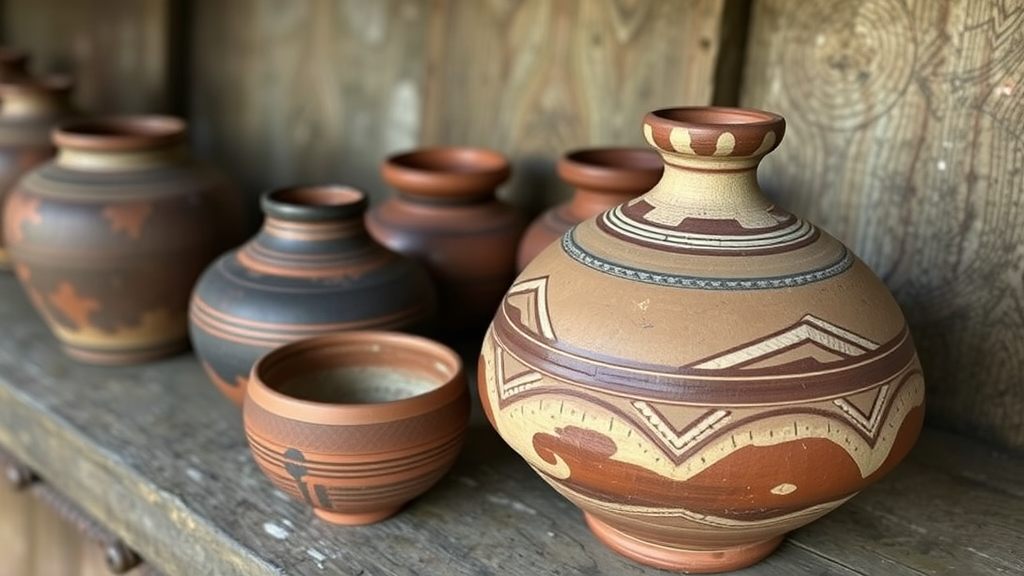
More than a hundred years ago, archaeologists digging into the shell mounds of Tampa Bay recovered pottery fragments that should not have been there. The designs etched into their surfaces were nearly identical to decorated vessels found hundreds of miles to the north, in the heartland of the Mississippian culture, a society that emerged over a thousand years ago and transformed social, economic and political life across southeastern North America. For decades, maps of the Mississippian world excluded peninsular Florida, yet the sherds kept hinting at a connection that no one could explain. The decorated pottery became one of the region’s most enduring puzzles: was it imported by trade, imitated by local hands, or made by someone else entirely?
That question has now been answered with laboratory evidence rather than stylistic argument. In a study published in American Antiquity, researchers at the Florida Museum of Natural History combined chemical fingerprinting with microscopic analysis of pottery from Tampa Bay and concluded that the vessels were made locally by migrants from the Florida Panhandle, the center of gravity of Mississippian culture. These artisans apparently carried specialized knowledge of clay processing and vessel construction hundreds of miles south, then used that expertise to establish a niche for themselves within the region’s existing Safety Harbor communities. The findings resolve a debate that has simmered since the sherds were first shelved in museum collections a century ago.
The cultural backdrop explains why the pottery was so puzzling. Around 1000 A.D., a new way of life took root in the Mississippi River Valley and radiated outward across much of the Midwest and eastern United States. In the heartland, Indigenous communities organized into regional hierarchies, with large chiefdoms concentrating political power over surrounding villages. They planted extensive fields of maize and quarried earth to build flat-topped mounds crowned with temples and elite residences. Tampa Bay, by contrast, sat on the southern edge of this world. The regional culture there, known as Safety Harbor, shared some Mississippian traits: communities aggregated into small chiefdoms, the largest centered on the Tocobaga, with the Mocoso, Pohoy and Uzita chiefdoms nearby, and they too built platform mounds. But no local group amassed the political scale of the northern centers, and the coastal communities never adopted maize agriculture, sustaining themselves instead on fishing and marine resources.
Given these mixed signals, archaeologists never fully understood how closely the coastal chiefdoms were tied to the Mississippian heartland, and the presence of Mississippian-style decorated pottery only deepened the uncertainty. Surface designs alone could not settle the matter, because motifs can be copied. What was needed was a way to look beneath the decoration, into the invisible decisions a potter makes before a vessel is ever fired. Trevor Duke, who began the research as a doctoral student at the University of Florida, and his colleagues assembled a sample of 58 pottery sherds from Tampa Bay, including both plain wares used for everyday cooking and serving and decorated vessels likely reserved for special occasions.
The first test targeted the clay itself. Using neutron activation analysis, the team measured the chemical composition of the sherds and compared it with that of raw clay sources around the region. The profiles matched, showing that every vessel in the sample, decorated or plain, had been made on-site from local clay. That result eliminated the trade hypothesis: the pots had not been manufactured in the Mississippian heartland and carried south. But chemistry could not yet rule out imitation, because a local potter copying northern designs would also use local clay. The decisive evidence had to come from the recipe hidden inside the paste.
To recover it, the researchers turned to petrography, a technique in which a thin slice of a pottery sherd is polished down to roughly half the width of a human hair. Light from a polarizing microscope passes through the section, revealing the voids, cracks and mineral grains that record how the clay was processed. The minerals can be identified by their color and shape under magnification, and from that, researchers can determine what was mixed into the clay. It is, in effect, a fingerprint of the people who made the vessel, preserving choices that no surface decoration can disguise.
Under the microscope, the Tampa Bay pottery revealed its secret. Several of the decorated fragments were tempered with grog, crushed pieces of old pottery mixed into fresh clay, a hallmark of some Mississippian pottery that improves a vessel’s ability to withstand the high temperatures of firing and cooking. Grog tempering appeared in none of the plain samples from Tampa Bay, but in the Tallahassee Hills, home to the nearest massive Mississippian mound center some 200 miles to the north, it is the standard tempering technique for all vessels. The connection ran deeper still: within the grog, the scientists identified mica, a shiny silicate mineral common to the Panhandle but not typically found in peninsular Florida. The host clay was local, but the particles mixed into it had come from the Mississippian heartland, apparently carried south by the potters themselves.
The contrast between the two vessel classes was stark. While 80 percent of the decorated pottery contained grog, not a single plain sherd did; most plain vessels were tempered with chunks of dry clay or sand, methods used in the region for the previous 3,000 years. The decorated pots were also shaped by coiling, the Mississippian technique, rather than molding, and were made with more consistent paste recipes, suggesting potters with advanced knowledge of clay processing. The plain wares, by contrast, were molded, a simple practice that could be quickly learned by novices as the region’s population grew. The most likely reconstruction is that migrant potters traveled from northern Florida carrying bags of their old decorated vessels, then crushed and ground that homeland pottery into the fresh clay of their new home. Every grog-tempered vessel contained multi-generational grog, fragments embedded within larger fragments like Russian nesting dolls, traceable through several generations of pots, and always drawn from the same lineage of decorated vessels. The migrants were quite literally incorporating pieces of their homeland into everything they made.
That expertise appears to have been the migrants’ ticket into an unfamiliar society. Their skill and their connection to Mississippian tradition would have set them apart, transforming commonplace homeland practices into valued services. Yet the knowledge stayed confined. The distinction between decorated and plain pottery persisted for centuries, and local residents never adopted the new techniques, whether because access was restricted or because the skills were simply too tightly held. The tempering, coiling and paste consistency are not clearly visible in a finished pot, so they cannot be easily mimicked without intimate access to the makers. The decorated vessels were also made from higher-quality clays than the plain wares, indicating the migrant artisans were granted access to a limited resource. As one of the researchers noted, secrets of this kind must be broadcast in part, so that people know a secret exists, and the circulating high-quality pots did exactly that, advertising a craft whose inner workings remained out of reach.
The study also offers a broader lesson in how migration reshapes material culture. Specialized knowledge passes directly from mentor to learner, and by tying homeland pottery into a chain of crushed and reused fragments across generations, the migrant potters may have been carrying their ancestors’ vessels into each new pot and the next generation. In Tampa Bay, a community of artisans found a way to matter in a new place, and the evidence of their arrival was hiding in plain sight for a century, waiting for the right instruments to read it.
Subject of Research: Compositional analysis of Mississippian-style pottery revealing migrant potters in pre-Columbian Tampa Bay, Florida
Article Title: Archaeologists uncover centuries-old mystery of Tampa Bay’s secret community of migrant potters
Article References: Archaeologists uncover centuries-old mystery of Tampa Bay’s secret community of migrant potters. (n.d.). Original publication
Image Credits: AI Generated
DOI: Not provided
Keywords: Mississippian culture, Tampa Bay, Safety Harbor, pottery analysis, neutron activation analysis, petrography, grog tempering, migration, Florida archaeology, American Antiquity, Tocobaga, Florida Museum of Natural History
Cite Scienmag News
Courtney Benton. (September 22, 2026). Migrant potters carried secret Mississippian recipes to Tampa Bay centuries ago. Scienmag. https://scienmag.com/migrant-potters-carried-secret-mississippian-recipes-to-tampa-bay-centuries-ago/
Courtney Benton. "Migrant potters carried secret Mississippian recipes to Tampa Bay centuries ago." Scienmag, 22 September 2026, https://scienmag.com/migrant-potters-carried-secret-mississippian-recipes-to-tampa-bay-centuries-ago/. Accessed 22 September 2026.
Courtney Benton. "Migrant potters carried secret Mississippian recipes to Tampa Bay centuries ago." Scienmag. September 22, 2026. https://scienmag.com/migrant-potters-carried-secret-mississippian-recipes-to-tampa-bay-centuries-ago/


