


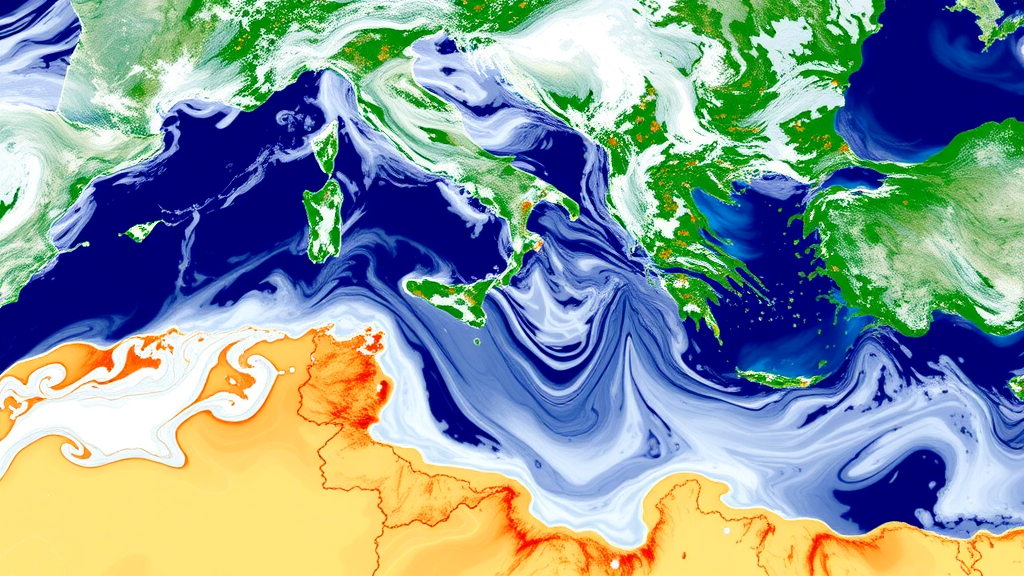
The Mediterranean Sea is one of the most studied bodies of water on Earth, yet some of its most important physics have long remained invisible to oceanographers. A new study published in Communications Earth & Environment has now brought those hidden dynamics into view, using satellite observations to map, for the first time on a basin-wide scale, how fine-scale turbulence in the Mediterranean changes with the seasons. The research reveals that the chaotic swirls and eddies that stir the sea are not a constant background feature but follow a pronounced annual cycle, with important implications for how the Mediterranean stores heat, distributes nutrients and responds to a warming climate.
Fine-scale turbulence occupies a middle ground in ocean physics. It sits between the vast, slow-moving gyres that dominate ocean circulation and the microscopic mixing that dissipates energy into heat. At scales of roughly one to ten kilometres, this turbulence takes the form of eddies, filaments and fronts that stir water masses horizontally and vertically. Although individually small, these structures collectively perform much of the ocean’s stirring, controlling how tracers such as heat, salt, carbon and plankton are redistributed beneath the surface. Measuring them directly from ships is extraordinarily difficult, because the features evolve over hours to days and shift position rapidly, making the Mediterranean’s interior a patchwork that in situ campaigns can only sample piecemeal.
The team behind the new work turned to an increasingly powerful alternative: satellite altimetry. Modern altimetry missions measure the height of the sea surface with centimetre-level precision, and because surface currents leave their imprint on the shape of that surface, the data can be transformed into maps of surface geostrophic flow. By applying a fine-scale processing approach that resolves structures far smaller than the traditional eddy fields captured by standard altimetric products, the researchers were able to extract a proxy for surface turbulence intensity across the entire Mediterranean basin, month by month, over a multi-year record.
The central finding is striking: fine-scale turbulence in the Mediterranean is strongly seasonal, and the pattern of that seasonality differs from region to region. In the northwestern Mediterranean, turbulence activity intensifies markedly in winter, when vigorous atmospheric cooling and strong winds such as the mistral and tramontane destabilise the upper ocean and energise mesoscale and submesoscale eddies. In summer, by contrast, a thin, warm, stratified layer caps the sea and suppresses vertical motion, and the turbulent activity quietens. The Gulf of Lion, a known site of deep water formation, emerges as a winter hotspot where fine-scale stirring is at its most intense.
In the eastern basin, the seasonal signal is more nuanced but equally revealing. Areas influenced by the major currents of the region, including the Atlantic Water jet entering through the Strait of Gibraltar and the flow along the North African coast, show turbulence maxima tied to the seasonal behaviour of these currents rather than to local wind forcing alone. When the currents intensify or become unstable, they shed eddies and meanders that show up unmistakably in the satellite-derived turbulence maps. The Strait of Sicily, the shallow sill that separates the western and eastern basins, also stands out as a persistent zone of elevated fine-scale activity, reflecting the energetic exchange of water masses funnelling through this narrow gateway.
The technical foundation of the study lies in how the researchers quantified turbulence from the surface velocity fields. They computed surface kinetic energy and, crucially, the fine-scale component of that kinetic energy: the portion associated with motions at the smaller end of the resolvable scale range, after removing the large, slowly varying background circulation. By examining the ratio of fine-scale to total kinetic energy, they obtained a robust indicator of turbulence intensity that is less sensitive to errors in the absolute current speed. They then averaged this indicator over many years for each month of the annual cycle, producing basin-wide climatologies that expose the seasonal heartbeat of Mediterranean turbulence with a clarity never previously achieved.
Validation against independent data sources was a key part of the analysis. The satellite-derived turbulence patterns align well with what is known from drifter measurements, which trace currents directly as floating instruments ride the flow, and with numerical model simulations of the Mediterranean circulation. The agreement between the space-based proxy and these ground-truth sources gives confidence that the seasonal signals are real features of the ocean rather than artefacts of the satellite processing. It also demonstrates, more broadly, that current-generation altimetry can be pushed to resolve fine-scale dynamics in semi-enclosed seas, where conventional coarse-resolution products have historically fallen short.
Why does this seasonal turbulence cycle matter? The answer lies in the role of fine-scale stirring as the ocean’s mixing engine. In winter, intense turbulence in the northwestern Mediterranean helps to homogenise the water column and ventilate the deep layers, a process central to the Mediterranean’s thermohaline circulation, often described as a miniature version of the global conveyor belt. Enhanced winter stirring also replenishes surface nutrients after the depleted summer months, setting the stage for the spring phytoplankton bloom that anchors the basin’s marine food web. In summer, weakened turbulence and strong stratification trap heat and carbon near the surface, influencing air-sea gas exchange and the fate of waters that will eventually spill over the Sicily sill into the eastern basin.
The findings also carry implications for climate science. The Mediterranean is warming faster than the global ocean average, and models of its future evolution depend on accurately representing the mixing processes that distribute heat vertically. If fine-scale turbulence follows predictable seasonal rhythms, then climate models must capture those rhythms to reproduce the sea’s heat uptake correctly, particularly during the critical winter period of deep water formation. Moreover, as surface warming strengthens stratification, the seasonal suppression of turbulence may intensify, potentially reducing winter ventilation and altering the nutrient supply that sustains Mediterranean ecosystems. The satellite record, extending back years and continuing into the future, offers a way to monitor whether such changes are already underway.
Beyond the Mediterranean, the study opens a template for observing fine-scale ocean dynamics in other semi-enclosed and marginal seas, from the Black Sea to the Gulf of Mexico, where ship-based sampling is logistically demanding and conventional altimetry struggles. As new high-resolution altimetry missions come online and processing techniques continue to improve, oceanographers expect to resolve turbulence at ever finer scales from orbit, closing one of the most stubborn observational gaps in physical oceanography. For now, the Mediterranean has become the proving ground, and it has delivered a vivid message: even the smallest, most turbulent motions of the sea obey the great clock of the seasons, and from hundreds of kilometres above, we can finally watch them turn.
Subject of Research: Seasonal variability of fine-scale turbulence in the Mediterranean Sea observed from satellites.
Article Title: Seasonality of fine-scale turbulence in the Mediterranean Sea observed from space
Article References: Barabinot, Y., Lopez, G., Mourre, B., & Pascual, A. (2026). Seasonality of fine-scale turbulence in the Mediterranean Sea observed from space. Communications Earth & Environment. https://doi.org/10.1038/s43247-026-04046-1
Image Credits: AI Generated
DOI: 10.1038/s43247-026-04046-1
Keywords: fine-scale turbulence, Mediterranean Sea, satellite altimetry, mesoscale eddies, ocean mixing, seasonality, deep water formation, thermohaline circulation, submesoscale dynamics, Gulf of Lion, fine-scale, turbulence
Cite Scienmag News
Violet Maxwell. (September 21, 2026). Satellites Reveal the Hidden Seasonal Rhythm of Turbulence in the Mediterranean Sea. Scienmag. https://scienmag.com/satellites-reveal-the-hidden-seasonal-rhythm-of-turbulence-in-the-mediterranean-sea/
Violet Maxwell. "Satellites Reveal the Hidden Seasonal Rhythm of Turbulence in the Mediterranean Sea." Scienmag, 21 September 2026, https://scienmag.com/satellites-reveal-the-hidden-seasonal-rhythm-of-turbulence-in-the-mediterranean-sea/. Accessed 21 September 2026.
Violet Maxwell. "Satellites Reveal the Hidden Seasonal Rhythm of Turbulence in the Mediterranean Sea." Scienmag. September 21, 2026. https://scienmag.com/satellites-reveal-the-hidden-seasonal-rhythm-of-turbulence-in-the-mediterranean-sea/


