


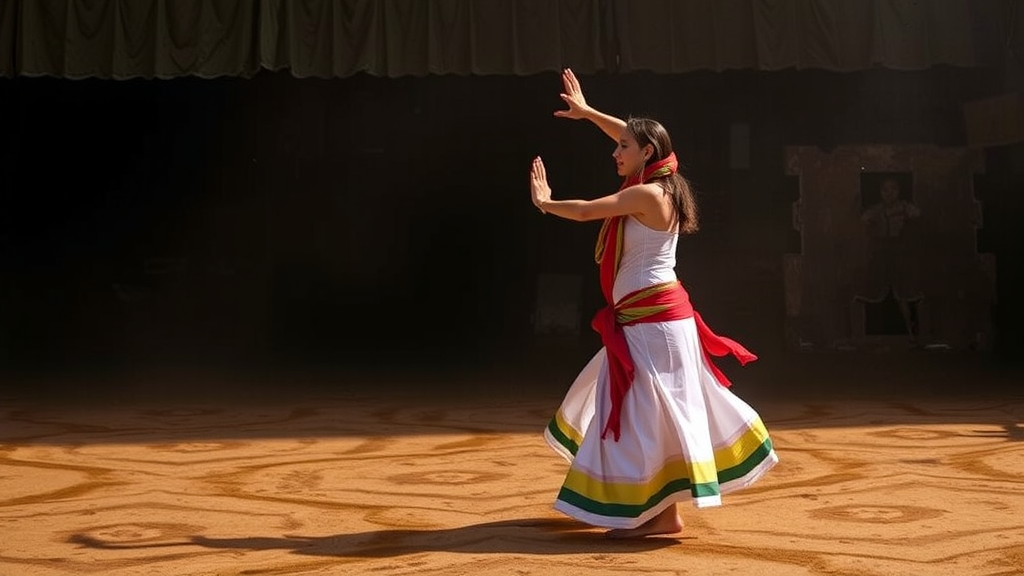
Sacred dance has always lived a double life. In one, it is an act of devotion, addressed to ancestors, gods, and unseen presences; in the other, it is a performance, framed by stage lights, ticket prices, and the expectations of tourists and festival audiences. A new comparative study published in Humanities and Social Sciences Communications examines how two celebrated dance traditions—the Drum Dance of the Miao people in China’s Xiangxi region and the Legong dance of Bali in Indonesia—have navigated the passage from ritual context to heritage performance, and how each has redefined what sacredness means in the process. The research suggests that the movement from temple and village square to proscenium stage is not simply a loss of authenticity, but an active, ongoing reconfiguration in which communities themselves decide what remains sacred and what becomes spectacle.
The study’s central concept is ritual reconfiguration: the deliberate and often negotiated reorganization of a dance’s sacred elements as its social setting changes. Rather than treating sacredness as a fixed substance that either survives or evaporates under modernization, the researchers frame it as a relationship between movement, space, participants, and meaning. When any of those elements shifts—when a dance that once accompanied funerary rites is performed at a tourism festival, for example—the community must decide which components carry spiritual weight and which can be adapted for display. The comparative approach is key to the argument: by placing a Chinese ethnic minority tradition alongside a Balinese court-derived dance, the authors show that the pressures of secularization, heritage designation, and cultural tourism produce remarkably parallel processes in very different religious and political environments.
Xiangxi, in the western part of China’s Hunan Province, is home to a large Miao population whose Drum Dance has long served communal and ceremonial purposes. In traditional settings, the drum functioned as more than an instrument; it was widely understood as a medium of communication with ancestors and a device for organizing communal life, from seasonal celebrations to rites marking life transitions. The dance vocabulary—vigorous, percussive, and performed by both men and women in distinct styles—was embedded in village events where the boundary between performer and participant was porous. Elders, family members, and neighbors gathered around the drum, and the performance’s efficacy depended partly on who was watching, who was dancing, and why. Sacredness in this context was distributed across the event rather than concentrated in the choreography alone.
The Legong dance presents a strikingly different starting point. Developed in the royal courts of Bali and historically performed by pre-adolescent girls trained in secluded contexts, Legong is inseparable from the island’s dense ritual calendar, in which dance offerings are presented at temple ceremonies and believed to please the gods and maintain cosmic balance. Balinese performing arts operate within a cosmology in which aesthetics and religion are not separable domains: a beautifully executed dance is itself a form of devotion. Yet Legong has also become one of Bali’s most exportable cultural symbols, performed nightly for tourists in Ubud and other centers, taught in conservatories, and adapted for international touring companies. The question the study poses is not whether this transformation happened, but how Balinese dancers, teachers, and religious authorities have explained and managed it.
The research draws on ethnographic fieldwork, interviews with performers and cultural custodians, and analysis of how each tradition has been catalogued and promoted as intangible cultural heritage. Heritage designation, the study emphasizes, is a crucial hinge in both cases. When a practice enters national or international heritage lists, it is described, standardized, and documented in ways that inevitably alter its transmission. Movements are codified, costumes are preserved as canonical, and lineages of teachers are recorded. This documentation can protect a tradition from extinction, but it also encourages a view of the dance as a bounded text rather than a living ritual event. In both Xiangxi and Bali, the study finds, communities have responded to this tension by distinguishing between the dance as heritage—something that can be taught, staged, and preserved—and the dance as rite, something that requires proper time, place, and intention.
One of the study’s most interesting findings concerns the strategies of reframing that performers use to keep sacredness intact within secular performance. In Xiangxi, some drum-dance practitioners describe stage performances as a form of cultural representation that honors, rather than replaces, the ritual drumming reserved for ceremonies. The sacred dimension is relocated from the specific performance to the tradition as a whole: dancing for tourists becomes an act of keeping Miao identity alive, which is itself framed in quasi-vocational, almost devotional terms. In Bali, a similar logic operates through the concept of offering. Dancers and teachers often maintain that performing Legong anywhere—even in a hotel courtyard—can constitute an offering if performed with the correct dedication and attitude, because the Balinese framework treats art itself as a channel to the divine. In both cases, sacredness is not abandoned but re-anchored, shifted from external conditions to internal disposition.
The comparison also reveals differences that matter. Balinese dance traditions operate within a still-vigorous living religion, where temple ceremonies continue to demand ritual performance and where priests, temples, and family compound associations provide institutional anchors for the sacred. Legong dancers may perform on stage one night and in a temple ceremony the next, and the two settings remain clearly differentiated even when the choreography is similar. The Miao Drum Dance, by contrast, has experienced heavier disruption from historical upheavals, population displacement, and the erosion of the ceremonial contexts in which it once functioned. For many Xiangxi practitioners, the stage is no longer a secondary venue but the primary one, which makes the work of reframing more difficult and more urgent. The study argues that this asymmetry helps explain why Balinese discourse about sacred performance appears more settled, while Miao discourse remains more actively contested.
Tourism emerges in the research as a double-edged force. On one hand, tourist demand has generated economic incentives that keep young people training in traditions that might otherwise thin out; festival stages, cultural tourism zones, and heritage showcases provide livelihoods and public visibility. On the other hand, market pressures push toward abbreviation, spectacle, and the exaggeration of visually striking elements at the expense of ritual sequencing and symbolic content. The study documents how both communities have developed internal mechanisms of quality control—master teachers who insist on correct technique and etiquette, elders who adjudicate what may be shown to outsiders, and in Bali, religious authorities who determine what is appropriate for temple versus stage. These gatekeepers, the authors suggest, are the true agents of ritual reconfiguration: the process is not imposed from outside by states or tourist boards, but managed from within, unevenly and sometimes contentiously.
The article’s broader theoretical contribution lies in its challenge to the authenticity discourse that still dominates much heritage policy and public discussion. Scholars and officials often ask whether a performed tradition is still authentic, implying a binary between pristine original and corrupted copy. The study’s answer is that authenticity is the wrong measure. Sacredness, in the cases examined, behaves less like a substance and more like a frame—something communities actively construct through intention, discourse, and practice. A drum dance can be both an ancestor-honoring rite and a national festival number; a Legong can be both a temple offering and a ticketed show, and the frame can shift from one performance to the next. What matters is who holds the authority to define the frame, and whether the community that owns the tradition retains that authority or cedes it to external actors.
The implications extend well beyond Xiangxi and Bali. As intangible cultural heritage programs multiply worldwide and cultural tourism becomes a pillar of rural economies, communities everywhere are negotiating similar boundaries between the sacred and the displayable. The study offers a vocabulary for those negotiations, and a caution: policies that freeze traditions into museum-ready versions may inadvertently strip them of the very flexibility that has allowed ritual dances to survive centuries of change. The Drum Dance of the Miao and the Legong of Bali endure, the research concludes, precisely because they have always been reconfigured—by courts, migrations, religions, and now heritage regimes—without losing their capacity to mean. Sacredness, in the end, is not what a dance loses on stage; it is what a community insists on carrying with it there.
Subject of Research: Ritual reconfiguration and the reframing of sacredness in the Xiangxi Miao Drum Dance and Balinese Legong Dance
Article Title: Reframing sacredness: ritual reconfiguration in Xiangxi Miao Drum Dance and Balinese Legong Dance
Article References: Reframing sacredness: ritual reconfiguration in Xiangxi Miao Drum Dance and Balinese Legong Dance. (n.d.). https://doi.org/10.1038/s41599-026-08996-x
Image Credits: AI Generated
DOI: 10.1038/s41599-026-08996-x
Keywords: sacredness, ritual reconfiguration, Miao Drum Dance, Legong Dance, intangible cultural heritage, Bali, Xiangxi, cultural tourism, dance ethnography, heritage performance, performing arts, religious ritual
Cite Scienmag News
Courtney Benton. (September 21, 2026). When Rituals Move On: How Two Sacred Dance Traditions Reinvented Themselves. Scienmag. https://scienmag.com/when-rituals-move-on-how-two-sacred-dance-traditions-reinvented-themselves/
Courtney Benton. "When Rituals Move On: How Two Sacred Dance Traditions Reinvented Themselves." Scienmag, 21 September 2026, https://scienmag.com/when-rituals-move-on-how-two-sacred-dance-traditions-reinvented-themselves/. Accessed 21 September 2026.
Courtney Benton. "When Rituals Move On: How Two Sacred Dance Traditions Reinvented Themselves." Scienmag. September 21, 2026. https://scienmag.com/when-rituals-move-on-how-two-sacred-dance-traditions-reinvented-themselves/


