


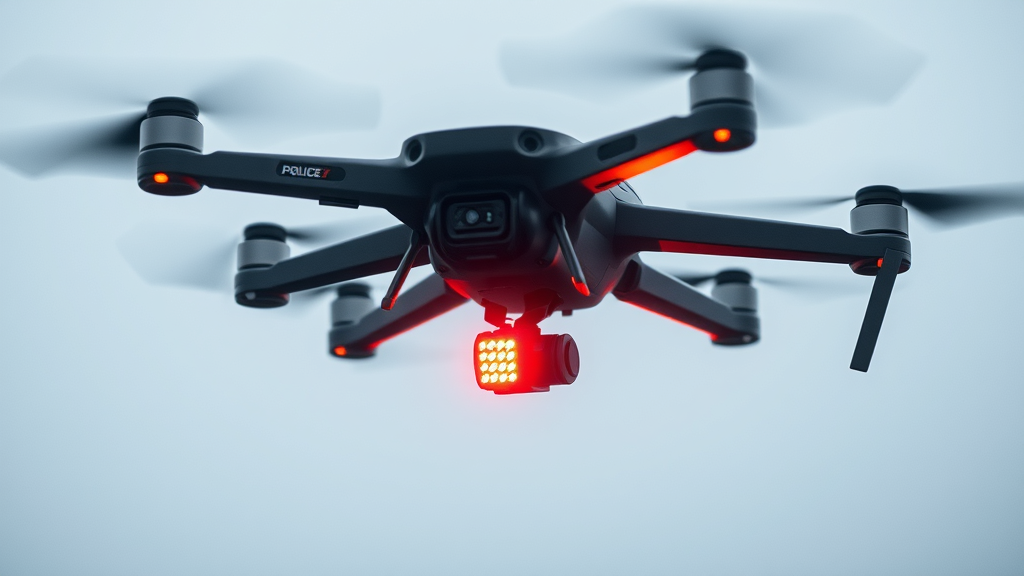
A pair of researchers at Concordia University in Montreal has unveiled a detailed conceptual blueprint for how police and public-safety drones could one day warn human officers about potentially escalating situations without ever deciding anything on their own. The framework, called SkySentience, is published in the journal Discover Informatics by Swarnamouli Majumdar and Anjali Awasthi of the Department of Cybersecurity and Intelligent Systems Engineering. It is deliberately not a working product: the authors present no prototype, field trial, or empirical validation, and they are explicit that the contribution is a rigorously specified, independently testable architecture together with a staged evaluation agenda for technical validity, human factors, governance feasibility, and community legitimacy.
The starting point of the paper is a familiar tension in modern policing. Public-safety agencies already juggle fragmented, time-sensitive information streams—radio calls, video feeds, sensor alerts, crowd movement, and human reports—yet most of the technology available to them remains retrospective. Footage is reviewed after an incident, logs are examined once a response has been triggered, and pattern analysis is applied only after historical trends have formed. Recent surveys of agentic artificial intelligence show the field moving toward adaptive reasoning over complex goals, and affective-computing research has matured in estimating probabilistic signals related to arousal, stress, vocal intensity, gesture, and group movement. Drones add mobility, altitude, and rapid redeployment, making them attractive sensing platforms. Together, these capabilities make anticipatory public-safety support technically conceivable.
But the authors argue that the shift from detecting incidents after escalation to sensing conditions that may precede escalation cannot be judged by technical performance alone. A raised voice, a compressed crowd, a sudden gesture, or a cluster of bystanders can accompany conflict, yet the same cues may reflect celebration, unrelated stress, disability-related behavior, cultural expressiveness, or simply the ordinary density of urban life. When an aerial system interprets such cues, the error is not confined to a model output: it may redirect police attention, change how officers approach a scene, or make members of the public feel watched, classified, and pre-judged. Because false positives can disproportionately burden communities already subject to heavier surveillance, the paper treats governance as an architectural requirement rather than an afterthought.
At the heart of SkySentience is the Pre-Incident Escalation Index, or PEI, an interpretable advisory score that aggregates four bounded, time-indexed channels: visual agitation indicators such as abrupt gestures and repeated encroachment into personal space; non-lexical acoustic markers such as rising vocal energy and speech overlap, with no attempt to recognize words, intent, or identity; crowd-dynamics measures such as localized compression, slowing or reversing pedestrian flow, and clustering; and a contextual prior built only from documented, non-individualized variables such as venue type, scheduled events, and time-dependent crowding baselines. The index is computed as a weighted linear combination, PEI equals alpha times the visual score plus beta times the acoustic score plus gamma times the crowd score plus delta times the contextual prior. The weights are deliberately left as calibration targets rather than universal constants, because their relative informativeness varies across venues and because the weighting choice is itself a governance decision that should be documented, version-controlled, and reviewed like any other policy parameter.
Because escalation is dynamic, the framework also tracks the short-term change in the index, delta PEI, so that a moderate score rising quickly can attract more attention than a higher but stable score in a benign setting. Every modality must also emit a quality or confidence value reflecting sensor conditions and model reliability, and raw scores should be calibrated on held-out, deployment-relevant data using auditable methods such as isotonic regression or Platt scaling, with expected calibration error and reliability diagrams reported. Missingness is handled conservatively: a degraded channel is never silently imputed, and as a reference rule at least two independent sensing modalities of acceptable quality must be available before any PEI-based advisory is produced; otherwise the system abstains and reports insufficient evidence. The contextual prior does not count as an independent sensor modality, and protected characteristics, inferred identity, and raw historical enforcement frequencies are excluded from the prior because they could reintroduce historical policing patterns into an ostensibly behavior-based score.
To make the design concrete, the paper walks through a hypothetical observation at a busy transit hub in which the visual channel reports 0.60, the acoustic channel 0.48, crowd dynamics 0.70, and the contextual prior 0.20. With documented weights of 0.30, 0.25, 0.30, and 0.15, the PEI works out to 0.54, and against a previous value of 0.43 the trend is plus 0.11. Weighted by quality values from each channel, the aggregate evidence reliability comes to 0.79—a figure the authors stress is an indicator of evidence quality, not a 79 percent probability that escalation will occur. The system would then report the triplet of score, trend, and confidence, and, if validated thresholds were met, issue a plain-language advisory such as a note that the score is moderate and increasing, driven primarily by crowd compression and visual movement cues, recommending continued observation or human review. The authors emphasize that every number in the example is illustrative, not empirical.
The decision logic built on top of the index is intentionally narrow. When the score is low and stable, the drone continues passive observation. When the score is moderate or rising quickly, the system may recommend light-touch, reversible responses such as repositioning for a clearer view or notifying an officer with a short explanation. Even when risk remains elevated and corroborated across modalities, the system prioritizes officer awareness rather than autonomous action, and it is never permitted to stop, identify, pursue, confront, or otherwise act coercively toward members of the public. Language models, if used at all, are restricted to summarizing and explaining policy-checked outputs; they do not control the drone, select enforcement actions, or generate unverified factual claims. The architecture separates perception, advisory reasoning, human authorization, and accountability into distinct layers, so that every action affecting a person’s liberty, safety, or legal exposure requires an explicit human decision.
The governance requirements are equally specific. The authors call for tamper-evident, time-stamped, access-controlled audit logs recording each PEI computation, the contributing modality scores, confidence estimates, recommendations, officer responses, and rationales for acceptance, modification, override, or inaction. They propose an institutional division of labor in which the deploying agency documents deployment criteria and configurations, an independent oversight function outside the chain of command audits logs, override patterns, and subgroup error rates, and a separate public-facing channel handles redress requests from people who believe they were observed or flagged. Proportionality ties intervention intensity to evidentiary strength, confidence, and persistence, while explainability must serve two audiences: officers need concise operational explanations of what drove a score, and the public needs to know what the system observes, what it does not infer, how data are retained or deleted, and how to challenge an assessment. The framework is also jurisdiction-contingent: where law prohibits emotion inference in policing, any channel constituting such inference must be disabled or the deployment must not proceed.
Two illustrative scenarios show how the framework behaves when it is right and when it is wrong. In the first, rising voices, prolonged eye contact, and slowing pedestrian flow at a transit platform jointly lift the index, prompting only a respectful vantage point and a notification to a nearby officer, who retains full discretion to observe, approach, or stand down. In the second, a group celebrating a cultural occasion sings loudly and clusters tightly, pushing the score across a moderate threshold even though the behavior is benign; the system may only reposition or notify, the officer recognizes the celebration and records an override, and that override feeds later recalibration and bias review. The authors argue that the difference between a harmless false positive and a harmful one lies precisely in this governance layer: without bounded autonomy, override logging, and public redress, the same score could produce unnecessary police attention or opaque records.
The paper closes with a candid reckoning. The authors acknowledge the strongest objection—that affect-inferring drone systems should not exist in public policing at all—and they distinguish the justificatory question of whether a community should permit such a system from the architectural question of what must be true of it if deployed. Safeguards, they note, can reduce harm only if a system is deployed; they do not prove deployment is justified, and that prior question belongs to legal, democratic, and community processes. A staged validation plan follows: first testing the index on public benchmark data with subgroup-disaggregated performance, then using simulation and replay studies to examine officer-facing explanations, alert burden, and override patterns, and finally evaluating whether audit records, public explanations, retention policies, and community review mechanisms actually function in practice. A system that passes the technical stage but fails the institutional one, the authors conclude, should not be considered successful—and satisfying every requirement would still not, by itself, establish that any jurisdiction should deploy affect-related drone decision support.
Subject of Research: A conceptual governance-centered framework for accountable, human-supervised UAV decision support in public safety using a Pre-Incident Escalation Index.
Article Title: The SkySentience conceptual framework for accountable drone decision support in public safety
Article References: Majumdar, S., & Awasthi, A. (2026). The SkySentience conceptual framework for accountable drone decision support in public safety. Discover Informatics, 1(1), Article 16. https://doi.org/10.1007/s44564-026-00018-x
Image Credits: AI Generated
DOI: 10.1007/s44564-026-00018-x
Keywords: SkySentience, public-safety informatics, drones, UAV surveillance, agentic AI, Pre-Incident Escalation Index, affect inference, algorithmic accountability, human-AI collaboration, auditability, responsible AI, policing technology
Cite Scienmag News
Denise Maddox. (September 20, 2026). SkySentience Framework Aims to Keep Police Drones Accountable Before Incidents Escalate. Scienmag. https://scienmag.com/skysentience-framework-aims-to-keep-police-drones-accountable-before-incidents-escalate/
Denise Maddox. "SkySentience Framework Aims to Keep Police Drones Accountable Before Incidents Escalate." Scienmag, 20 September 2026, https://scienmag.com/skysentience-framework-aims-to-keep-police-drones-accountable-before-incidents-escalate/. Accessed 20 September 2026.
Denise Maddox. "SkySentience Framework Aims to Keep Police Drones Accountable Before Incidents Escalate." Scienmag. September 20, 2026. https://scienmag.com/skysentience-framework-aims-to-keep-police-drones-accountable-before-incidents-escalate/


