


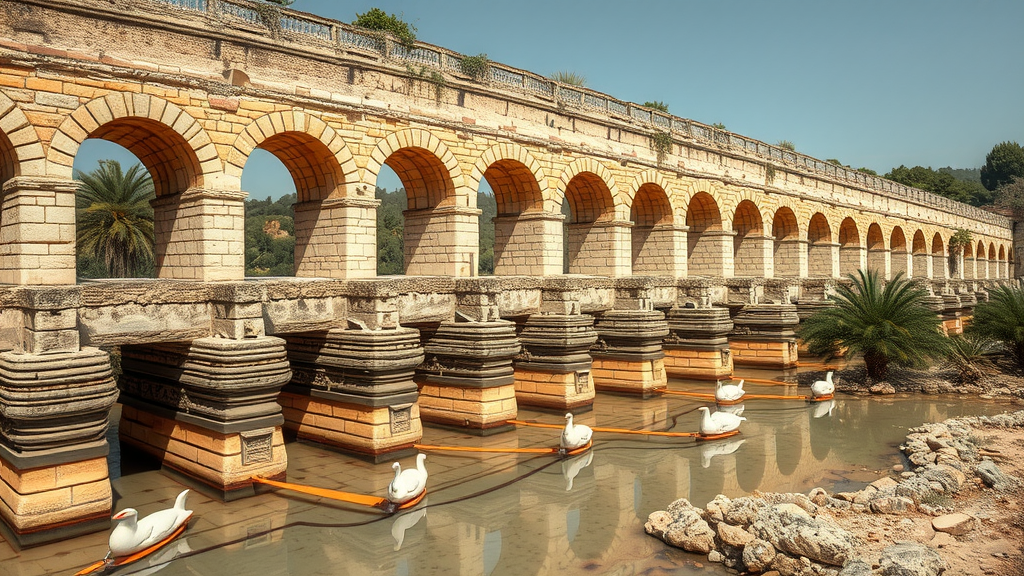
Hidden inside the limestone crust of one of the most famous monuments of the Roman world, researchers have found a detailed record of how an ancient city rose, prospered, faltered and apparently emptied out. A team at Johannes Gutenberg University Mainz, led by Professor Cees Passchier and Dr. Gül Sürmelihindi, has analyzed carbonate deposits from the 50-kilometer-long aqueduct that once carried water to Nîmes in southern France, crossing the Gardon river on the spectacular three-tiered bridge known as the Pont du Gard. Their study, published in the journal Geoarchaeology on September 15, shows that the layered scale lining the aqueduct channel preserves a chronological archive of human decisions spanning roughly three centuries, from the aqueduct’s construction around 50 AD until the urban water supply was cut off around 270 AD. The final chapter of that archive coincides with the era of the Plague of Cyprian, and the researchers argue that the epidemic may have depopulated Nîmes, rendering its water supply unnecessary.
Carbonate deposits form naturally in Roman aqueducts as calcium carbonate precipitates from the flowing water, building up layer upon layer on the walls and floor of the channel. Because the chemistry and temperature of the water change over time, the deposits develop distinct banding patterns that can be read much like tree rings. The Mainz team extracted samples of this carbonate rock from ten locations along the entire course of the Nîmes aqueduct and subjected the layers to isotope analysis, allowing them to reconstruct variations in water source, flow volume and maintenance quality across the monument’s working life. The result is an unusually fine-grained history of water management in the western Roman Empire, written in stone by the water itself.
The deepest layers in the samples tell a story that begins with a crisis. At the base of the cores lies a carbonate layer about two centimeters thick, capped by a thin layer of clay. Both were deposited during the aqueduct’s first eleven years of operation, and their composition points to a drought affecting the western Mediterranean, an episode also recorded by the Roman historian Tacitus. The dry spell apparently reduced the flow of the original spring source enough to threaten the city’s supply. The response was decisive: after eleven years, the carbonate record shows that a different type of water entered the channel, indicating that an additional water source had been tapped to guarantee sufficient flow. This intervention correlates with structural modifications still visible today on the Pont du Gard, where the sidewalls were raised, reinforced and partially buttressed to accommodate a higher water level.
For the next century, the aqueduct functioned reliably, but around 150 AD the carbonate layers became significantly thinner, signaling a marked drop in the water level in the channel. According to Sürmelihindi, about half of the water supplying the city was diverted to irrigate fields, and the sheer volume involved suggests that this was an authorized withdrawal rather than clandestine siphoning. Such an arrangement, she notes, would likely have been possible only for highly influential individuals with the power to negotiate a formal reduction of the urban supply. The fact that the city apparently tolerated the loss without complaint also implies that Nîmes did not have a critical need for the full volume of water at that time. For roughly a hundred years afterward, the aqueduct continued to operate flawlessly, albeit delivering a reduced flow to the urban fountains, baths and distribution network.
The tone of the archive changes dramatically in the mid-third century. From that point onward, the color and composition of the carbonate shift: the deposits become more porous and begin to incorporate clay and sand, classic signs that the channel was no longer being properly maintained. This deterioration coincides with a period of great economic and political turmoil across many parts of the Roman Empire, an era of usurpations, invasions and fiscal collapse that historians call the third-century crisis. The carbonate record, in other words, mirrors the condition of the city itself, documenting a gradual loss of the administrative capacity and civic wealth that had kept the aqueduct in good repair for two hundred years.
Then comes the abrupt end. Around 270 AD, carbonate deposition stops entirely in the samples taken near the city: the urban water supply was completely cut off. Crucially, however, the rural sections of the aqueduct show continuous carbonate deposition through this same period, revealing that owners of vast estates upstream were diverting the water for their own use. The channel had not failed physically; it had simply stopped serving the city. The researchers interpret this pattern as evidence that something happened to the population of Nîmes, leaving too few urban consumers to justify maintaining the supply or defending it against private appropriation.
The prime suspect is the Plague of Cyprian, the pandemic named after the bishop of Carthage who described its ravages, which swept the Roman Empire roughly between 250 and 270 AD. The disease is primarily documented in North Africa and in Rome, where it claimed many lives, but very little is known about its impact in Western Europe. Study co-author Professor Andrew Wilson of the University of Oxford has suggested that the plague may also have posed a serious problem in southern France, and the carbonate evidence from Nîmes lends weight to that hypothesis. If the epidemic killed or displaced much of the city’s population, survivors may have abandoned the urban center for the countryside, a pattern of urban contraction that archaeologists have observed at many sites in southern France during this period. Some of those cities shrank following barbarian invasions, but others declined for reasons that remain unexplained.
Supporting evidence comes from an unexpected quarter. The city of Cahors, located about 300 kilometers west of Nîmes, was also in crisis at the same time, a fact that Passchier and Sürmelihindi established through their earlier study of local carbonate deposits in that city’s aqueduct. Two independent aqueduct archives, hundreds of kilometers apart, recording urban breakdown at the same moment, strengthen the case that a region-wide catastrophe such as the Plague of Cyprian, rather than purely local misfortune, lay behind the abandonment of urban water systems in Gaul.
Perhaps the most striking finding is what happened after the city lost its water. In the rural stretches of the aqueduct, the channel continued to be exploited for another 140 years, well into the fifth century. People drilled holes into the sidewalls to extract water for agriculture, a practice betrayed today by massive limescale deposits on the exterior of the conduit, formed by water leaking from these informal taps. As Passchier points out, the city could easily have repaired the aqueduct during those 140 years had there been the will and the population to do so. Apparently, however, the decline in population density and urban wealth was permanent. The famous bridge and its channel stood ready to serve, but the city that had built them never came back to claim the water, leaving the carbonate crust of the Pont du Gard aqueduct as a silent witness to one of antiquity’s most consequential pandemics.
Subject of Research: Reconstruction of the operational history of the Roman aqueduct of Nîmes from carbonate deposits and its link to the Plague of Cyprian
Article Title: Was Nîmes depopulated by the Plague of Cyprian?
Article References: Was Nîmes depopulated by the Plague of Cyprian?. (n.d.). Original publication
Image Credits: AI Generated
DOI: Not provided
Keywords: Nîmes aqueduct, Pont du Gard, Plague of Cyprian, Roman water management, carbonate deposits, isotope analysis, Geoarchaeology, third-century crisis, ancient urban decline, Johannes Gutenberg University Mainz, Roman Empire, aqueduct maintenance
Cite Scienmag News
Courtney Benton. (September 20, 2026). Roman Aqueduct Carbonate Layers Reveal Nîmes May Have Been Depopulated by the Plague of Cyprian. Scienmag. https://scienmag.com/roman-aqueduct-carbonate-layers-reveal-nimes-may-have-been-depopulated-by-the-plague-of-cyprian/
Courtney Benton. "Roman Aqueduct Carbonate Layers Reveal Nîmes May Have Been Depopulated by the Plague of Cyprian." Scienmag, 20 September 2026, https://scienmag.com/roman-aqueduct-carbonate-layers-reveal-nimes-may-have-been-depopulated-by-the-plague-of-cyprian/. Accessed 20 September 2026.
Courtney Benton. "Roman Aqueduct Carbonate Layers Reveal Nîmes May Have Been Depopulated by the Plague of Cyprian." Scienmag. September 20, 2026. https://scienmag.com/roman-aqueduct-carbonate-layers-reveal-nimes-may-have-been-depopulated-by-the-plague-of-cyprian/


