


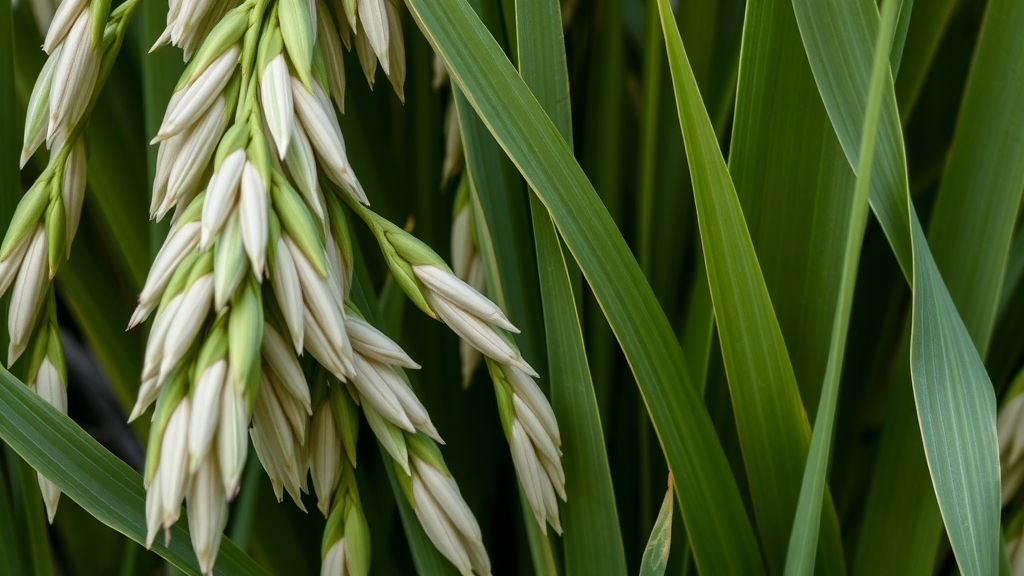
Every rice plant performs a quiet act of self-sacrifice in the final weeks of its life cycle. As grains swell inside the panicle, the flag leaf, the topmost leaf and the plant’s principal photosynthetic engine, systematically dismantles itself, shipping carbon, nitrogen and minerals to the developing seeds. This process, known as leaf senescence, is far more than simple decay. It is a tightly choreographed program of gene expression that largely determines how much grain a rice crop ultimately yields. Now, a team of researchers in South Korea has mapped that program in unprecedented detail, publishing a stage-by-stage atlas of gene activity in rice flag leaves that exposes when and how the plant commits to nutrient remobilization.
The study, led by Giwon Kim and Xu Jiang of Kyung Hee University under the supervision of Ki-Hong Jung, appears in the journal Plant Molecular Biology. The researchers profiled the transcriptomes, the complete set of expressed genes, of rice flag leaves at five distinct reproductive stages: one week before heading, at heading itself, and one, three and five weeks after heading. Rather than simply cataloging genes that changed over time, they applied a stringent intersection-based criterion to identify stage-preferential genes, meaning genes whose expression peaked at one particular stage relative to all the others. This approach allowed them to isolate the specific transcriptional signatures of each moment in the grain-filling period rather than blurring them into a single generic aging profile.
The results revealed two dramatic peaks of transcriptional reprogramming. At heading, the moment when the panicle emerges and flowering begins, 419 genes were preferentially expressed. Gene Ontology analysis showed that these genes were strongly enriched in jasmonate-related processes and defense-associated functions. Jasmonic acid is a plant hormone best known for its roles in wound responses and pest resistance, but previous work has also implicated it in spikelet development and reproductive timing. The new data suggest that as the rice plant transitions from vegetative growth to reproduction, its flag leaf mounts a coordinated hormone- and defense-linked transcriptional program, perhaps protecting the reproductive structures at a moment of exceptional vulnerability.
The second, and far larger, wave of reprogramming came five weeks after heading, when 1,317 genes showed preferential expression. This late-stage gene set told a very different story. Enrichment analysis linked these genes to senescence, nutrient transport, alternative respiration and plastid regulation. In other words, five weeks after heading is when the flag leaf appears to commit fully to its dismantling program: chloroplast components are broken down, transporters are mobilized to move nitrogen, phosphorus and mineral ions out of the leaf, and metabolic pathways shift toward the catabolic reactions that convert cellular infrastructure into exportable nutrients. Alternative respiration, a mitochondrial pathway that can help manage the reactive oxygen species generated during cellular breakdown, also featured prominently, hinting at how the senescing leaf keeps its energy metabolism functional even as its photosynthetic machinery is dismantled.
To move from a list of stage-preferential genes to an understanding of functional relationships, the team turned to network biology. They used the STRING database, which compiles known and predicted protein-protein associations, to construct an interaction network combining the genes preferentially expressed at five weeks after heading with reference senescence genes drawn from the Leaf Senescence Database. Within the largest connected component of this network, they applied a maximal clique centrality algorithm to identify hub candidates, the most highly connected and presumably most influential proteins in the system. The hubs that emerged clustered around two major biological themes: chloroplast and chlorophyll turnover, and nitrogen remobilization. This convergence is biologically telling, because the chloroplast holds the majority of the leaf’s nitrogen in the form of photosynthetic proteins, so breaking down chlorophyll-protein complexes is simultaneously the visible hallmark of senescence and the engine of nitrogen export.
Among the nitrogen-related hub candidates were components long associated with glutamine synthetase activity, the enzymatic gateway through which organic nitrogen is prepared for transport out of the leaf. Decades of research, from early work on glutamine synthetase in naturally senescing rice leaves to recent studies of cytosolic glutamine synthetase isoforms in grain ripening, have established this pathway as central to yield formation. By anchoring it within a stage-resolved interaction network, the new study provides a prioritized shortlist of genes that breeders and molecular biologists can now interrogate as potential levers for improving nitrogen use efficiency, a trait of enormous agronomic and environmental importance given the costs and consequences of nitrogen fertilizer.
The researchers also validated their findings experimentally using quantitative RT-PCR in the pale-green leaf mutant, or pgl, a rice line carrying a defect in a gene encoding chlorophyllide a oxygenase 1, an enzyme involved in chlorophyll metabolism. The pgl mutant is known to senesce differently from wild-type plants, indirectly affecting grain yield and quality. When the team measured the expression of representative hub genes in the mutant, they found broadly reduced expression compared with the wild type. This result suggests that the late-stage senescence network identified at five weeks after heading is attenuated in pgl, providing an independent line of evidence that the hub genes are genuine functional components of the senescence program rather than statistical artifacts of the profiling pipeline.
Technically, the study exemplifies the modern toolkit of plant genomics. RNA sequencing data were processed with standard trimming and alignment pipelines, expression quantified as transcripts per million, differential expression assessed with rigorous false discovery rate control, and time-course patterns examined with dedicated clustering methods. Data visualization relied on heatmap frameworks, and functional interpretation drew on enrichment tools and metabolic mapping platforms. The complete RNA-seq dataset has been deposited in ArrayExpress at EMBL-EBI under accession number E-MTAB-16817, making the resource freely available to the research community. For a crop that feeds more than half the world’s population, an open, stage-resolved reference of flag leaf biology is a contribution that extends well beyond the individual laboratory that generated it.
What makes the study particularly valuable is its insistence on stringency. Many transcriptomic surveys of leaf senescence collapse time points into broad categories and report long lists of differentially expressed genes, leaving researchers to guess which candidates matter most. By requiring that a gene be upregulated at one stage relative to every other stage, the Korean team produced a far more restrictive gene set, one in which each entry carries a clear temporal identity. The two major hubs of activity, heading and five weeks after heading, now stand as well-defined windows in which breeders might look for natural variation or in which genome editors might intervene. Delaying the late senescence program slightly, for example, could extend the photosynthetic duration of the flag leaf, while enhancing the remobilization program could improve the efficiency with which nutrients reach the grain.
The work also reframes an old question in crop physiology. Scientists have long known that a rice plant’s last leaf is both its factory and its warehouse, and that the timing of the warehouse’s liquidation is a matter of delicate balance. Senesce too early, and the grain is starved of photosynthate; senesce too reluctantly, and nutrients remain locked in the leaf. By showing that the transition is governed by discrete, stage-specific transcriptional programs, one defensive and hormonal at heading, one catabolic and export-oriented five weeks later, the study offers a molecular vocabulary for describing that balance. It links visible yellowing to specific network modules, and those modules to testable candidate genes. As global rice production faces mounting pressure from climate variability and the need to reduce fertilizer inputs, understanding the genetic timetable of the flag leaf may prove to be one of the more consequential stories in modern plant science, told this time gene by gene, stage by stage, in the fading green of a single leaf.
Subject of Research: Stage-preferential transcriptome profiling of rice flag leaf senescence and nutrient remobilization during grain filling.
Article Title: Stage-preferential transcriptome profiling reveals senescence associated transcriptional programs linked to nutrient remobilization in rice flag leaves during grain filling
Article References: Kim, G., Jiang, X., Yoo, Y.-H., Hong, W.-J., & Jung, K.-H. (2026). Stage-preferential transcriptome profiling reveals senescence associated transcriptional programs linked to nutrient remobilization in rice flag leaves during grain filling. Plant Molecular Biology, 116(5), Article 98. https://doi.org/10.1007/s11103-026-01762-2
Image Credits: AI Generated
DOI: 10.1007/s11103-026-01762-2
Keywords: rice flag leaf, grain filling, leaf senescence, transcriptome, nutrient remobilization, pale-green leaf mutant, protein-protein interaction network, chlorophyll degradation, nitrogen remobilization, jasmonic acid, RNA-seq, Plant Molecular Biology
Cite Scienmag News
Juliet Wilcox. (September 20, 2026). Rice Leaves Reveal a Hidden Genetic Timetable That Governs Grain Filling. Scienmag. https://scienmag.com/rice-leaves-reveal-a-hidden-genetic-timetable-that-governs-grain-filling/
Juliet Wilcox. "Rice Leaves Reveal a Hidden Genetic Timetable That Governs Grain Filling." Scienmag, 20 September 2026, https://scienmag.com/rice-leaves-reveal-a-hidden-genetic-timetable-that-governs-grain-filling/. Accessed 20 September 2026.
Juliet Wilcox. "Rice Leaves Reveal a Hidden Genetic Timetable That Governs Grain Filling." Scienmag. September 20, 2026. https://scienmag.com/rice-leaves-reveal-a-hidden-genetic-timetable-that-governs-grain-filling/


