


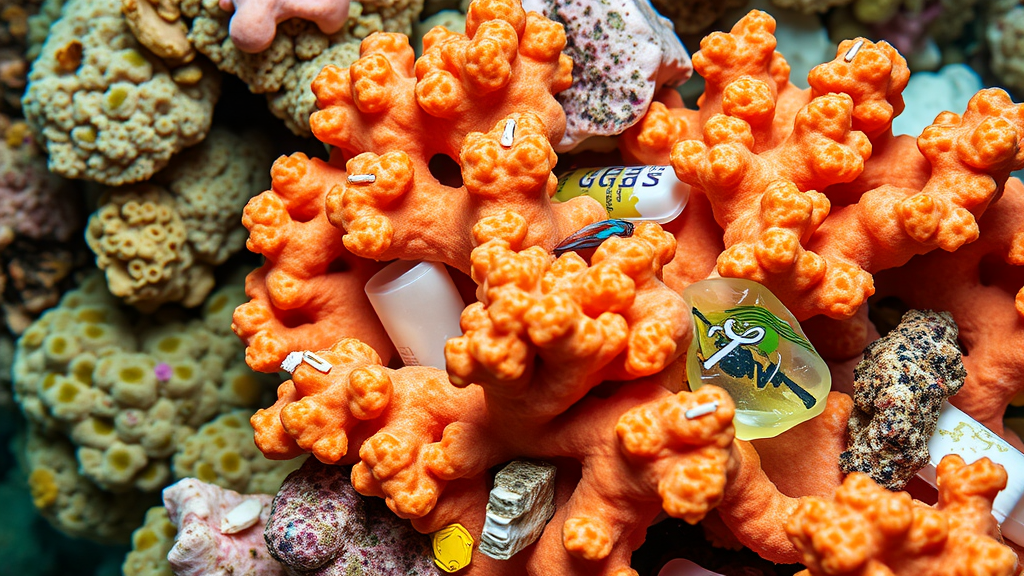
On the subtropical shores of Okinawa, Japan, a routine beach litter survey has uncovered something that no one had documented before: fragments of dead coral fused inseparably with melted plastic. Researchers from the Okinawa Institute of Science and Technology (OIST) and the University of the Ryukyus encountered small, brightly colored specks embedded within pale coral rubble during fieldwork along the island’s coastline. What initially looked like odd coloration in ordinary debris turned out, under laboratory analysis, to be a previously unrecognized form of pollution now described in the journal Marine Pollution Bulletin. The team has given these hybrid fragments a name that captures both their composition and their origin: plasticorals.
The discovery began, as many do, with careful observation rather than a targeted hunt. During standard surveys of beach litter, the researchers noticed that certain pieces of coral rubble were not entirely natural in appearance. Back at the laboratory, they subjected the suspicious fragments to spectroscopic and microscopic analyses. These techniques, which allow scientists to identify the chemical signatures and microstructure of materials, revealed that the colored specks were melted polymers derived from common household plastics. Crucially, the plastic had seeped into the skeletal pores of the dead coral pieces, binding to them in a way that makes the two materials effectively impossible to separate. The result is a single, durable object composed of both biological and synthetic material.
The researchers, with first author Dr. Ifenna Ilechukwu and senior author Professor James D. Reimer leading the study, classify plasticorals as a type of plastiglomerate. Plastiglomerates are hybrid debris formations created when plastic combines with naturally occurring materials such as rock, sand, or, in this case, coral skeleton. The concept has been discussed in the geological literature as a marker of human influence on sedimentary records, but the identification of coral-specific plasticorals on reef-adjacent beaches adds a new dimension to the phenomenon. Coral rubble is not inert material; it is a functional component of reef ecosystems, and its contamination with plastic has implications that extend well beyond the visual.
Coral rubble on beaches plays a surprisingly important role in the health of nearby reefs. Waves and storms wash rubble pieces back into the sea, where they perform several ecological functions. New corals settle on rubble and use it as a stable substrate on which to grow, making it a foundation for reef recovery and expansion. The irregular shapes of rubble fragments also create nooks and crevices that shelter juvenile fish and other small marine organisms from strong currents and from predators. In this sense, rubble acts as a nursery habitat embedded within the reef structure. If a significant fraction of that rubble is replaced or contaminated by plastic-fused equivalents, the ecological services it provides could be compromised, particularly for young organisms at the most vulnerable stages of their life cycles.
The exact origin of plasticorals remains an open question, and the authors emphasize that more research is needed to pin down how the plastic came to be melted into the coral in the first place. One likely source is beach bonfires. On many coastlines, and Okinawa is no exception, people light fires on the beach, and any plastic waste in the vicinity can melt and drip into surrounding sand and rubble. Molten plastic behaves almost like a glue, flowing into pores and cavities and then hardening as it cools. Dead coral skeleton, with its porous calcium carbonate structure, offers an ideal matrix for this process. Whether bonfires are the dominant mechanism or whether other heat sources and weathering pathways contribute is something future studies will need to establish through field observations and controlled experiments.
The potential ecological consequences are equally in need of investigation, but the broader scientific context offers reasons for concern. Previous studies have shown that chemicals leaching from common polymers can disrupt coral propagation, interfering with the reproductive and settlement processes that reefs depend on for recovery. Plastic debris in marine environments has also been found to harbor coral pathogens, effectively acting as a vector for disease. Beyond corals themselves, plastic fragments propagate up through the marine food chain, from small grazers and filter feeders to fish and eventually to organisms, including humans, higher up the trophic ladder. Plasticorals, by embedding plastic directly into a material that is actively recycled back into reef habitats, could concentrate these risks at exactly the locations where reef-building and reef-dwelling organisms are most exposed.
What makes plasticorals particularly striking is their durability. Plastic is the third-most widely manufactured material in the world, surpassed only by cement and steel. Yet while those two materials degrade over millennia, plastic persists for dramatically longer periods in recognizable form. Its resistance to breakdown means that plasticorals formed today could remain on shorelines and in reef sediments for centuries, serving as long-lasting physical reminders of human activity. The study’s authors situate this within the emerging concept of the Plasticene, the popularly named interval from the 1950s onward during which plastic production has become so pervasive that future geologists will likely be able to identify it as a distinct plastic-bearing layer in the Earth’s crust. Plasticorals, formed at the intersection of biological and synthetic materials, would be a characteristic marker of that layer in tropical and subtropical coastal environments.
The setting of the discovery adds a layer of urgency. Okinawa’s reefs are already threatened by climate change, which drives coral bleaching through marine heatwaves, as well as by other human pressures such as coastal development and runoff. Reef ecosystems support extraordinary biodiversity and provide food, coastal protection, and economic value to island communities. Finding a new and persistent form of pollution on the shores of these already stressed environments underscores how thoroughly plastic has penetrated even remote and protected coastal zones. Notably, plasticoral samples were collected on Sosu Beach, which lies inside the protected Yanbaru National Park in northern Okinawa, demonstrating that protected status does not shield coastlines from this class of contamination.
From a technical standpoint, the identification of plasticorals relied on the combined power of spectroscopy and microscopy. Spectroscopic analysis matches the vibrational or chemical signatures of an unknown material against reference libraries of known polymers, allowing researchers to determine precisely which types of plastic are present. Microscopic imaging reveals how the plastic is distributed within the coral skeleton, showing the degree of fusion and the structure of the bond between the synthetic and biogenic components. Together, these methods ruled out superficial contamination, such as plastic fragments merely resting against rubble, and confirmed genuine agglutination, meaning the plastic and coral have merged into a single composite object. This distinction matters because only truly fused material will travel, persist, and behave ecologically as a unit.
The researchers describe plasticorals as an emerging indicator of the Plasticene in Okinawa reef environments, a phrase that signals both a scientific classification and a warning. As an indicator, plasticorals can help scientists trace the reach and history of plastic pollution in coastal sedimentary records, offering a tangible proxy for the Anthropocene’s most notorious material. As a warning, they highlight a potential threat to critical marine environments: a pollution form that is long-lasting, difficult to remediate once formed, and situated within the very rubble that reefs depend on for regeneration. The team’s work opens several avenues for follow-up research, from mapping the global distribution of plasticorals on reef-fringed coasts to quantifying their effects on coral settlement, juvenile fish sheltering, and contaminant transfer through food webs. For now, the small, brightly colored specks found in the rubble of Okinawa’s beaches stand as evidence that the boundary between the natural and the synthetic in the ocean is becoming harder, and in some cases chemically impossible, to draw.
Subject of Research: Discovery of plasticorals, a plastiglomerate of coral rubble and melted plastic, on Okinawa reef shores
Article Title: New form of plastic pollution discovered on the shores of vulnerable coral reefs
Article References: New form of plastic pollution discovered on the shores of vulnerable coral reefs. (n.d.). Original publication
Image Credits: AI Generated
DOI: Not provided
Keywords: plasticorals, plastic pollution, coral reefs, plastiglomerate, Okinawa, Marine Pollution Bulletin, coral rubble, Plasticene, marine debris, reef ecosystems, Yanbaru National Park, Okinawa Institute of Science and Technology
Cite Scienmag News
Reese Ellison. (September 20, 2026). Plasticorals: Fused Plastic and Coral Rubble Reveal a New Pollution Threat to Reefs. Scienmag. https://scienmag.com/plasticorals-fused-plastic-and-coral-rubble-reveal-a-new-pollution-threat-to-reefs/
Reese Ellison. "Plasticorals: Fused Plastic and Coral Rubble Reveal a New Pollution Threat to Reefs." Scienmag, 20 September 2026, https://scienmag.com/plasticorals-fused-plastic-and-coral-rubble-reveal-a-new-pollution-threat-to-reefs/. Accessed 20 September 2026.
Reese Ellison. "Plasticorals: Fused Plastic and Coral Rubble Reveal a New Pollution Threat to Reefs." Scienmag. September 20, 2026. https://scienmag.com/plasticorals-fused-plastic-and-coral-rubble-reveal-a-new-pollution-threat-to-reefs/


