


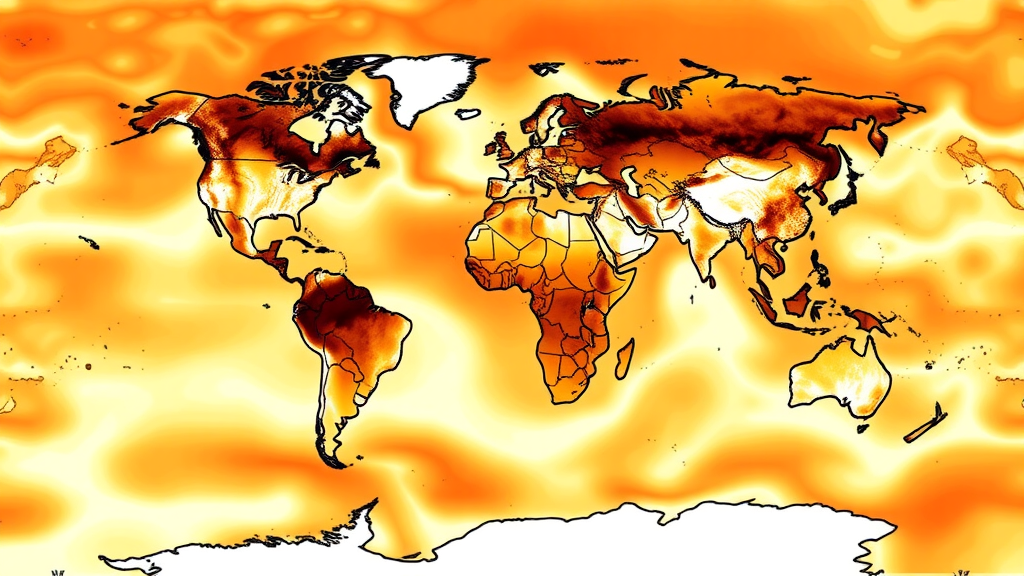
Climate change is widely expected to intensify drought around the world, and for years the scientific literature has warned that a rapidly drying planet may already be taking shape. A new study published in Communications Earth & Environment, however, adds a crucial and carefully qualified twist to that narrative: when the observational record is examined in full, global drought conditions show no statistically detectable acceleration in recent decades, even as global temperatures continue their relentless climb. The finding does not undermine the physical expectation that warming should alter the hydrological cycle. Instead, it highlights how difficult it remains to separate the emerging signal of anthropogenic climate change from the loud, chaotic noise of natural climate variability in the observational record.
Drought is one of the most consequential natural hazards on Earth, affecting agriculture, water supplies, ecosystems, energy production, and the livelihoods of billions of people. Yet defining and measuring drought is notoriously tricky. Unlike temperature, which can be recorded with a thermometer and compared across decades with relative confidence, drought is a deficit phenomenon, defined relative to what a region expects under normal climatic conditions. A drought in the humid Amazon basin looks very different from a drought in the semi-arid Sahel, and the same rainfall shortfall can carry different meanings in different places and seasons. Any attempt to track global drought trends must therefore confront a thicket of methodological choices that can strongly influence the result.
Researchers typically rely on standardized drought indices to make such comparisons possible. The Palmer Drought Severity Index, developed in the 1960s, and its self-calibrating successor combine precipitation and temperature-driven evaporative demand into a single soil-moisture proxy. The Standardized Precipitation Index, by contrast, relies only on rainfall statistics, while the Standardized Precipitation Evapotranspiration Index incorporates the increased atmospheric thirst that accompanies warming. Each index answers a slightly different question, and each carries assumptions about how evaporation, soil properties, and vegetation respond to a changing climate. The authors of the new analysis emphasize that the choice of index, the spatial resolution of the underlying data, and the length of the baseline period can all shift the apparent trajectory of global drought.
The study’s central result emerges from a rigorous treatment of these choices. Rather than adopting a single metric and a single time window, the researchers evaluated drought evolution across multiple indices, temporal resolutions, and definitions of drought events, spanning durations from short-lived meteorological dry spells to prolonged multi-season hydrological droughts. Across this ensemble of analytical configurations, the observational record does not reveal a globally coherent acceleration in drought severity, frequency, or extent during the most recent decades. Some regions have indeed experienced more intense or more frequent drought conditions, consistent with local projections, but these regional changes are offset or masked elsewhere, and the global aggregate shows no statistically significant speeding up.
This nuance matters because the climate system is not expected to respond uniformly or linearly to rising greenhouse gas concentrations. Physical reasoning suggests that warming increases evaporative demand, which should stress soils and vegetation even in the absence of rainfall changes. At the same time, the atmospheric circulation patterns that deliver precipitation are shifting in complex, regionally divergent ways. Some areas, including parts of the Mediterranean, southwestern North America, and southern Africa, have been identified in previous work as warming hotspots where drought conditions may already be intensifying. Other regions have seen increases in rainfall or no clear trend at all. The global average, in other words, can be a poor summary of a deeply uneven phenomenon.
One of the most important contributions of the new work is its explicit confrontation with the role of natural variability. Modes of climate variability such as the El Niño–Southern Oscillation, the Pacific Decadal Oscillation, and the North Atlantic Oscillation exert enormous influence on precipitation patterns from year to year and decade to decade. A strong El Niño or La Niña event can trigger drought on multiple continents simultaneously, while multi-decadal swings in ocean temperatures can produce drying or wetting trends that mimic, or temporarily overwhelm, the forced signal from greenhouse gases. When the researchers accounted for this variability in their statistical framework, the residual trend attributable to anthropogenic warming remained difficult to detect at the global scale, even though climate models consistently project such an acceleration over the coming decades.
The discrepancy between model projections and observational detection is a familiar tension in climate science, and it is not necessarily evidence that models are wrong. Model simulations of historical conditions do show intensifying drought under warming, and the mechanisms they invoke, including rising evaporative demand and shifting circulation, are physically well established. But the forced signal emerges gradually from the noise, and its detectability depends on the length and quality of the observational record, the accuracy of early-twentieth-century precipitation data, and the magnitude of natural fluctuations. Sparse monitoring networks in much of Africa, South America, and Asia mean that global drought datasets rely heavily on interpolated gauges and satellite-based estimates, both of which carry substantial uncertainties that grow larger further back in time.
The authors are careful to stress what their results do not imply. The absence of a detectable global acceleration is not evidence that climate change is not affecting drought, nor is it a license for complacency. Projections from the Coupled Model Intercomparison Project, the ensemble backbone of international climate assessments, robustly indicate that continued warming will drive substantial increases in drought risk in many regions during the second half of this century, particularly under high-emission scenarios. The new analysis suggests that humanity may still be in the early portion of the emergence window, the period during which the forced signal grows strong enough to rise above variability. If anything, the study sharpens the motivation for improved monitoring, since the coming decades are precisely when the signal should become unmistakable.
The research also carries practical implications for how drought risk is communicated and managed. Media coverage and policy debates often frame drought impacts through the lens of immediate attribution, seeking to connect individual events or short-term trends directly to climate change. This study is a reminder that the attribution of long-term trends requires statistical care, long records, and honest treatment of uncertainty. Water managers, agricultural planners, and disaster-response agencies need trend information that is both accurate and properly contextualized. Overstating an acceleration that the data do not yet support risks eroding public trust, while understating the robust physical link between warming and future drought risk risks delaying adaptation. The nuanced picture presented here, in which regional changes are real but the global acceleration remains below detection thresholds, offers a more defensible foundation for decision-making.
Ultimately, the study is less a refutation of climate-driven drought intensification than a measurement of how far the observational record has come, and how far it still has to go. As temperatures continue to rise and hydrological monitoring networks expand and improve, the forced signal should emerge more clearly, and future updates of this kind of analysis will be watched closely by climate scientists and water managers alike. For now, the global drought record tells a story of profound regional complexity, powerful natural variability, and a warming fingerprint that models say is coming, but that current observations have not yet resolved at the planetary scale. That distinction, subtle as it may seem, is exactly the kind of precision on which sound climate science, and sound climate policy, depends.
Subject of Research: Detection of global drought trend acceleration under anthropogenic climate warming using observational drought indices
Article Title: Global drought shows no detectable recent acceleration under climate warming
Article References: Xu, J., Zhang, X., McColl, K. A., Berg, A., Zhou, S., Yang, J., Dong, Z., Luo, Y., & Fan, Y. (2026). Global drought shows no detectable recent acceleration under climate warming. Communications Earth & Environment, 7(1), Article 726. https://doi.org/10.1038/s43247-026-03954-6
Image Credits: AI Generated
DOI: 10.1038/s43247-026-03954-6
Keywords: drought, climate change, global warming, drought indices, hydroclimate, climate variability, evaporative demand, precipitation trends, climate models, attribution, water resources, Communications Earth & Environment
Cite Scienmag News
Violet Maxwell. (September 20, 2026). Global Drought Trends Reveal No Detectable Recent Acceleration Under Warming. Scienmag. https://scienmag.com/global-drought-trends-reveal-no-detectable-recent-acceleration-under-warming/
Violet Maxwell. "Global Drought Trends Reveal No Detectable Recent Acceleration Under Warming." Scienmag, 20 September 2026, https://scienmag.com/global-drought-trends-reveal-no-detectable-recent-acceleration-under-warming/. Accessed 20 September 2026.
Violet Maxwell. "Global Drought Trends Reveal No Detectable Recent Acceleration Under Warming." Scienmag. September 20, 2026. https://scienmag.com/global-drought-trends-reveal-no-detectable-recent-acceleration-under-warming/


