


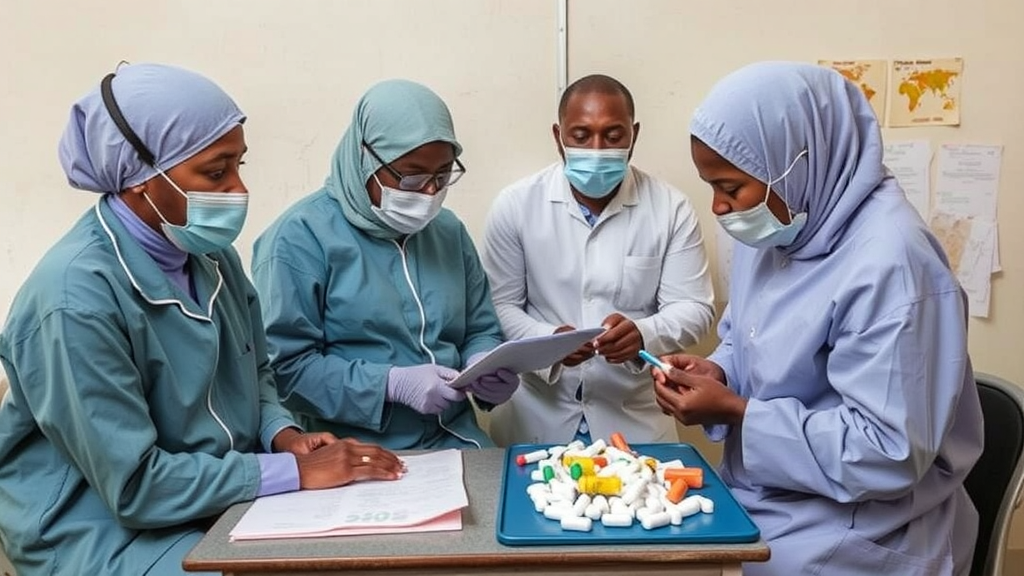
Malaria remains one of the most relentless public health challenges in sub-Saharan Africa, and the medicines used to treat it, particularly artemisinin-based combination therapies, are deployed on a staggering scale across the continent. Yet the safety monitoring that should accompany this massive drug exposure is, in many settings, almost entirely silent. A new mixed-methods study from Ogun State in Southwest Nigeria has now quantified just how deep the silence runs, finding that only 5.4 percent of healthcare workers surveyed had ever filed a report of an adverse drug reaction, despite treating malaria patients every day. The findings, published in BMC Health Services Research, offer one of the most detailed pictures to date of why spontaneous adverse drug reaction reporting fails to take root in malaria-endemic low- and middle-income countries.
The research team, led by Frederick Ifijeh of Management Sciences for Health in Abuja, together with colleagues from Asaba Specialist Hospital and the Ogun State Ministry of Health, designed the study as a sequential explanatory mixed-methods cross-sectional investigation. Between September and October 2025, the team covered all 490 functional public health facilities in Ogun State, a comprehensive sampling frame that gives the results unusual breadth for a study of this kind. The quantitative component captured 404 healthcare workers through structured questionnaires administered with KoboCollect, a mobile data collection platform built on the Open Data Kit framework. The qualitative component then followed up with 162 key informants, drawn from the same facilities, whose interviews allowed the researchers to probe the reasons behind the statistical patterns.
The headline number is stark: of the 404 healthcare workers who completed the survey, only 23, or 5.4 percent, had ever reported an adverse drug reaction in their careers. This is not merely a matter of low enthusiasm. The researchers are careful to note that because so few respondents had actually reported, the events-per-variable ratios in their regression models fell below conventional statistical thresholds, meaning the regression estimates should be read as exploratory rather than definitive. This methodological honesty matters, because it signals to readers that the true drivers of reporting behavior are best understood by triangulating the survey data with the qualitative interviews rather than relying on odds ratios alone.
Even with that caveat, the quantitative signals were consistent across both bivariate tests and multivariable logistic regression. Three factors stood out repeatedly: whether a worker had completed an adverse drug reaction reporting form before, whether suspected reactions were routinely documented in patient case notes, and whether the worker knew the channels through which reports should be submitted. In the exploratory consolidated model, routine documentation of suspected reactions, knowledge of reporting forms, time constraints, and perceived reporting burden all remained significant predictors of reporting practice. In other words, the workers most likely to report were those for whom adverse drug reaction documentation had been woven into their everyday clinical routines, and who had the practical tools and knowledge to act on a suspicion when it arose.
The qualitative interviews with 162 key informants added a sobering institutional dimension to these findings. Most informants reported receiving no pharmacovigilance training in the preceding two years, and nearly half indicated that no formal adverse drug reaction reporting system existed in their facilities at all. This is a critical distinction that the study’s authors emphasize: underreporting in Ogun State is not primarily a problem of individual motivation or ignorance among clinicians. It is a problem of infrastructure. A healthcare worker cannot file a report if the facility has no reporting forms, no designated focal person to receive them, and no established pathway to the national regulator.
Thematic analysis of the interviews, following the framework developed by Braun and Clarke, identified four principal barriers. The first is limited pharmacovigilance knowledge, meaning many workers simply do not recognize when a patient’s symptom cluster constitutes a suspected adverse reaction worth flagging. The second is weak or absent reporting systems at the facility level, which renders even well-informed workers powerless to act. The third is inadequate training and supervision, with frontline staff left without refresher courses, supportive oversight, or standard operating procedures to guide them. The fourth comprises patient-related barriers to detection, including patients who do not mention symptoms they attribute to malaria itself, who discontinue treatment without follow-up, or who seek care from informal providers outside the reporting system entirely.
The structural diagnosis has significant implications for Nigeria’s national pharmacovigilance architecture, which centers on the National Agency for Food and Drug Administration and Control, known as NAFDAC, and the National Malaria Elimination Programme. Spontaneous reporting systems depend on a chain that runs from the bedside to the regulator: a clinician must suspect a reaction, document it, complete a form, transmit it through a facility or district focal person, and eventually receive feedback confirming that the report was received and acted upon. The study suggests that in Ogun State this chain is broken at multiple links simultaneously. Without feedback from regulators, even motivated reporters receive no signal that their efforts matter, which is a well-known cause of reporting fatigue in pharmacovigilance systems worldwide.
What makes the study particularly valuable is its insistence that awareness campaigns alone will not solve the problem. The authors argue that improving adverse drug reaction reporting requires more than telling healthcare workers that reporting is important. It requires operational support: routine supervision visits, designated pharmacovigilance focal persons in every facility, consistent availability of reporting tools, and functional feedback mechanisms that close the loop between frontline reporters and the national system. Integrating adverse drug reaction documentation into routine case note workflows, so that recording a suspected reaction becomes as habitual as recording a temperature, emerges from the data as one of the most promising single interventions.
The context of malaria treatment makes these gaps especially consequential. Artemisinin-based combination therapies are administered to millions of Nigerians each year, and the emergence of drug resistance or previously unrecognized safety signals would first appear as patterns in adverse event data. If 94.6 percent of frontline providers have never filed a single report, the national surveillance system is effectively operating with a fraction of the sensitivity it needs. The authors note that underreporting driven by system-level constraints, including the lack of reporting forms, the absence of trained focal persons, weak supervision, and limited feedback from regulators, is likely to yield the greatest gains when those systems are strengthened, rather than when individual workers are exhorted to try harder.
For policymakers across malaria-endemic countries, the Ogun State findings offer a replicable template. The combination of a facility-wide quantitative survey with a large qualitative informant pool allowed the researchers to move beyond describing how rarely reporting happens and toward explaining why. The answer, in this setting, is that pharmacovigilance has been treated as an individual responsibility without being supported as an institutional function. Reversing that imbalance, through trained focal persons, reliable forms, embedded documentation routines, and visible feedback from NAFDAC and partner programs, would transform adverse drug reaction reporting from an occasional act of individual initiative into a routine, self-sustaining part of malaria case management, and would give Nigeria’s medicine safety system the early-warning capability its treatment scale demands.
Subject of Research: Determinants of adverse drug reaction reporting for antimalarial medicines among healthcare workers in Ogun State, Southwest Nigeria
Article Title: Determinants of adverse drug reaction reporting for antimalarial medicines: a mixed-methods study among healthcare workers in ogun State Southwest Nigeria
Article References: Ifijeh, F., Ejiyere, H., Babarinde, T., Adenekan, O. J., Otohabru, B., Adejo, I., Chukwuji, C., & Uko, I. (2026). Determinants of adverse drug reaction reporting for antimalarial medicines: a mixed-methods study among healthcare workers in ogun State Southwest Nigeria. BMC Health Services Research. https://doi.org/10.1186/s12913-026-15598-5
Image Credits: AI Generated
DOI: 10.1186/s12913-026-15598-5
Keywords: adverse drug reactions, pharmacovigilance, antimalarial medicines, malaria, healthcare workers, Nigeria, drug safety, health systems, mixed-methods research, reporting barriers, artemisinin-based combination therapies, NAFDAC
Cite Scienmag News
Ophelia Keating. (September 13, 2026). Why Nigerian Health Workers Rarely Report Antimalarial Drug Reactions. Scienmag. https://scienmag.com/why-nigerian-health-workers-rarely-report-antimalarial-drug-reactions/
Ophelia Keating. "Why Nigerian Health Workers Rarely Report Antimalarial Drug Reactions." Scienmag, 13 September 2026, https://scienmag.com/why-nigerian-health-workers-rarely-report-antimalarial-drug-reactions/. Accessed 13 September 2026.
Ophelia Keating. "Why Nigerian Health Workers Rarely Report Antimalarial Drug Reactions." Scienmag. September 13, 2026. https://scienmag.com/why-nigerian-health-workers-rarely-report-antimalarial-drug-reactions/


