


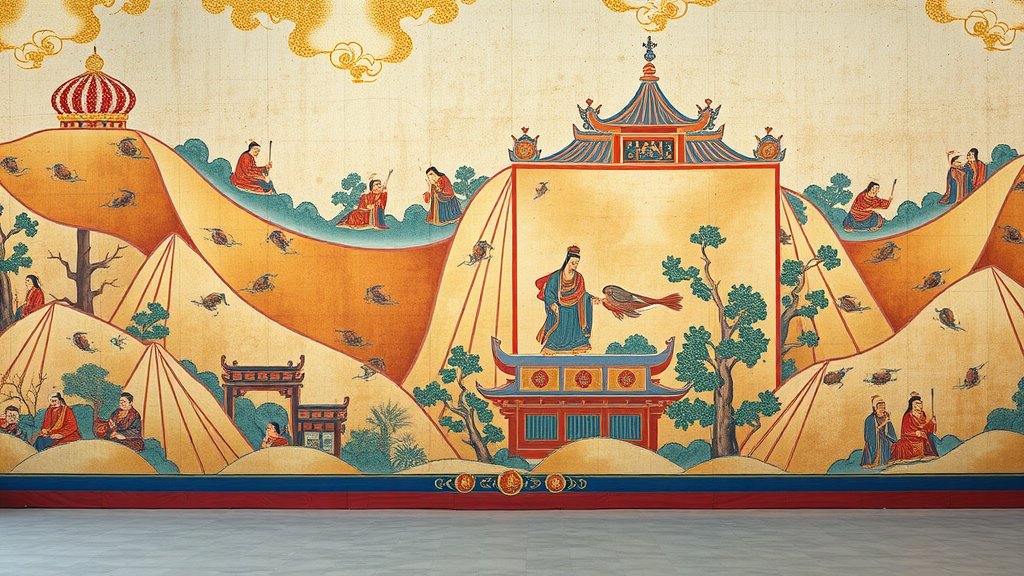
Deep in the arid expanses of northwest China, the murals of the Dunhuang caves have endured for more than a millennium, their pigments slowly surrendering to wind, sand, fluctuating humidity, and the passage of pilgrims and scholars. Now, a research team publishing in the journal Heritage has introduced a computational approach designed to breathe new life into these damaged artworks digitally. The method, described as inpainting of Dunhuang murals based on progressive reference guidance and sparse feature matching, aims to reconstruct missing or degraded regions of wall paintings in a way that respects both the artistic conventions of the original painters and the technical constraints of modern image-processing systems.
Inpainting, in the language of computer vision, refers to the task of filling in missing or corrupted portions of an image with content that is plausible and visually coherent. For photographs of landscapes or portraits, this is already a demanding problem, but for cultural heritage imagery the stakes are considerably higher. A digitally restored mural is not merely an aesthetic object; it is a document of religious iconography, historical craft techniques, and material culture. An algorithm that invents plausible-looking but historically unfounded details risks distorting the very record it is meant to protect. The researchers behind the new work therefore framed their challenge as one of constrained reconstruction: the filled regions must harmonize with surrounding brushwork, color palettes, and compositional logic drawn from the mural itself and from related, better-preserved examples.
The first pillar of the proposed framework is progressive reference guidance. Rather than asking a generative model to produce an entire missing region in a single step, the approach guides the reconstruction through a sequence of stages, each one informed by reference material that is progressively refined. In practical terms, the system begins with coarse structural cues about what the damaged area should contain, drawn from the intact portions of the same mural and from curated reference images of comparable Dunhuang artwork. As the process advances, these cues become sharper and more specific, steering the synthesis toward details that match the line quality, shading, and ornamental motifs characteristic of the cave’s artistic period. This staged strategy reflects a broader insight in image synthesis: models that attempt everything at once often produce blurry or internally inconsistent results, whereas incremental refinement allows errors to be corrected before they propagate.
The second pillar, sparse feature matching, addresses the problem of where to look for guidance. Murals are enormous, dense compositions, and naively comparing every pixel of a damaged region against every pixel of a reference image would be computationally prohibitive and semantically noisy. Sparse feature matching instead identifies a limited set of distinctive landmarks, such as the contour of a halo, the fold of a robe, or the petal of a lotus, and establishes correspondences between these features in the damaged mural and in reference images. Because the matches are sparse, the computation remains tractable, and because the features are semantically meaningful, the correspondences tend to be reliable. The matched features then act as anchors around which the inpainting algorithm weaves the remaining content, ensuring that reconstructed figures and ornaments align with the visual grammar of the original.
Combining these two ideas yields a pipeline that is unusually attentive to the specific character of Dunhuang art. The murals of the Mogao caves, painted over roughly a thousand years beginning in the fourth century, blend Chinese, Indian, Central Asian, and Persian influences into a visual language that evolved across dynasties. A restoration system that treats a Tang dynasty bodhisattva the same way it treats a Northern Wei flying apsara would inevitably flatten that diversity. By grounding the reconstruction in references and in sparse, meaningful correspondences, the new method allows the algorithm to adapt to the style of each individual mural rather than imposing a generic notion of what ancient religious art should look like. The authors present their work as a step toward restoration tools that are collaborators with conservators rather than replacements for them.
The significance of this research extends well beyond the aesthetics of a single cave complex. Dunhuang’s murals are among the most important artistic archives in the world, documenting a millennium of cultural exchange along the Silk Road. Yet they are fragile in the extreme. Pigments derived from minerals and organic binders react to the salts in the underlying plaster, flake away, and discolor. Earlier restorations, some conducted with the best intentions and the limited science of their eras, have themselves added layers of complexity for modern conservators. Digital restoration offers a way to visualize what has been lost without touching the physical walls, supporting scholarly interpretation, public engagement, and the planning of physical conservation interventions.
From a technical standpoint, the progressive nature of the guidance mechanism deserves particular attention. Many contemporary inpainting systems rely on deep generative networks trained on large datasets of natural images. These networks excel at producing textures and shapes that look plausible to the human eye, but plausibility is not the same as fidelity. A generative model might fill a damaged corner with a convincing cloud pattern when the original composition called for a geometric border. Progressive reference guidance counters this tendency by repeatedly consulting reference material at each stage of synthesis, effectively asking, at every step, whether the emerging content remains consistent with what is known about the artwork and its artistic lineage. The result is a reconstruction that is constrained by evidence rather than by statistical averages alone.
Sparse feature matching, meanwhile, speaks to a long-standing tension in computer vision between exhaustive computation and selective attention. Exhaustive methods, which compare everything against everything, are accurate in principle but slow and prone to false matches in visually repetitive imagery, and Dunhuang murals are nothing if not repetitive, filled with rows of seated figures, repeated halos, and swirling ribbons. By focusing on a sparse set of discriminative features, the method sidesteps much of this ambiguity. The anchors it identifies serve as a skeleton for the reconstruction, and the generative machinery fills in the tissue between them. This division of labor, between reliable correspondence and flexible synthesis, mirrors strategies that have proven effective in other areas of image editing and 3D reconstruction, suggesting the approach could generalize to other heritage contexts, from frescoed churches to illuminated manuscripts.
The publication arrives at a moment when digital heritage is undergoing rapid transformation. High-resolution photography, multispectral imaging, and 3D scanning have made it possible to capture cultural sites with extraordinary precision, and machine learning is increasingly the tool of choice for interpreting and restoring that data. Projects around the world are using neural networks to reconstruct damaged texts, complete broken sculptures virtually, and simulate the original appearance of faded paintings. The Dunhuang work contributes a specifically heritage-aware methodology to this movement, one that treats reference guidance and feature correspondence not as optional refinements but as core design principles. In doing so, it acknowledges a truth that conservators have long understood: restoration, even digital restoration, is an act of interpretation, and interpretation must be disciplined by evidence.
For the caves of Dunhuang themselves, the practical implications are considerable. Digitally reconstructed murals can be displayed in visitor centers, reducing the foot traffic and microclimatic disturbances that threaten the originals. They can support virtual reality experiences that transport audiences into caves they might never physically enter. They can assist scholars in testing hypotheses about iconography and composition, allowing damaged scenes to be visualized under different interpretive assumptions. And they can serve as blueprints for physical restoration, helping conservators decide where intervention is warranted and what form it should take. The research team’s combination of progressive reference guidance and sparse feature matching offers a template for how such reconstructions can be performed with rigor, transparency, and respect for the original artists whose work, a millennium on, is still finding new ways to be seen.
Subject of Research: Digital restoration of damaged Dunhuang cave murals using progressive reference-guided inpainting and sparse feature matching.
Article Title: Inpainting of Dunhuang murals based on progressive reference guidance and sparse feature matching
Article References: Liu, H., Tan, Q., Li, Q., & Wang, W. (2026). Inpainting of Dunhuang murals based on progressive reference guidance and sparse feature matching. npj Heritage Science. https://doi.org/10.1038/s40494-026-02971-0
Image Credits: AI Generated
DOI: 10.1038/s40494-026-02971-0
Keywords: Dunhuang murals, digital inpainting, cultural heritage, image restoration, sparse feature matching, progressive reference guidance, Mogao caves, computer vision, deep learning, Silk Road art, mural conservation, digital heritage
Cite Scienmag News
Courtney Benton. (September 12, 2026). AI Restores Fading Dunhuang Murals With Progressive Reference Guidance. Scienmag. https://scienmag.com/ai-restores-fading-dunhuang-murals-with-progressive-reference-guidance/
Courtney Benton. "AI Restores Fading Dunhuang Murals With Progressive Reference Guidance." Scienmag, 12 September 2026, https://scienmag.com/ai-restores-fading-dunhuang-murals-with-progressive-reference-guidance/. Accessed 12 September 2026.
Courtney Benton. "AI Restores Fading Dunhuang Murals With Progressive Reference Guidance." Scienmag. September 12, 2026. https://scienmag.com/ai-restores-fading-dunhuang-murals-with-progressive-reference-guidance/


