

Friday, July 10, 2026
Science
No Result
View All Result
  • Login
  • HOME
  • SCIENCE NEWS
  • CONTACT US
  • HOME
  • SCIENCE NEWS
  • CONTACT US
No Result
View All Result
Scienmag
No Result
View All Result
Home Science News Anthropology

Response to Comment on Harappan Ernestites Geochemical Study

July 10, 2026
in Anthropology
Reading Time: 2 mins read
0
Response to Comment on Harappan Ernestites Geochemical Study

Response to Comment on Harappan Ernestites Geochemical Study

65
SHARES
587
VIEWS
Share on FacebookShare on Twitter
ADVERTISEMENT

New Insights Into Isotopic Stability Challenge Critiques of Harappan Ernestite Provenance

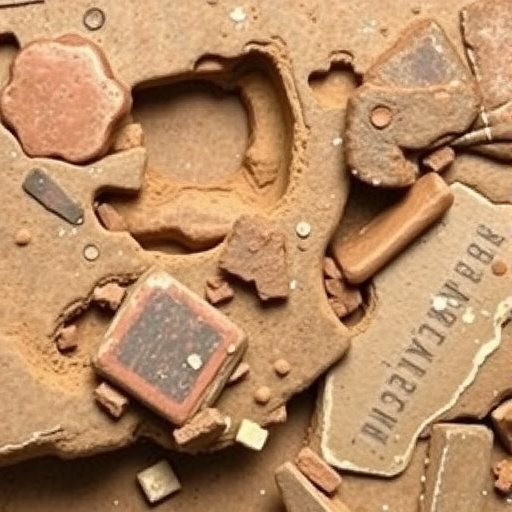
Recent advances in isotope geochemistry have sparked a robust scientific debate concerning the origin of Harappan Ernestites, ancient artifacts whose provenance offers clues to early human trade and technology. A new study vigorously defends the established isotopic mixing models used to unravel the geological sources of these enigmatic materials, responding directly to criticism that questioned the reliability of isotope data interpretation.

Central to the debate is the isotopic behavior of strontium (Sr) and neodymium (Nd), specifically the isotope ratios ^87Sr/^86Sr and ^143Nd/^144Nd. These isotopes are widely regarded as geochemically stable markers because their heavy atomic masses prevent significant isotopic fractionation under low-temperature geological processes. The recent discourse raises fundamental questions about whether these isotopic signatures can be altered during the sintering, or firing, of Ernestite raw materials—an essential step in their fabrication.

The defending authors emphasize that the likelihood of meaningful isotopic fractionation affecting Sr and Nd during sintering is minimal, given their robust chemical nature. This assertion aligns with established geochemical principles. They argue that critiques demanding experimental proof for the impossibility of fractionation reveal a misunderstanding of isotope geochemistry fundamentals. Such fractionation is generally negligible at both low and high temperatures, affirming the validity of isotopic data in provenance studies.

Another focal point of contention involves the construction of isotopic mixing models meant to identify the source rock compositions of Ernestites. Critics suggested these models lack independent constraints on “end-member” compositions — the geological sources mixed in varying proportions to generate observed isotopic ratios. However, the authors clarify that their approach includes extensive referencing of prior work and independent measurements conducted directly on the source rock samples, ensuring the robustness and accuracy of their mixing models.

This exchange underscores the importance of meticulous experimental design and comprehensive literature integration in isotope geochemistry research. The isotopic fingerprints of Sr and Nd remain among the most reliable tools to trace the origin of archaeological materials, providing crucial evidence about ancient trade networks and cultural exchange.

The discussion also highlights the broader scientific principle that rigorous scrutiny and challenge are vital for advancing knowledge. Nevertheless, critiques must be grounded in an accurate understanding of geochemical processes to avoid misinterpretation or unnecessary skepticism.

Ultimately, the study reaffirmed that the isotopic composition of Harappan Ernestites is consistent with their proposed geological sources. This finding supports existing narratives about the trade routes and fabrication techniques employed by the Indus Valley civilization, adding a further layer of scientific validation to our understanding of this Bronze Age culture.

As isotope geochemistry continues to evolve, such detailed isotopic analyses offer unparalleled insights into the past, bridging the gap between natural sciences and archaeology. This debate serves as a reminder of the critical importance of interdisciplinary expertise when interpreting complex scientific data.


Subject of Research: Isotopic analysis of Harappan Ernestites for provenance and fabrication insights

Article Title: Reply to comment on “Origin of the Harappan Ernestites: geochemical insights into provenance and fabrication”

Article References:
Mahala, M.K., Sree Bhuvan, G.N.S., George, B.G. et al. Reply to comment on “Origin of the Harappan Ernestites: geochemical insights into provenance and fabrication”. npj Herit. Sci. 14, 344 (2026). https://doi.org/10.1038/s40494-026-02734-x

Image Credits: AI Generated

DOI: https://doi.org/10.1038/s40494-026-02734-x

Tags: ancient artifact sourcingarchaeological geochemistrydebate on isotope data reliabilityearly human trade routesgeochemical analysis of raw materialsgeochemical mixing modelsHarappan Ernestite provenanceisotope geochemistryisotopic fractionation during sinteringisotopic stability in archaeological materialsneodymium isotope ratiosstrontium isotope ratios
Share26Tweet16
Previous Post

Soil Type Influences Impact of Carbon and Nitrogen on Nitrous Oxide Emissions

Next Post

BioVenture eLab Wins $1.5M Grant to Expand Weill Cornell Startup Hub

Related Posts

Visual Emotions in Heritage Shape Public Behavior
Anthropology

Visual Emotions in Heritage Shape Public Behavior

February 14, 2026
Resistance Songs Amplify Chinese Voices in Anti-Fascist War
Anthropology

Resistance Songs Amplify Chinese Voices in Anti-Fascist War

January 30, 2026
Xi Jinping Thought: Theory Evolution and Modern Cultural Impact
Anthropology

Xi Jinping Thought: Theory Evolution and Modern Cultural Impact

January 22, 2026
Restoring Braj’s Heritage Through Water Infrastructure
Anthropology

Restoring Braj’s Heritage Through Water Infrastructure

December 29, 2025
Origins and Evolution of Chinese “Great Unity” Ideology
Anthropology

Origins and Evolution of Chinese “Great Unity” Ideology

December 10, 2025
Ancient Chinese Ethnic Texts: Theoretical Insights Explored
Anthropology

Ancient Chinese Ethnic Texts: Theoretical Insights Explored

December 8, 2025
Next Post
BioVenture eLab Wins $1.5M Grant to Expand Weill Cornell Startup Hub

BioVenture eLab Wins $1.5M Grant to Expand Weill Cornell Startup Hub

  • Mothers who receive childcare support from maternal grandparents show more

    Mothers who receive childcare support from maternal grandparents show more parental warmth, finds NTU Singapore study

    27656 shares
    Share 11059 Tweet 6912
  • University of Seville Breaks 120-Year-Old Mystery, Revises a Key Einstein Concept

    1061 shares
    Share 424 Tweet 265
  • Bee body mass, pathogens and local climate influence heat tolerance

    682 shares
    Share 273 Tweet 171
  • Researchers record first-ever images and data of a shark experiencing a boat strike

    546 shares
    Share 218 Tweet 137
  • Groundbreaking Clinical Trial Reveals Lubiprostone Enhances Kidney Function

    531 shares
    Share 212 Tweet 133
Science

Embark on a thrilling journey of discovery with Scienmag.com—your ultimate source for cutting-edge breakthroughs. Immerse yourself in a world where curiosity knows no limits and tomorrow’s possibilities become today’s reality!

RECENT NEWS

  • AGA Introduces Nigel, AI Assistant for Gastroenterology and Hepatology
  • BioVenture eLab Wins $1.5M Grant to Expand Weill Cornell Startup Hub
  • Response to Comment on Harappan Ernestites Geochemical Study
  • Soil Type Influences Impact of Carbon and Nitrogen on Nitrous Oxide Emissions

Categories

  • Agriculture
  • Anthropology
  • Archaeology
  • Athmospheric
  • Biology
  • Biotechnology
  • Blog
  • Bussines
  • Cancer
  • Chemistry
  • Climate
  • Earth Science
  • Editorial Policy
  • Marine
  • Mathematics
  • Medicine
  • Pediatry
  • Policy
  • Psychology & Psychiatry
  • Science Education
  • Social Science
  • Space
  • Technology and Engineering

Subscribe to Blog via Email

Enter your email address to subscribe to this blog and receive notifications of new posts by email.

Join 5,146 other subscribers

© 2025 Scienmag - Science Magazine

Welcome Back!

Login to your account below

Forgotten Password?

Retrieve your password

Please enter your username or email address to reset your password.

Log In
No Result
View All Result
  • HOME
  • SCIENCE NEWS
  • CONTACT US

© 2025 Scienmag - Science Magazine

Discover more from Science

Subscribe now to keep reading and get access to the full archive.

Continue reading
