


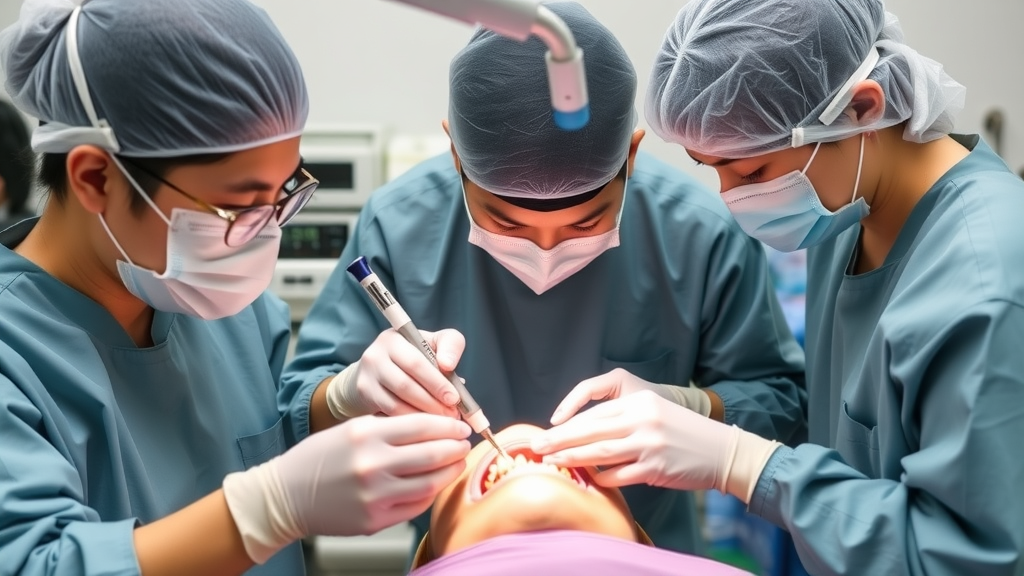
A sweeping national survey of Chinese dental schools has provided the most detailed picture yet of how future dentists in the world’s most populous country are trained in dentoalveolar surgery, the branch of oral surgery that covers everyday procedures such as tooth extraction, local anesthesia and the removal of impacted wisdom teeth. The study, published in BMC Medical Education, reveals a teaching framework that is well established in its fundamentals but strikingly uneven in its depth, with wide variation in teaching hours, simulation training and practical assessment across institutions.
Researchers led by Yu Zhang and Wei Cui of the Fourth Military Medical University in Xi’an, working with colleagues at Xi’an Medical University, distributed a cross-sectional questionnaire to all 109 public institutions approved by China’s Ministry of Education to offer undergraduate dentistry programs between 2021 and 2023. The questionnaire was adapted from validated frameworks used in the United Kingdom, reviewed by five subject-matter experts and pilot-tested before deployment. Forty-nine institutions returned valid responses, a participation rate of 45 percent, but the sample carried considerable weight: it included all 28 institutions holding an official discipline ranking of C-minus or above in the most recent national evaluation, and it spanned all seven major geographic regions of China.
The structural findings show a remarkable degree of consensus on how the subject is delivered. Nearly all responding institutions, 47 of 49 or 95.92 percent, teach dentoalveolar surgery not as a standalone course but embedded within a broader oral and maxillofacial surgery curriculum. Three-quarters of schools, 75.51 percent, schedule the material in the fourth academic year, positioning it after students have completed foundational biomedical coursework and general dental training but before graduation and clinical licensure.
Beneath that structural agreement, however, lies substantial variability in time commitment. For both theoretical and practical instruction, the most commonly reported duration was 10 to 20 hours, yet the actual range was dramatic: theory teaching ranged from as little as 4 hours to as many as 36 hours, while practical teaching spanned from 4 hours to more than 36 hours. That means a student at one Chinese dental school might receive nine times the hands-on surgical instruction of a peer at another institution, a disparity with potential implications for entry-level competence in procedures that carry real risks of nerve injury, fracture and infection.
The content itself follows an internationally recognizable core. Institutions consistently reported covering tooth extraction, local anesthesia, the extraction of impacted mandibular third molars, and the management of post-extraction healing and complications. These are the bread-and-butter procedures of general dental practice, and their prominence reflects the reality that most graduates will perform them daily rather than pursue surgical specialization.
Where the survey offers its most actionable insights is in the details of practical training pathways. Thirty institutions, 61.22 percent, described a progressive training sequence that moves students from instrument familiarization, through phantom-head simulation on artificial jaw models, to supervised peer-to-peer practice of local anesthesia injections. This staged approach mirrors competency-based models advocated in dental education literature, allowing students to build psychomotor skills incrementally before touching a patient. Yet simulation for more complex procedures lagged considerably: only 53.06 percent of schools provided simulation training for the surgical removal of impacted mandibular third molars, 42.86 percent for root or fractured-root removal, and just 36.73 percent for the extraction of other impacted teeth. These are precisely the procedures where inexperienced operators face the steepest learning curves and the highest complication rates.
Digital teaching tools present a similar picture of uneven adoption. Videos were nearly universal, used by 95.92 percent of institutions, and animations were employed by 79.59 percent, reflecting how inexpensive and easily deployed these passive formats have become. Interactive virtual programs, by contrast, were reported by only 24.49 percent of schools. The distinction matters educationally: passive media support observation and conceptual understanding, while interactive simulation platforms provide deliberate practice with feedback, the mechanism most strongly associated with skill acquisition in the surgical education literature.
Pedagogical innovation shows a clear hierarchy as well. Problem-based learning was the most widely adopted active-learning method, reported by 71.43 percent of institutions, followed by case-based learning at 42.86 percent and flipped-classroom teaching at 34.69 percent. These approaches ask students to reason through clinical scenarios before or instead of receiving didactic lectures, and their growing footprint suggests Chinese dental educators are engaging with international trends in health-professions education, even if penetration remains incomplete.
Assessment practices reveal perhaps the most significant gap between theory and practice in Chinese dentoalveolar surgery education. Summative theoretical examinations were nearly universal at 95.92 percent, confirming that knowledge acquisition is rigorously tested. But practical skills assessment was implemented at only 59.18 percent of institutions, and phantom-head assessment, in which students demonstrate operative technique on simulation models, at just 48.98 percent. In other words, at roughly half of Chinese dental schools, a student could complete the surgical component of their degree without ever being formally examined on their ability to perform the procedures they studied.
The authors conclude that undergraduate dentoalveolar surgery education in China has an established framework centered on tooth extraction and local anesthesia, with broad use of practical and digital teaching methods, but that marked variation persists in teaching hours, complex-procedure simulation, interactive digital tools and practical assessment. They suggest that future curriculum development may consider competency-guided learning objectives, strengthened simulation and case-based training, and more comprehensive assessment strategies, while cautioning that the educational effectiveness of such reforms requires empirical evaluation. For a country graduating thousands of dentists annually into a health system where tooth extraction remains one of the most commonly performed surgical procedures, the findings offer a data-driven baseline for national conversations about standardization, and a reminder that what happens in the simulation laboratory may matter as much as what happens in the lecture hall.
Subject of Research: Curriculum structure, simulation training and assessment in undergraduate dentoalveolar surgery education across Chinese dental schools
Article Title: Dentoalveolar surgery education in Chinese undergraduate dental schools: a national survey of curriculum structure, simulation training and assessment
Article References: Zhang, Y., Cui, W., Hu, K., Mo, J., He, F., Wang, Y., Wang, J., Zhang, W., Zhang, Z., Wang, Y., & Xue, Y. (2026). Dentoalveolar surgery education in Chinese undergraduate dental schools: a national survey of curriculum structure, simulation training and assessment. BMC Medical Education. https://doi.org/10.1186/s12909-026-10374-9
Image Credits: AI Generated
DOI: 10.1186/s12909-026-10374-9
Keywords: dentoalveolar surgery, dental education, undergraduate curriculum, simulation training, tooth extraction, local anesthesia, China, BMC Medical Education, problem-based learning, phantom head, assessment, oral and maxillofacial surgery
Cite Scienmag News
Ophelia Keating. (September 12, 2026). National Survey Reveals How Chinese Dental Schools Teach Tooth Extraction and Oral Surgery. Scienmag. https://scienmag.com/national-survey-reveals-how-chinese-dental-schools-teach-tooth-extraction-and-oral-surgery/
Ophelia Keating. "National Survey Reveals How Chinese Dental Schools Teach Tooth Extraction and Oral Surgery." Scienmag, 12 September 2026, https://scienmag.com/national-survey-reveals-how-chinese-dental-schools-teach-tooth-extraction-and-oral-surgery/. Accessed 12 September 2026.
Ophelia Keating. "National Survey Reveals How Chinese Dental Schools Teach Tooth Extraction and Oral Surgery." Scienmag. September 12, 2026. https://scienmag.com/national-survey-reveals-how-chinese-dental-schools-teach-tooth-extraction-and-oral-surgery/


