


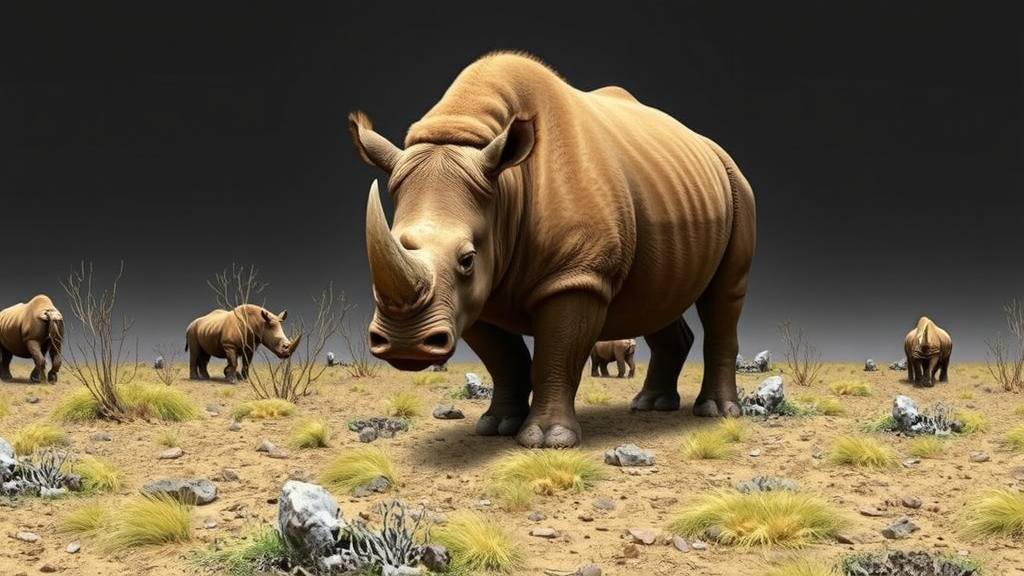
The woolly rhinoceros has long stood as one of the defining icons of the Ice Age, its shaggy coat and sweeping horns immortalized in cave paintings and frozen in the permafrost of Siberia. Yet a sweeping new analysis of ancient DNA and Pleistocene habitats suggests that the species may owe far more of its evolutionary success to the milder, more temperate regions of Eurasia than to the frozen landscapes with which it is most closely associated. The research, published in Science, argues that the greatest reservoirs of woolly rhinoceros genetic diversity arose in mid-latitude East Asia, a finding that challenges long-held assumptions about where this megafaunal giant truly thrived and evolved.
The study also carries a broader methodological message for the field of ancient DNA research. Because cold, permafrost-rich environments preserve genetic material far better than warmer regions, ancient genomic studies have historically concentrated on northern Eurasia, leaving vast stretches of the species’ southern range largely unexplored. The new findings underscore how much evolutionary history may be hidden in these overlooked southern landscapes, where diversity may have originated and persisted even as northern populations waxed and waned with the ice ages.
The woolly rhinoceros inhabited Eurasia for more than 100,000 years before its extinction near the beginning of the Holocene, persisting through the repeated glacial and interglacial cycles that defined the Pleistocene epoch. Despite this remarkable longevity across dramatic environmental swings, scientists have understood surprisingly little about how these climate fluctuations shaped the animal’s evolution, its population structure, and its eventual decline. Reconstructing that history has been hampered by a fundamental gap in the available data: nearly all previously sequenced woolly rhinoceros genomes came exclusively from Late Pleistocene Northeastern Siberia, a narrow sample that left major blind spots across the rest of the species’ vast range, particularly in mid-latitude Eurasia.
To close those gaps, a team led by Xiao-Le Lei screened 183 woolly rhinoceros fossils collected from across Eurasia. From this material, the researchers successfully recovered 29 mitochondrial genomes and 14 nuclear genomes, drawn from specimens spanning East Asia, the Altai region, and Europe. These newly generated data were then combined with previously published genomes from woolly rhinoceroses and related species, creating by far the most geographically and temporally comprehensive genetic dataset ever assembled for the species.
Dating the material required several complementary methods, which together placed the fossils across multiple stages of the Ice Age, extending back more than 200,000 years. This deep temporal reach allowed the team to track genetic lineages across successive glacial and interglacial periods, rather than viewing the species only through the narrow window of the Late Pleistocene, the final chapter of its existence. The result is a far richer picture of how woolly rhinoceros populations moved, mixed, and diverged over hundreds of millennia.
The researchers did not stop at genetics. They also modeled suitable woolly rhinoceros habitat across the past 500,000 years, drawing on the fossil record and climate data covering Pleistocene temperature, rainfall, and food availability. By overlaying this habitat reconstruction onto the genetic data, the team could evaluate how long-term environmental shifts influenced changes in the rhinoceros’s population history and genetic structure, connecting the movement of ice sheets and steppe ecosystems directly to the fates of individual breeding populations.
Taken together, the analyses reveal a species with a complex genetic history profoundly shaped by climate and shifting habitats. Mitochondrial evidence shows that the major maternal lineages of the woolly rhinoceros emerged roughly 460,000 years ago, and that a clear genetic divide separated populations in East and West Eurasia. Crucially, the greatest genetic diversity was concentrated in mid-latitude regions rather than in Siberia, inverting the picture suggested by the earlier, geographically skewed genomic record.
The nuclear genomic data sharpen this conclusion further. They indicate that the species’ greatest genetic diversity arose in mid-latitude East Asia, not in the high-latitude Siberian refuges often imagined as the species’ heartland. Meanwhile, the Altai region appears to have served as a long-term refugium and a dispersal hub during interglacial periods, a staging ground from which populations expanded and through which lineages exchanged genes as climates warmed and cooled. In this view, temperate Eurasia was not merely a peripheral habitat for the woolly rhinoceros but a cradle in which much of its diversity was born and maintained.
The study also uncovered an unexpected twist in the species’ family tree: clear evidence of gene flow between the woolly rhinoceros and Merck’s rhinoceros, a more temperate-adapted relative. The genetic signal indicates that the two species interbred during the Late Pleistocene, adding the woolly rhinoceros to a growing list of Ice Age megafauna whose boundaries were more permeable than their skeletons suggest. For conservation-minded scientists studying today’s rhinoceroses, the findings offer a reminder that even seemingly well-understood Ice Age icons still hold surprises, and that the southern edges of ancient ranges may preserve the deepest secrets of how species survive planetary change.
Subject of Research: Ancient genomic and habitat modeling analysis of woolly rhinoceros population history across Pleistocene Eurasia
Article Title: Temperate Eurasia was a cradle of woolly rhinoceros genetic diversity
Article References: Temperate Eurasia was a cradle of woolly rhinoceros genetic diversity. (n.d.). Original publication
Image Credits: AI Generated
DOI: Not provided
Keywords: woolly rhinoceros, ancient DNA, Pleistocene, paleogenomics, Eurasia, Siberia, Altai, genetic diversity, climate cycles, Merck's rhinoceros, habitat modeling, extinction
Cite Scienmag News
Gavin Prescott. (September 12, 2026). Woolly Rhinoceros Origins Traced to Temperate Eurasia, Not Siberia. Scienmag. https://scienmag.com/woolly-rhinoceros-origins-traced-to-temperate-eurasia-not-siberia/
Gavin Prescott. "Woolly Rhinoceros Origins Traced to Temperate Eurasia, Not Siberia." Scienmag, 12 September 2026, https://scienmag.com/woolly-rhinoceros-origins-traced-to-temperate-eurasia-not-siberia/. Accessed 12 September 2026.
Gavin Prescott. "Woolly Rhinoceros Origins Traced to Temperate Eurasia, Not Siberia." Scienmag. September 12, 2026. https://scienmag.com/woolly-rhinoceros-origins-traced-to-temperate-eurasia-not-siberia/


