


SAN ANTONIO — September 4, 2024 — Southwest Research Institute has signed a memorandum of understanding (MOU) with Blade Energy Partners, establishing a new research collaboration focused on advancing carbon dioxide storage technology to reduce greenhouse gas emissions.
Carbon capture, utilization, and storage (CCUS) refers to the practices of capturing CO2 from its industrial sources or the atmosphere, transport it using pipelines and other means, using it as alternative fuel or other industrial applications, and storing it for later use. The drive to meet net-zero greenhouse gas emissions goals and make industrial processes more sustainable has fueled considerable growth in the CCUS market in recent years.
Under the terms of the MOU, SwRI and Blade Energy Partners will address many of the larger-scale problems the energy industry is facing as the CCUS market expands, with a strong focus on sequestration.
“We are not just addressing a single problem, but a combination of challenges to make carbon capture, utilization, and sequestration more accessible to the energy industry at large,” said SwRI’s Dr. Florent Bocher, who leads the project.
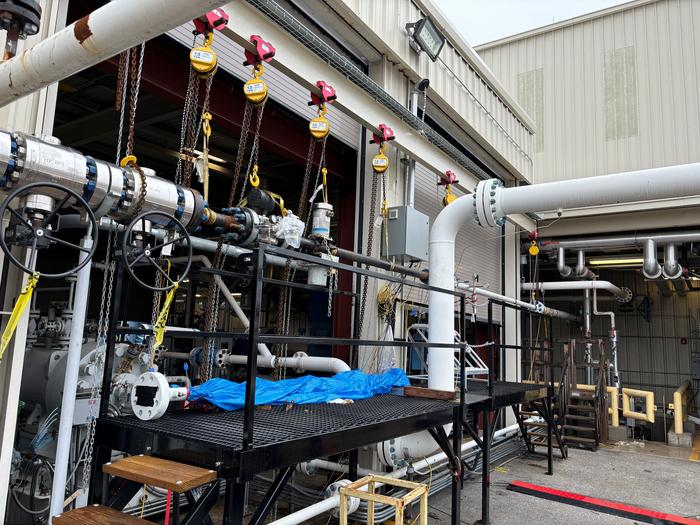
The organizations will explore the challenges industry professionals may face when storing CO2 in its supercritical state. Supercritical CO2 (sCO2) behaves like a gas, while having densities similar to a liquid. Its higher density can increase storage capacity by a factor of 10. When used as a thermal medium in power cycles, it can increase efficiency by as much as 10% due to its favorable thermodynamic properties. It is also nontoxic and nonflammable. The Institute is a leader in sCO2 research, especially in the field of rotating machinery, which includes the development of the $169 million, 10-megawatt Supercritical Transformational Electric Power (STEP) Demo pilot plant at the SwRI campus in San Antonio.
“In an effort to accelerate and reduce the cost of large-scale implementation of CCUS, the industry is exploring using existing unused wells to store sCO2,” Bocher said. “But before we proceed, questions need to be answered to ensure the CO2 will not leak and that the integrity of the wells will be maintained. For example, we must know how CO2 will interact with the reservoir rock.”
The MOU will combine experimental and modeling expertise to support research to overcome challenges in the way to safely store CO2 such as degradation of building materials (cements, metallics, or non-metallics), reliability of rotating machinery such as compressors, properties of CO2 contaminated with impurities from upstream processes, interaction and contamination of the CO2 with the surrounding geological environment, and geomechanical analysis.
“We are supporting CCUS solutions that can be implemented very quickly, reduce CO2 emissions in the atmosphere, and provide a transitional option as low-to-no CO2 emissions technologies are being developed,” Bocher said. “Sources of CO2 emissions cannot disappear instantly, but this should not stop us from bridging the gap with realistic solutions for a more sustainable future.”
For more information, contact Florent Bocher.

Credit: Southwest Research Institute
SAN ANTONIO — September 4, 2024 — Southwest Research Institute has signed a memorandum of understanding (MOU) with Blade Energy Partners, establishing a new research collaboration focused on advancing carbon dioxide storage technology to reduce greenhouse gas emissions.
Carbon capture, utilization, and storage (CCUS) refers to the practices of capturing CO2 from its industrial sources or the atmosphere, transport it using pipelines and other means, using it as alternative fuel or other industrial applications, and storing it for later use. The drive to meet net-zero greenhouse gas emissions goals and make industrial processes more sustainable has fueled considerable growth in the CCUS market in recent years.
Under the terms of the MOU, SwRI and Blade Energy Partners will address many of the larger-scale problems the energy industry is facing as the CCUS market expands, with a strong focus on sequestration.
“We are not just addressing a single problem, but a combination of challenges to make carbon capture, utilization, and sequestration more accessible to the energy industry at large,” said SwRI’s Dr. Florent Bocher, who leads the project.
The organizations will explore the challenges industry professionals may face when storing CO2 in its supercritical state. Supercritical CO2 (sCO2) behaves like a gas, while having densities similar to a liquid. Its higher density can increase storage capacity by a factor of 10. When used as a thermal medium in power cycles, it can increase efficiency by as much as 10% due to its favorable thermodynamic properties. It is also nontoxic and nonflammable. The Institute is a leader in sCO2 research, especially in the field of rotating machinery, which includes the development of the $169 million, 10-megawatt Supercritical Transformational Electric Power (STEP) Demo pilot plant at the SwRI campus in San Antonio.
“In an effort to accelerate and reduce the cost of large-scale implementation of CCUS, the industry is exploring using existing unused wells to store sCO2,” Bocher said. “But before we proceed, questions need to be answered to ensure the CO2 will not leak and that the integrity of the wells will be maintained. For example, we must know how CO2 will interact with the reservoir rock.”
The MOU will combine experimental and modeling expertise to support research to overcome challenges in the way to safely store CO2 such as degradation of building materials (cements, metallics, or non-metallics), reliability of rotating machinery such as compressors, properties of CO2 contaminated with impurities from upstream processes, interaction and contamination of the CO2 with the surrounding geological environment, and geomechanical analysis.
“We are supporting CCUS solutions that can be implemented very quickly, reduce CO2 emissions in the atmosphere, and provide a transitional option as low-to-no CO2 emissions technologies are being developed,” Bocher said. “Sources of CO2 emissions cannot disappear instantly, but this should not stop us from bridging the gap with realistic solutions for a more sustainable future.”
For more information, contact Florent Bocher.
Cite Scienmag News
Courtney Benton. (September 4, 2024). SwRI signs MOU with Blade Energy Partners to support carbon dioxide sequestration research. Scienmag. https://scienmag.com/swri-signs-mou-with-blade-energy-partners-to-support-carbon-dioxide-sequestration-research/
Courtney Benton. "SwRI signs MOU with Blade Energy Partners to support carbon dioxide sequestration research." Scienmag, 4 September 2024, https://scienmag.com/swri-signs-mou-with-blade-energy-partners-to-support-carbon-dioxide-sequestration-research/. Accessed 3 September 2026.
Courtney Benton. "SwRI signs MOU with Blade Energy Partners to support carbon dioxide sequestration research." Scienmag. September 4, 2024. https://scienmag.com/swri-signs-mou-with-blade-energy-partners-to-support-carbon-dioxide-sequestration-research/

