


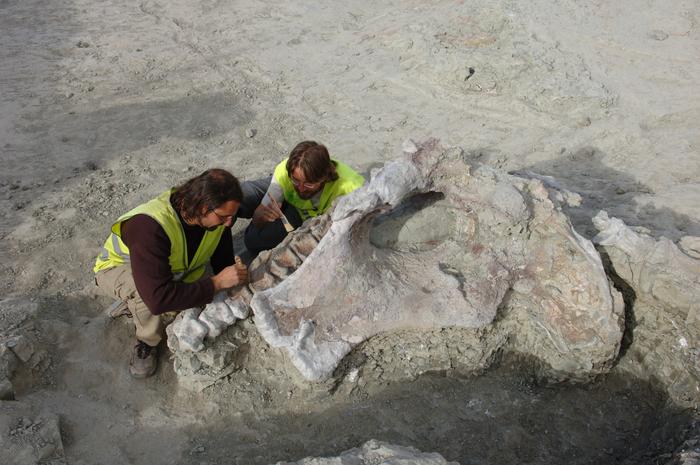
A new study led by Portuguese paleontologist Pedro Mocho, from the Instituto Dom Luiz of the Faculty of Sciences of the University of Lisbon (CIÊNCIAS), has just been published in the Communications Biology journal, which announces a new species of sauropod dinosaur that lived in Cuenca, Spain, 75 million years ago: Qunkasaura pintiquiniestra.

Credit: GBE-UNED
A new study led by Portuguese paleontologist Pedro Mocho, from the Instituto Dom Luiz of the Faculty of Sciences of the University of Lisbon (CIÊNCIAS), has just been published in the Communications Biology journal, which announces a new species of sauropod dinosaur that lived in Cuenca, Spain, 75 million years ago: Qunkasaura pintiquiniestra.
The more than 12,000 fossils collected from 2007 onwards during works to install the Madrid-Levante high-speed train (AVE) tracks revealed this deposit, giving rise to one of the most relevant collections of fossil vertebrates from the Upper Cretaceous of Europe. The collection has been studied continuously thanks to national projects and the Junta de Comunidades de Castilla-La Mancha, which has made it possible to significantly increase the understanding of the ecosystems of southwestern Europe during the Late Cretaceous and also identify several new species for science.
“The study of this specimen allowed us to identify for the first time the presence of two distinct lineages of saltasauroids in the same fossil locality. One of these groups, called Lirainosaurinae, is relatively known in the Iberian region and is characterized by small and medium-sized species, which evolved in an island ecosystem. In other words, Europe was a huge archipelago made up of several islands during the Late Cretaceous. However, Qunkasaura belongs to another group of sauropods, represented in the Iberian Peninsula by medium-large species 73 million years ago. This suggests to us that this lineage arrived in the Iberian Peninsula much later than other groups of dinosaurs”, explains Pedro Mocho, paleontologist at CIÊNCIAS.
One of the most relevant features of the Lo Hueco fossil record is the abundance of large partial skeletons of sauropod dinosaurs, which are rare in the rest of Europe. Qunkasaura pintiquiniestra stands out for being one of the most complete sauropod skeletons found in Europe, including cervical, dorsal and caudal vertebrae, part of the pelvic girdle and elements of the limbs. Their unique morphology, especially in the tail vertebrae, offers new insights into the non-avian dinosaurs of the Iberian Peninsula, a historically poorly understood group.
The study, now published in the Communications Biology journal, identifies Qunkasaura as a representative of the opisthocoelicaudine saltasaurids, a group present in the northern hemisphere (Laurasia). On the other hand, most Late Cretaceous sauropods from southwestern Europe, including Lohuecotitan pandafilandi, previously described from Lo Hueco, belong to the group Lirainosaurinae, a group of sauropods apparently exclusive to the European continent. This study suggests that Lo Hueco is the only place where the coexistence of both groups is known and proposes a new group of titanosaurs called Lohuecosauria, which includes representatives of both lineages. Lohuecosaurs may have originated on the southern continents (Gondwana) before dispersing globally.
The name Qunkasaura pintiquiniestra is made up of several geographic and cultural references close to the Lo Hueco site. “Qunka” refers to the oldest etymology of the toponym from the Cuenca and Fuentes area, “Saura” alludes to the feminine of the Latin saurus (lizard), but also pays homage to the painter Antonio Saura, and “pintiquiniestra” refers to the giant “Queen Pintiquiniestra”, character from a novel mentioned in ‘Don Quijote de la Mancha’ by Cervantes.
“Fortunately, the Lo Hueco deposit also preserves several skeletons of sauropod dinosaurs to be determined, which may correspond to new species and which will help us understand how these animals evolved”, concludes Pedro Mocho.
The study is part of the research conducted by the Evolutionary Biology Group at UNED on ecosystems with dinosaurs in central Iberian Peninsula. Part of the skeleton of Qunkasaura is already on display in the Paleontological Museum of Castilla-La Mancha in Cuenca (Spain).
Reference:
Mocho, P.; Escaso, F.; Marcos-Fernández, F.; Páramo, A.; Sanz, J. L.; Vidal, D.; Ortega, F. 2024. A Spanish saltasauroid titanosaur reveals Europe as a melting pot of endemic and immigrant sauropods in the Late Cretaceous. Communications Biology. DOI:
Journal
Communications Biology
Article Title
A Spanish saltasauroid titanosaur reveals Europe as a melting pot of endemic and immigrant sauropods in the Late Cretaceous
Article Publication Date
4-Sep-2024
Cite Scienmag News
Drew Townsend. (September 4, 2024). Qunkasaura: New sauropod dinosaur from the Cretaceous discovered in the Iberian Peninsula. Scienmag. https://scienmag.com/qunkasaura-new-sauropod-dinosaur-from-the-cretaceous-discovered-in-the-iberian-peninsula/
Drew Townsend. "Qunkasaura: New sauropod dinosaur from the Cretaceous discovered in the Iberian Peninsula." Scienmag, 4 September 2024, https://scienmag.com/qunkasaura-new-sauropod-dinosaur-from-the-cretaceous-discovered-in-the-iberian-peninsula/. Accessed 3 September 2026.
Drew Townsend. "Qunkasaura: New sauropod dinosaur from the Cretaceous discovered in the Iberian Peninsula." Scienmag. September 4, 2024. https://scienmag.com/qunkasaura-new-sauropod-dinosaur-from-the-cretaceous-discovered-in-the-iberian-peninsula/

