


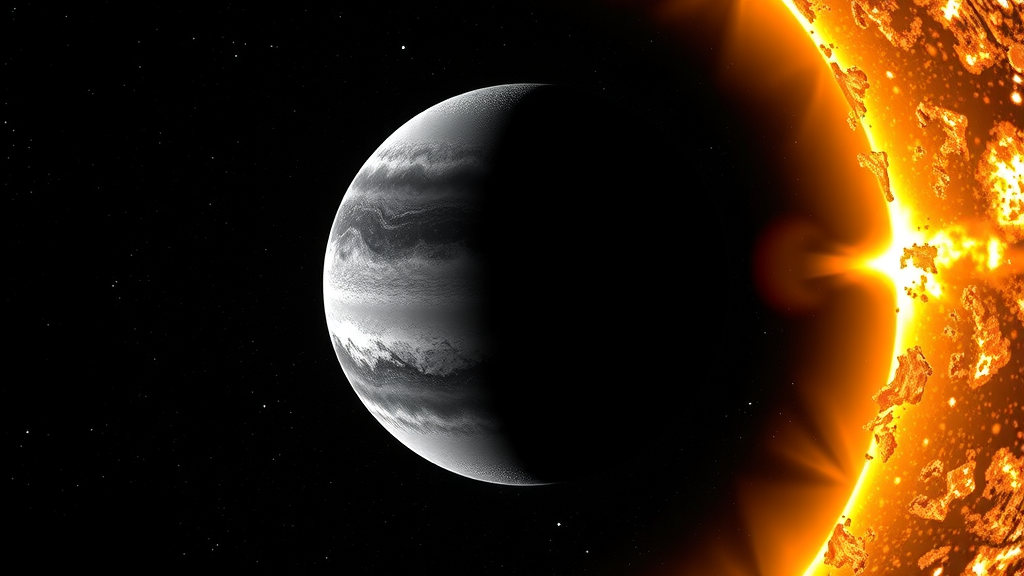
When the joint European and Japanese BepiColombo spacecraft swept past Mercury in September 2024, it was not supposed to witness a storm. The mission, a partnership between the European Space Agency (ESA) and the Japan Aerospace Exploration Agency (JAXA), was executing the fourth of a series of gravity-assist flybys designed to bleed off speed during an eight-year cruise to the innermost planet. Yet as the spacecraft glided to within 165 kilometers of the cratered surface, closer than it will ever come during its science orbit, the Sun erupted. A major particle event hurled energetic electrons and protons across interplanetary space, and BepiColombo found itself positioned, by pure chance, to watch that invisible bombardment crash into Mercury and rain down across its unprotected surface.
The particle and X-ray detector known as SIXS, designed and built in Finland, recorded the entire encounter. Now the measurements have been published in the journal Nature Astronomy, offering scientists their first close-range view of how solar energetic particles penetrate a planetary magnetosphere as small and feeble as Mercury’s and precipitate onto the planet itself. The results matter far beyond one small, scorched world. They provide a natural laboratory for understanding what happens when the most violent space weather strikes a magnetosphere, knowledge that directly informs how researchers assess the threat such storms pose to Earth’s own technological infrastructure and atmosphere.
Emilia Kilpua, principal investigator of SIXS and professor of space physics at the University of Helsinki, describes the flyby as an extraordinary stroke of fortune. The spacecraft came much closer to the surface than it will on its final science orbit, and a significant particle eruption occurred on the Sun at precisely that moment. Observing a powerful solar energetic particle event from a few hundred kilometers above Mercury, with instruments built to measure exactly such particles, is the kind of convergence mission scientists rarely dare to hope for. Instead of a quiet pass used mainly for steering and instrument testing, the team obtained a dataset of genuine scientific value that would have been impossible to schedule.
What SIXS revealed is striking. During the eruption, a large number of highly energetic particles reached Mercury’s surface across a wide area, sweeping over the planet rather than being funneled into narrow polar cusps alone. Mercury lacks a substantial atmosphere, so there is no cushion of air to absorb or slow the incoming radiation the way Earth’s atmosphere shields the surface. The planet’s magnetic field, moreover, is far weaker than Earth’s, and its magnetosphere is correspondingly much smaller, leaving it far more exposed to the full force of solar outbursts. The measurement therefore captures, in real time and at close range, how effectively a planetary magnetic field can or cannot shield the ground beneath it when the Sun unleashes its energy.
The physics of what happens next on the surface is central to why these observations matter. When energetic electrons and protons slam into the regolith, the loose layer of dust and rock that coats Mercury, they knock atoms and molecules loose from the surface material in a process called sputtering. The same impacts also generate X-ray radiation, as particles decelerate and excite atoms in the crust. Both the ejected particles and the induced X-rays carry chemical fingerprints of the surface composition. By measuring them, scientists can deduce what Mercury’s crust is made of and how the planet has been processed by billions of years of exposure to solar radiation and micrometeorite impacts. In orbit, several BepiColombo instruments will study these processes together, cross-referencing particle measurements from SIXS with X-ray observations of the surface from the MIXS instrument, in which Finland is also heavily involved, to build a coherent picture of the planet’s chemistry and evolution.
Rami Vainio, co-principal investigator of SIXS and professor of space physics at the University of Turku, emphasizes the comparative dimension of the findings. Mercury’s magnetic field is weaker than Earth’s and its magnetosphere much smaller, but the conditions at Mercury during this event resemble what Earth would experience if a powerful solar storm compressed its own magnetosphere. Under extreme conditions, Earth’s protective magnetic bubble can be squeezed inward dramatically, allowing energetic particles to penetrate far deeper into near-Earth space than usual, threatening satellites, disrupting radio communications, and in the most severe cases depositing energy into the upper atmosphere. Mercury during this flyby effectively demonstrated the end-member scenario, a magnetosphere overwhelmed by particle flux, showing how such radiation propagates and where it ultimately lands.
This is why the SIXS observations are expected to feed directly into space weather research focused on our own planet. Understanding how destructive particle radiation penetrates a planetary near-space environment and atmosphere during the most powerful space storms helps researchers refine models of radiation dose at aviation altitudes, satellite orbital predictions, and the behavior of Earth’s magnetosphere under stress. The data will also be used in the Center of Excellence in Space Resilience, funded by the Research Council of Finland for the period 2026 to 2033, in which both Kilpua’s and Vainio’s research groups participate. That program brings together space physicists, engineers, and resilience researchers to anticipate and mitigate the effects of extreme space weather on society, a concern that has grown as solar cycle activity has intensified and as modern infrastructure has become ever more dependent on satellites and sensitive electronics.
The broader context of the measurement is the remarkable journey that made it possible. BepiColombo was launched in October 2018 and has spent eight years traveling to Mercury, using a series of flybys of Earth, Venus, and Mercury itself to shed the orbital energy that a direct trajectory to the Sun’s neighborhood would make prohibitively expensive in fuel. In early September, the mission reached a milestone: the two orbiters, the Mercury Planetary Orbiter built by ESA and the Mercury Magnetospheric Orbiter built by JAXA, separated from the transfer module that had carried them across the solar system. The orbiters will enter Mercury’s orbit in November and separate from each other in December, beginning the dedicated science phase in complementary orbits. In total, the two spacecraft carry sixteen scientific instruments, forming the most comprehensive payload ever sent to the smallest and least explored of the solar system’s eight planets.
Mercury holds a special place in that exploration history, and a humble one. It is the planet closest to the Sun, which makes it exceptionally strongly affected by solar activity, yet only three spacecraft have ever studied it at close range. Mariner 10 flew past three times in the mid-1970s, revealing a heavily cratered world with a surprising magnetic field. MESSENGER orbited the planet from 2011 to 2015, mapping its surface, confirming water ice in permanently shadowed polar craters, and revealing an offset magnetic field whose origin remains debated. BepiColombo is only the third mission to visit and Europe’s first, carrying the ambition not merely to revisit these discoveries but to understand the planet as a coupled system: its interior, its surface, its thin exosphere, and its magnetosphere, all responding continuously to the ferocious output of the nearby Sun.
The fourth flyby measurements now published add an unexpected early dividend to that mission. Long before the orbiters begin their systematic observations, SIXS has demonstrated how solar energetic particles behave at Mercury, how widely they spread across the surface, and what that means for both planetary science and space weather forecasting. The lucky timing of the September 2024 encounter has effectively given the BepiColombo team a preview of the storm-driven physics they will study in detail from orbit, and given space weather scientists on Earth a benchmark dataset drawn from the most sun-exposed planet in the solar system. As the Sun approaches and passes through the active phase of its cycle, the lessons learned from Mercury’s bombardment will resonate directly in models that protect satellites, astronauts, and power grids far from the scorched world where they were first measured.
Subject of Research: Solar energetic particle precipitation onto Mercury's surface measured by the BepiColombo spacecraft during its close flyby
Article Title: BepiColombo measured Mercury's particle bombardment up close
Article References: BepiColombo measured Mercury's particle bombardment up close. (n.d.). Original publication
Image Credits: AI Generated
DOI: Not provided
Keywords: BepiColombo, Mercury, solar energetic particles, space weather, magnetosphere, SIXS instrument, ESA, JAXA, solar storms, X-ray radiation, planetary shielding, Nature Astronomy
Cite Scienmag News
Grant Pearson. (September 12, 2026). BepiColombo caught Mercury being blasted by a solar storm up close. Scienmag. https://scienmag.com/bepicolombo-caught-mercury-being-blasted-by-a-solar-storm-up-close/
Grant Pearson. "BepiColombo caught Mercury being blasted by a solar storm up close." Scienmag, 12 September 2026, https://scienmag.com/bepicolombo-caught-mercury-being-blasted-by-a-solar-storm-up-close/. Accessed 12 September 2026.
Grant Pearson. "BepiColombo caught Mercury being blasted by a solar storm up close." Scienmag. September 12, 2026. https://scienmag.com/bepicolombo-caught-mercury-being-blasted-by-a-solar-storm-up-close/


