


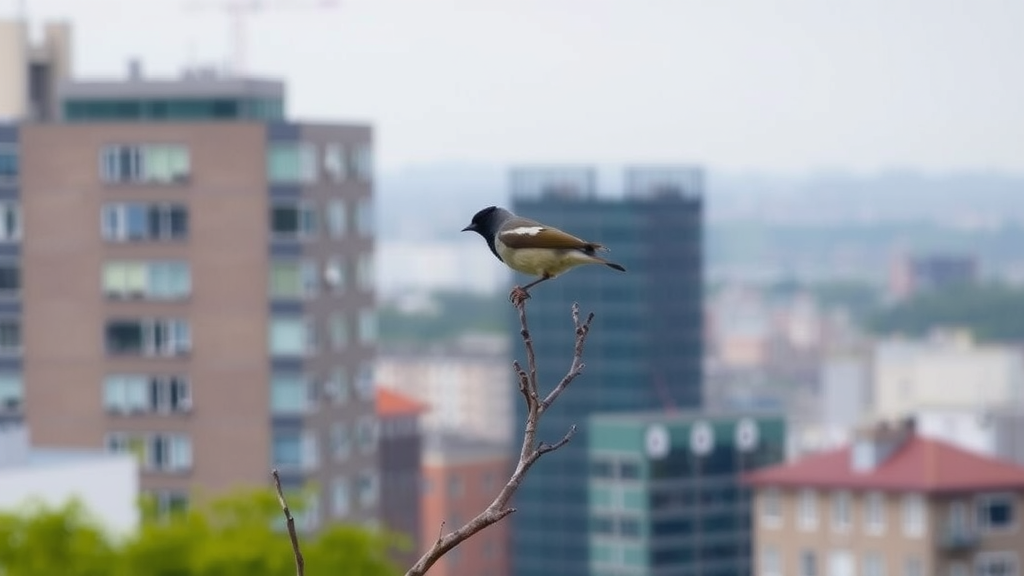
Cities around the world are under pressure to grow denser. Compact urban development is widely promoted as a climate strategy, because tightly packed housing reduces car dependence, curbs sprawl into surrounding countryside, and lowers per-capita energy use. Yet densification has an ecological cost that is harder to measure: as buildings crowd together and green space disappears, the wildlife that shares the urban landscape can be squeezed out. A study published in npj Urban Sustainability examines this tension in Gothenburg, Sweden, using bird observations to ask whether it is possible to build dense, compact cities without jeopardizing biodiversity.
Birds are among the most practical indicators available for this kind of question. They respond quickly to changes in vegetation, building cover, and habitat fragmentation; they are surveyed with standardized methods across many cities; and their ecological requirements are well documented. When planners compress more housing into a fixed urban footprint, bird communities are often the first visible signal of what densification does to the living fabric of a city. The Gothenburg study uses this signal to probe the relationship between urban form and biodiversity at a scale relevant to actual planning decisions.
The research is set against a long-running debate in urban ecology and urban planning. One school argues that compact cities are the greenest cities, because concentrating development spares land at the urban fringe and reduces the ecological footprint of each resident. The opposing view warns that compaction intensifies local pressures—less vegetation, more impervious surface, more disturbance from people, traffic, noise, and light—and that these pressures fall hardest on the species that live inside the city itself. Both positions can be correct at different scales, which is precisely why empirical studies like this one matter: they test whether the global benefits of density can be reconciled with the local loss of urban nature.
Gothenburg offers a useful laboratory for this question. As Sweden’s second-largest city, it combines a dense central core, older residential districts with mature trees, postwar neighborhoods with varied green structure, and expanding areas where infill development is adding new housing on previously open land. This variation in urban form means that different parts of the city represent different points along the density spectrum, allowing researchers to compare how bird life changes as built cover increases and green structure changes.
The study draws on bird observations collected across the city, following established survey approaches in which species are recorded at defined observation points or along fixed routes during the breeding season. Standardized counts of this kind allow researchers to estimate both how many bird species occur in an area—species richness—and how those species are distributed across the urban landscape. Because the same methods are used across the city, differences in the resulting bird communities can be linked to differences in the surrounding environment rather than to differences in survey effort.
The analytical approach connects these bird observations to detailed characterizations of the urban environment around each survey location. Typical variables in such analyses include the proportion of built-up surface, the amount and configuration of vegetation, tree cover, distance to larger green areas, and measures of how compact or dispersed the surrounding urban fabric is. Statistical models then test which aspects of urban form best explain the patterns in bird diversity, and whether the effects of density are uniform or depend on the quality and arrangement of the green space that remains.
This last question is the crux of the study. If bird diversity simply declined in lockstep with density, the message for planners would be stark: every increment of compaction costs biodiversity. But urban ecological research repeatedly shows that the relationship is more nuanced. The amount of green space matters, but so does its quality—whether vegetation is structurally diverse, whether native trees are present, whether green areas connect to each other and to habitats beyond the city. A dense district that retains a well-connected network of parks, gardens, and tree-lined streets can support far more bird species than a sparser district with mowed lawns and isolated ornamental plantings.
The policy stakes are considerable. Many European cities, Gothenburg among them, have adopted densification targets as part of climate and sustainability strategies, and the pressure to build on remaining open land within the urban boundary is intense. If planners treat all green space as interchangeable, densification can quietly erode the ecological infrastructure that supports urban biodiversity and the many benefits it provides, from pollination and pest regulation to cooling, stormwater management, and the psychological well-being of residents. Studies that identify which elements of green structure are most critical give decision-makers a way to densify strategically rather than indiscriminately.
The Gothenburg findings speak directly to that challenge. By grounding the analysis in systematic bird observations, the study provides evidence that the design of compact development—not just its intensity—determines its ecological outcome. The broader implication is that density and biodiversity are not inherently opposed; they are opposed only when compaction is carried out without attention to the retention, quality, and connectivity of urban green space. Cities that internalize this lesson can pursue the climate advantages of compact form while safeguarding the birds, and the broader ecological communities, that make urban environments livable.
As urbanization accelerates worldwide, research of this kind becomes part of the essential toolkit for sustainable city-building. Bird surveys are relatively inexpensive, repeatable, and interpretable, which makes them a practical monitoring instrument for cities that want to track the ecological consequences of their planning choices over time. The Gothenburg study demonstrates how such monitoring can be turned into actionable insight, helping to ensure that the dense, compact cities of the future are not only low-carbon but also rich in the biodiversity on which both ecosystems and people depend.
Subject of Research: The relationship between compact urban densification and bird biodiversity in Gothenburg, Sweden
Article Title: Building dense or compact cities without jeopardizing biodiversity: Insights from bird observations in Gothenburg, Sweden
Article References: Building dense or compact cities without jeopardizing biodiversity: Insights from bird observations in Gothenburg, Sweden. (n.d.). https://doi.org/10.1038/s42949-026-00471-5
Image Credits: AI Generated
DOI: 10.1038/s42949-026-00471-5
Keywords: urban densification, biodiversity, birds, Gothenburg, urban sustainability, compact cities, urban ecology, green space, urban planning, species richness, Sweden, habitat connectivity
Cite Scienmag News
Margaret Porter. (September 12, 2026). Building Dense Cities Without Sacrificing Biodiversity: What Birds Reveal in Gothenburg. Scienmag. https://scienmag.com/building-dense-cities-without-sacrificing-biodiversity-what-birds-reveal-in-gothenburg/
Margaret Porter. "Building Dense Cities Without Sacrificing Biodiversity: What Birds Reveal in Gothenburg." Scienmag, 12 September 2026, https://scienmag.com/building-dense-cities-without-sacrificing-biodiversity-what-birds-reveal-in-gothenburg/. Accessed 12 September 2026.
Margaret Porter. "Building Dense Cities Without Sacrificing Biodiversity: What Birds Reveal in Gothenburg." Scienmag. September 12, 2026. https://scienmag.com/building-dense-cities-without-sacrificing-biodiversity-what-birds-reveal-in-gothenburg/


