


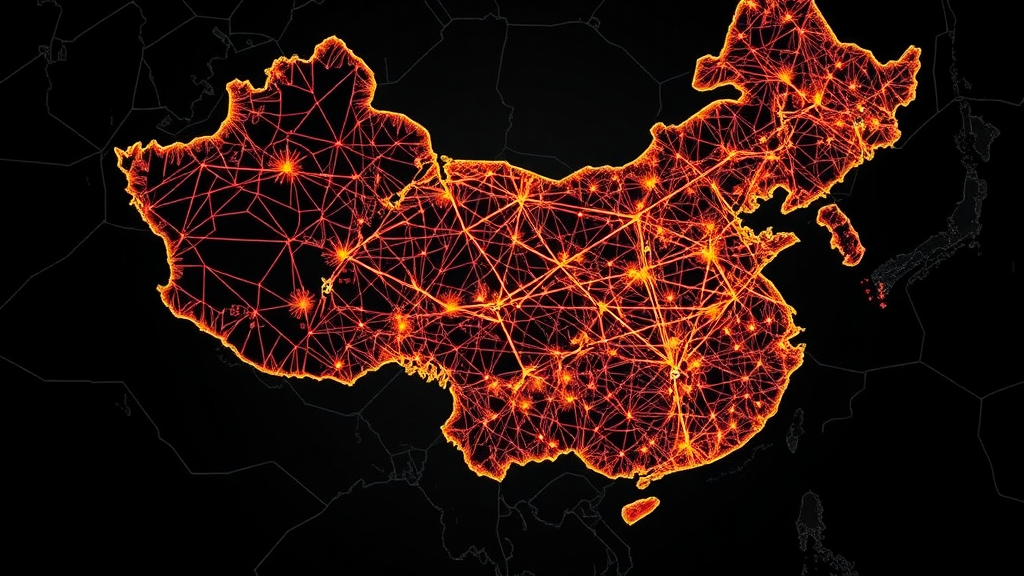
China’s energy system, the largest and most carbon-intensive on Earth, has long been studied as a collection of provinces chasing separate efficiency targets. A new study argues that this fragmented view misses the point entirely. Researchers Xiaodong Yan of Liaoning Normal University and Fei Wang of Hunan University of Finance and Economics, writing in the Journal of Industrial Ecology, treat the country’s energy economy as a single metabolic network, in which provinces behave like organs exchanging energy and carbon through an intricate circulatory system. Their analysis shows that the health of this network cannot be judged by looking at any one province in isolation. Instead, the ecological performance of the whole depends on how efficiently resources flow between regions and how resilient the connections among them are when the system comes under stress.
The conceptual foundation of the work is regional metabolism, an idea borrowed from industrial ecology that frames human settlements and economies in biological terms. Just as an organism consumes nutrients, converts them into useful energy, and excretes waste, a regional economy ingests fossil fuels and electricity, transforms them into economic output, and emits carbon dioxide and other pollutants along the way. In this framing, provinces are nodes, and the trade links between them are the vessels through which embodied energy and carbon travel. The metaphor is more than rhetorical: it allows the researchers to borrow analytical tools from network science and ecology to ask quantitative questions about efficiency and vulnerability that conventional province-by-province accounting cannot answer.
To build the network, the authors turned to environmentally extended multi-regional input-output tables for 2010, 2012, 2015, and 2017, covering China’s provincial economies. These tables record the flows of goods and services between every pair of provinces, and by combining them with provincial energy consumption data and carbon emission inventories, the researchers could trace exactly how much energy, and how much associated carbon, is embedded in each interprovincial transaction. This environmentally extended approach is technically demanding because it distinguishes between emissions produced within a province and those generated elsewhere to satisfy that province’s consumption, exposing the often-hidden transfer of environmental burden from energy-producing interior provinces to coastal manufacturing and consumption centers.
On top of this flow matrix, the study constructs two complementary indicators. The first is network ecological efficiency, a measure of how much economic value each interregional energy pathway delivers per unit of environmental burden, essentially asking which routes through the network convert energy into prosperity with the least carbon cost. The second is network ecological resilience, assessed using social network analysis, a suite of techniques developed in sociology that quantify the structure of relationships among nodes. Measures such as connectivity, centrality, and accessibility reveal how the network is organized, which provinces act as hubs, and how easily the system would absorb the shock of losing a particular link or node.
The results are striking. In 2017, network ecological efficiency varied enormously across China’s interprovincial energy pathways, with the route connecting Sichuan to Jiangsu standing out as the most resource-efficient corridor in the entire network. This path channels relatively clean hydropower-rich Sichuan energy toward the industrial powerhouse of Jiangsu, delivering high economic value with comparatively low emissions. Other corridors performed far worse, moving carbon-heavy energy at a much higher environmental cost per unit of output. Over the study period, the authors found a clear trend toward regional differentiation, in which a subset of provinces pulled ahead in efficiency while others lagged, widening the gap between the metabolic performance of China’s leading and trailing regions.
The structural analysis proved equally revealing. China’s energy network, the study finds, is organized hierarchically, with a small number of highly connected hub provinces commanding disproportionate influence over flows, while many peripheral provinces maintain only thin connections to the core. Adjacent regions tend to be more tightly interconnected with one another, forming clustered neighborhoods of exchange, whereas isolated areas contain few nodes and limited alternative pathways. This topology has a double edge. Dense clustering can foster efficient local collaboration, but it also means that disruptions hitting a hub province or a critical corridor can cascade through dependent regions, while isolated nodes lack the redundant connections that would let them reroute supply in a crisis.
Perhaps the most policy-relevant finding concerns spatial externalities, the spillover effects by which one province’s efficiency or resilience shapes outcomes in its neighbors. The analysis detected significant externalities in both network ecological efficiency and network ecological resilience across China, meaning that no province can fully optimize its energy metabolism unilaterally. A province that improves the carbon intensity of its energy trade benefits not only itself but also the regions linked to it, while a fragile, poorly connected province transmits vulnerability to its partners. This interdependence undermines the traditional logic of provincial-level environmental governance, in which each jurisdiction pursues its own targets, and instead points toward the necessity of coordinated, network-aware policy design.
Building on these findings, the authors propose three priorities for improving China’s energy metabolism. The first is to strengthen cross-regional collaboration, formalizing the mechanisms by which provinces jointly manage shared energy corridors and carbon budgets rather than treating interprovincial flows as externalities. The second is to optimize ecological governance by targeting the specific pathways with the worst efficiency performance, channeling cleaner energy sources and cleaner technologies into the corridors where the marginal environmental gains are largest. The third is to reinforce resilience in vulnerable areas, adding redundancy and connectivity to isolated provinces and reducing the systemic dependence on a handful of hub nodes whose failure would ripple across the network.
The timing of this work is significant. China has pledged to peak its carbon emissions before 2030 and to achieve carbon neutrality by 2060, goals that require not only deploying renewable energy at staggering scale but also reorganizing the geography of energy production and consumption. Studies of this kind illuminate the plumbing beneath the headline targets. They show where embodied carbon actually travels, which corridors waste the most energy per unit of economic output, and which structural weaknesses could sabotage decarbonization efforts when shocks arrive, whether those shocks are political, economic, or climatological. The multi-year input-output approach also demonstrates the value of tracking the system over time, capturing trends such as the growing differentiation in efficiency that a single snapshot would miss.
Methodologically, the study’s marriage of environmentally extended input-output accounting with social network analysis offers a template that researchers can apply well beyond China. Any large economy with strong internal trade linkages, from the United States to the European Union to India, could be modeled as a regional metabolic network, and the paired efficiency-resilience framework could be extended to other critical resource systems such as water, food, and materials. The broader lesson is that sustainability is as much a property of relationships as of places. Provinces, like organs in a body, live or die together, and designing energy systems for the coming decades will require treating the network itself, not the individual region, as the fundamental unit of governance and care.
Subject of Research: Network ecological efficiency and resilience of China's interprovincial energy system analyzed through a regional metabolism framework
Article Title: Ecological efficiency and resilience of energy networks in China: a regional metabolism perspective
Article References: Yan, X., & Wang, F. (2026). Ecological efficiency and resilience of energy networks in China: a regional metabolism perspective. Journal of Industrial Ecology. https://doi.org/10.1007/s44498-026-00174-1
Image Credits: AI Generated
DOI: 10.1007/s44498-026-00174-1
Keywords: China, energy networks, regional metabolism, ecological efficiency, ecological resilience, multi-regional input-output analysis, social network analysis, carbon emissions, interregional energy flows, spatial externalities, industrial ecology, sustainable development
Cite Scienmag News
Sloane Callahan. (September 12, 2026). China’s Energy Grid Mapped Like a Living Organism Reveals Hidden Fault Lines. Scienmag. https://scienmag.com/chinas-energy-grid-mapped-like-a-living-organism-reveals-hidden-fault-lines/
Sloane Callahan. "China’s Energy Grid Mapped Like a Living Organism Reveals Hidden Fault Lines." Scienmag, 12 September 2026, https://scienmag.com/chinas-energy-grid-mapped-like-a-living-organism-reveals-hidden-fault-lines/. Accessed 12 September 2026.
Sloane Callahan. "China’s Energy Grid Mapped Like a Living Organism Reveals Hidden Fault Lines." Scienmag. September 12, 2026. https://scienmag.com/chinas-energy-grid-mapped-like-a-living-organism-reveals-hidden-fault-lines/


