


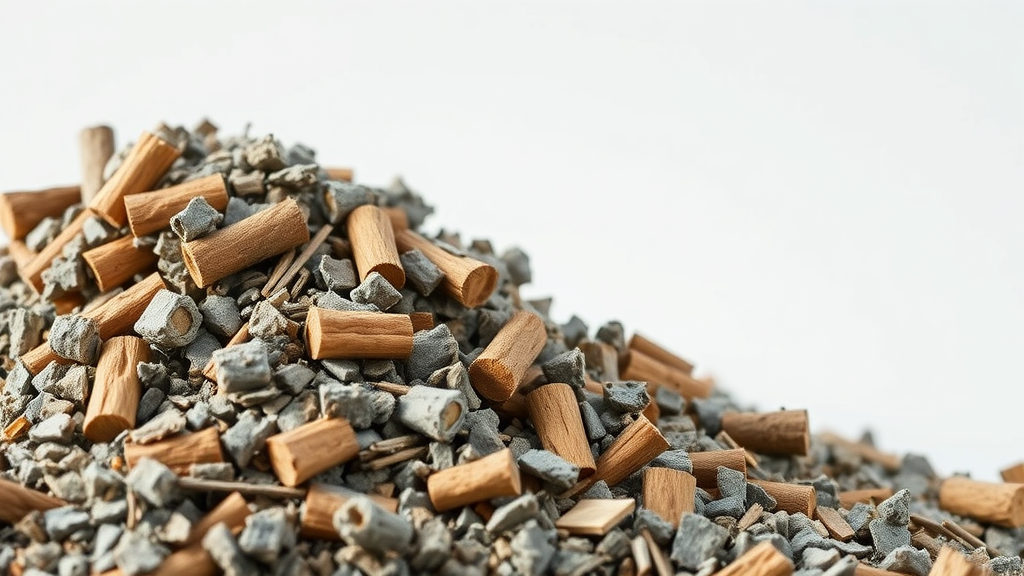
Every year, the world’s power plants and heating systems burn enough wood to generate an estimated 18.5 million tons of ash, a powdery residue that mostly ends up in landfills, threatening soils and groundwater. As the planet shifts away from coal and toward biomass-based energy, that mountain of ash is only growing. A new study from researchers in France suggests there may be a surprisingly simple way to give much of it a second life: mix it with just a small amount of ordinary Portland cement. The findings, published in Cleaner Engineering and Technology, show that adding as little as 5 to 20 percent cement to binders made up to 95 percent wood ash dramatically improves the stiffness, density and internal structure of the resulting pastes, opening the door to low-carbon construction materials built almost entirely from waste.
The research team, led by Désiré Ndahirwa of UniLaSalle with colleagues including Hélène Lenormand, Hafida Zmamou and Nathalie Leblanc, focused on a question that has dogged the field for years. Wood ash contains reactive silica, alumina and calcium-bearing phases that can, in principle, behave like cement itself, reacting with water through hydraulic and pozzolanic pathways. In practice, however, pastes made from pure wood ash are weak and porous. Previous studies had shown that replacing moderate amounts of cement with wood ash often reduces compressive and flexural strength, and most work had examined substitution levels below 50 percent. Almost nothing was known about what happens at very high replacement levels, where wood ash dominates the mixture, and the stiffness of such materials, measured as Young’s modulus, had rarely been quantified despite its importance for structural design.
To close that gap, the researchers gathered four locally sourced wood ashes from the Normandy region of France. Two of them, designated WFA3 and WBA, came from the combustion of wood pellets and were delivered as wet sludge, requiring oven drying and crushing before use. The other two, WFA8 and WFA9, arrived as dry fine powders from a local heating plant operated by Coriance in Mont-Saint-Aignan, where boilers with power inputs of 6 and 8 megawatts burn forestry wood chips, bocage wood chips and pallet residues at temperatures between 900 and 1100 degrees Celsius. The team prepared seventeen paste formulations in total: four containing only wood ash, twelve blending 80 to 95 percent wood ash with 5 to 20 percent ordinary Portland cement, and a reference paste of pure cement, all compacted with a mini-Proctor device to boost density and cured for up to 28 days.
The chemical analysis alone revealed why wood ash is such a tricky raw material. The four ashes were dominated by calcium oxide, silica, potassium oxide and sulfur trioxide, but in wildly varying proportions. Sulfate contents reached 15.4 percent in WFA8 and 14 percent in WFA9, far above the 4 to 5 percent limit set by ASTM standards for pozzolans, and their combined pozzolanic oxides fell well below the required thresholds. In plain terms, these ashes do not qualify as conventional pozzolans, yet X-ray diffraction showed they carry crystalline phases such as portlandite, calcite, albite, alite, dolomite and sylvite that can still participate in binding reactions. The variability is a direct consequence of differing feedstocks, boiler designs and combustion temperatures, and it means each ash must be evaluated on its own terms rather than lumped into a single category.
When it came to mechanical performance, the effect of the small cement additions was unmistakable. Pure wood ash pastes managed compressive strengths of only 0.13 to 1.65 megapascals at 28 days, but raising the cement content to 20 percent lifted those values substantially. The best performer was the WFA8-based blend, which reached 5.49 megapascals, while WFA9 and WFA3 pastes achieved 4.01 and 3.87 megapascals respectively at the same dosage. The researchers attribute the gains to a richer supply of hydration products, including calcium silicate hydrate gel, portlandite and ettringite, formed as the cement’s tricalcium silicate reacts with water and progressively densifies the paste matrix. Stiffness told the same story: the modulus of elasticity, estimated from the linear portion of stress-strain curves, climbed with cement content, curing time and bulk density in three of the four ash families, with the highest values consistently recorded in mixtures containing 20 percent cement.
One ash refused to follow the script. The wood bottom ash, WBA, behaved atypically across every measurement. Its pastes lost compressive strength between 7 and 28 days at certain dosages, its modulus of elasticity peaked at 7 days and then declined, and thermogravimetric analysis found no detectable portlandite whatsoever. X-ray diffraction offered an explanation: the WBA pastes contained no alite, the calcium silicate phase that drives strength development in hydrating cement, and their dominant crystalline phases were calcite and quartz. Adding 20 percent cement pushed the estimated calcite content up from about 47 to 63.5 percent while quartz fell, a signature of carbonation of calcium silicate hydrate or the formation of complex, less efficient hydrate phases, both of which are associated with increased porosity and weaker binding.
Scanning electron microscopy added a visual dimension to the story. Under the microscope, pure cement paste appeared dense and well packed, bristling with the products of hydration, while pastes made from 100 percent wood ash showed loosely arranged particles riddled with interparticle voids, along with unreacted ash grains and dark fragments of unburnt wood. With 20 percent cement added, the microstructure tightened, porosity dropped and hydration products proliferated, with needle-like ettringite crystals, gel-like calcium silicate hydrates, plate-shaped portlandite and rhombohedral calcite all visible. The ashes from the heating plant, WFA8 and WFA9, consistently produced more compact matrices than the pellet-derived WFA3 and the bottom ash WBA, underlining how much origin and processing shape a material’s destiny.
The mineralogical detective work also turned up some genuinely unexpected chemistry. In the WFA8 blends, introducing cement promoted the formation of alunite, a potassium aluminum sulfate hydroxide phase not present in the unblended paste, alongside an array of compounds including syngenite, arcanite, serandite and harmotome. Thermogravimetric analysis at 7 and 28 days complemented the diffraction data, identifying calcium silicate hydrates and ettringite dehydrating between 50 and 200 degrees Celsius, AFm phases such as calcium monocarboaluminate and hemicarboaluminate decomposing between 200 and 300 degrees, portlandite dehydroxylating between 400 and 500 degrees, and carbonates releasing carbon dioxide from 500 to 800 degrees. The two techniques agreed closely, with the single discrepancy being ettringite in the bottom ash pastes, which thermal analysis detected but diffraction did not, likely because its concentration fell below the instrument’s detection limit.
What emerges from the study is a nuanced but practical message. Low doses of ordinary Portland cement, between 5 and 20 percent, can meaningfully upgrade pastes in which wood ash makes up as much as 95 percent of the solid content, provided the ash is fine and reasonably reactive. The improvements in stiffness, strength and microstructure are real, even if the resulting materials remain suited to low-strength applications such as lightweight binders rather than load-bearing concrete. The decisive variable, the authors conclude, is the variability of the ash itself: its origin, chemistry and mineralogy govern everything from phase development to porosity. That insight carries weight well beyond Normandy. With millions of tons of biomass ash generated annually and cement production responsible for a major share of global carbon dioxide emissions, even modest cement dosages that transform a landfill-bound waste into a functional building material represent a meaningful step toward circular, lower-carbon construction. The next challenge will be standardizing how ashes are characterized and selected, so that builders can trust what is in the bag before it ever reaches the site.
Subject of Research: The effect of low ordinary Portland cement content on the stiffness, microstructure and mineralogical composition of wood ash-based pastes
Article Title: Effect of low ordinary Portland cement content on stiffness, microstructure and mineralogical composition of wood ash pastes
Article References: Ndahirwa, D., Lenormand, H., Zmamou, H., Chenot, E., Potel, S., & Leblanc, N. (2026). Effect of low ordinary Portland cement content on stiffness, microstructure and mineralogical composition of wood ash pastes. Cleaner Engineering and Technology, 34, Article 101303. https://doi.org/10.1016/j.clet.2026.101303
Image Credits: AI Generated
DOI: 10.1016/j.clet.2026.101303
Keywords: wood ash, ordinary Portland cement, Young's modulus, compressive strength, X-ray diffraction, thermogravimetric analysis, scanning electron microscopy, calcium silicate hydrate, ettringite, porosity, biomass ash, sustainable construction
Cite Scienmag News
Sloane Callahan. (September 12, 2026). Tiny Doses of Cement Could Turn Wood Ash Into a Viable Green Building Material. Scienmag. https://scienmag.com/tiny-doses-of-cement-could-turn-wood-ash-into-a-viable-green-building-material/
Sloane Callahan. "Tiny Doses of Cement Could Turn Wood Ash Into a Viable Green Building Material." Scienmag, 12 September 2026, https://scienmag.com/tiny-doses-of-cement-could-turn-wood-ash-into-a-viable-green-building-material/. Accessed 5 October 2026.
Sloane Callahan. "Tiny Doses of Cement Could Turn Wood Ash Into a Viable Green Building Material." Scienmag. September 12, 2026. https://scienmag.com/tiny-doses-of-cement-could-turn-wood-ash-into-a-viable-green-building-material/


