


Conventionally, decision-making is portrayed as a rational process: individuals calculate potential risks and aim to maximise benefits. Yet, our brains do not always endorse rational action, particularly when an immediate response is required. Sometimes, individuals mistakenly choose objectively worse options because of how these options are perceived in a given context.

Credit: Zinchenko et al.
Conventionally, decision-making is portrayed as a rational process: individuals calculate potential risks and aim to maximise benefits. Yet, our brains do not always endorse rational action, particularly when an immediate response is required. Sometimes, individuals mistakenly choose objectively worse options because of how these options are perceived in a given context.
For instance, if an investor is presented with the opportunity to purchase a portfolio of shares with a 60% probability of yielding profit, they are likely to accept. However, if informed that there’s a 40% chance of the portfolio incurring losses, they will probably decline the offer. Similarly, two circles of identical diameter may appear different in size depending on the shapes surrounding them. The context is what determines our evaluation of the available options.
The researchers aimed to investigate whether context consistently influences our decisions or whether the degree of human rationality varies depending on socioeconomic and cultural factors such as country of origin, status, religion, political system, and others.
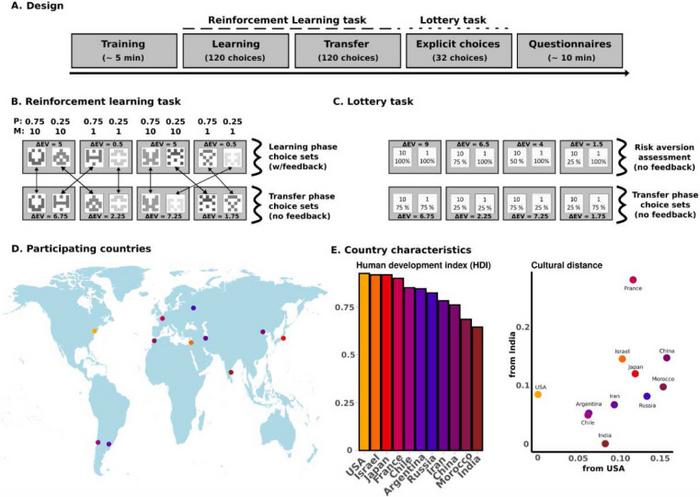
An international team of authors, including researchers at the HSE Institute for Cognitive Neuroscience, conducted a study involving volunteers across eleven countries of remarkably different socio-economic and cultural makeup. More than 500 nationals of Russia, France, Argentina, India, China and some other countries performed a decision-making task consisting of two phases. During the first phase, participants were asked to choose between two options, each linked to either obtaining a reward or facing the risk of losing it. In each round, the options were reiterated, forming various combinations to establish contexts in which these options were perceived as either more or less rewarding. Thus, participants had the opportunity to maximise their rewards based on learning from previous rounds; however, all participants without exception, irrespective of nationality, made suboptimal decisions and incorrectly evaluated the options in certain contexts.
To assess the reproducibility of context-dependent results from the first phase of the experiment, the study authors instructed participants to perform a second task involving a choice between two options presented in the same contexts but with known variables. For instance, the participating volunteers were informed that they could either receive a substantial reward with a 50% probability or opt for a guaranteed but small reward. By consistently administering such lotteries, it becomes possible to identify the threshold at which individuals cease taking risks and choose the safe option. This threshold is individual and depends on a person’s risk preference, which, as revealed, is a culture-specific characteristic. Thus, Russian nationals exhibited average risk preferences, Chinese and Japanese participants demonstrated the highest risk propensity, while residents of India and Chile emerged as the most risk-averse.
‘Previously, it was believed that the primary factor influencing our decisions was our willingness to take risks. However, through our research, we discovered that this is not always the case. Our decision-making primarily depends on how we receive information: whether we experience the situation first-hand or are informed about it,’ explains co-author of the study Oksana Zinchenko, Senior Research Fellow at the Institute for Cognitive Neuroscience, HSE University. ‘We have demonstrated that human consciousness exhibits a certain cognitive limitation, which is a shared characteristic not contingent on our beliefs, attitudes, or nationality.’
According to the authors, the findings from this study may find practical application in economics, psychology, marketing, and other fields.
Journal
Nature Human Behaviour
Method of Research
Experimental study
Subject of Research
People
Article Title
Comparing experience- and description-based economic preferences across 11 countries
Article Publication Date
14-Jun-2024
Cite Scienmag News
Courtney Benton. (September 3, 2024). The right to be wrong. Scienmag. https://scienmag.com/the-right-to-be-wrong/
Courtney Benton. "The right to be wrong." Scienmag, 3 September 2024, https://scienmag.com/the-right-to-be-wrong/. Accessed 4 September 2026.
Courtney Benton. "The right to be wrong." Scienmag. September 3, 2024. https://scienmag.com/the-right-to-be-wrong/

