


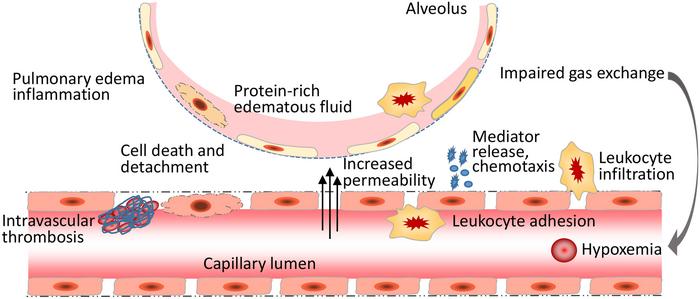
Acute lung injury (ALI), marked by the sudden onset of widespread lung inflammation, severely impairs gas exchange function in the lungs and can progress to acute respiratory distress syndrome (ARDS). ARDS, a more severe and often fatal disorder, is characterized by widespread alveolar damage, compromised lung function, and high mortality rates. ALI progresses to ARDS due to complex interactions between lung endothelial cells and inflammatory mediators. Understanding the mechanisms of lung endothelial barrier disruption and repair is crucial for developing effective treatments and improving patient outcomes in ARDS.

Credit: Professor Yunchao Su, Augusta University
Image Source Link:
Acute lung injury (ALI), marked by the sudden onset of widespread lung inflammation, severely impairs gas exchange function in the lungs and can progress to acute respiratory distress syndrome (ARDS). ARDS, a more severe and often fatal disorder, is characterized by widespread alveolar damage, compromised lung function, and high mortality rates. ALI progresses to ARDS due to complex interactions between lung endothelial cells and inflammatory mediators. Understanding the mechanisms of lung endothelial barrier disruption and repair is crucial for developing effective treatments and improving patient outcomes in ARDS.
The integrity of the lung endothelial barrier is essential for preventing pulmonary edema and ensuring proper gas exchange. In ARDS, severe pulmonary inflammation triggers endothelial cell death through multiple pathways, leading to increased permeability, edema, and impaired lung function.
In this vein, a research team from Augusta University led by Professor Yunchao Su set out to investigate these mechanisms and explore strategies that promote endothelial repair. Sharing the motivation behind their study, Prof. Yunchao says, “Despite the use of potent antibiotics and aggressive intensive care support, the mortality of ALI is still high, because the mechanisms of pulmonary EC barrier disruption are not fully understood.” The findings of their study were published on 1 June 2024 in Volume 2, Issue 2 of Chinese Medical Journal Pulmonary and Critical Care Medicine and were made available online on 12 June 2024.
The study utilized a combination of experimental models and clinical data to investigate endothelial cell death and repair mechanisms. Researchers employed advanced techniques to analyze various forms of endothelial cell death. They also assessed biomarkers associated with endothelial injury and inflammation, such as interleukin-6 (IL-6), interleukin-8 (IL-8), tumor necrosis factor- α (TNF-α), von Willebrand factor (vWF), angiopoietin-2 (Ang-2), and thrombomodulin. Additionally, the study explored potential therapeutic strategies, focusing on modulating cytoskeleton dynamics, targeting endothelial inflammation, and utilizing cell-based therapies to promote endothelial repair in ALI and ARDS.
The researchers identified several key mechanisms of endothelial cell death in ARDS: apoptosis, necrosis, necroptosis, pyroptosis, and ferroptosis. “Apoptosis is an ATP-dependent programmed cell death, morphologically characterized by cellular shrinkage, chromatin condensation, nuclear DNA fragmentation, cytosolic membrane blebbing, and apoptotic body formation,” explains Prof. Su.
Key biomarkers for the early diagnosis and prognosis of ARDS include IL-6, IL-8, TNF-α, vWF, Ang-2, and intercellular adhesion molecule-1 (ICAM-1). The researchers explored various therapeutic strategies for ARDS, including cytoskeleton modulation with sphingosine-1-phosphate analogs and calpain inhibitors, which effectively alleviated endothelial leakage and pulmonary edema. Enhancing endothelial junction integrity with natural products and myosin II inhibitors also showed promise. Additionally, targeting endothelial inflammation with ICAM-1 inhibitors and chitin derivatives demonstrated potential. Furthermore, cell-based therapies utilizing endothelial progenitor cells and mesenchymal stem cells exhibited significant potential for vascular regeneration and inflammation reduction. These findings open new avenues for treatment and emphasize the need for further research to bring these strategies into clinical practice.
In conclusion, this study not only advances our understanding of the underlying mechanisms of ARDS but also paves the way for innovative treatment strategies that could significantly improve patient care and reduce the global burden of this condition.
***
Reference
Title of original paper: Mechanisms of pulmonary endothelial barrier dysfunction in acute lung injury and acute respiratory distress syndrome
Journal: Chinese Medical Journal Pulmonary and Critical Care Medicine
Method of Research
Literature review
Subject of Research
Cells
Article Title
Mechanisms of pulmonary endothelial barrier dysfunction in acute lung injury and acute respiratory distress syndrome
Article Publication Date
12-Jun-2024
COI Statement
The authors declare that they have no known competing financial interests or personal relationships that could have appeared to influence the work reported in this paper.
Cite Scienmag News
Nathaniel Bowman. (September 3, 2024). Chinese Medical Journal Pulmonary and Critical Care Medicine study reveals mechanisms underlying acute respiratory distress syndrome. Scienmag. https://scienmag.com/chinese-medical-journal-pulmonary-and-critical-care-medicine-study-reveals-mechanisms-underlying-acute-respiratory-distress-syndrome/
Nathaniel Bowman. "Chinese Medical Journal Pulmonary and Critical Care Medicine study reveals mechanisms underlying acute respiratory distress syndrome." Scienmag, 3 September 2024, https://scienmag.com/chinese-medical-journal-pulmonary-and-critical-care-medicine-study-reveals-mechanisms-underlying-acute-respiratory-distress-syndrome/. Accessed 4 September 2026.
Nathaniel Bowman. "Chinese Medical Journal Pulmonary and Critical Care Medicine study reveals mechanisms underlying acute respiratory distress syndrome." Scienmag. September 3, 2024. https://scienmag.com/chinese-medical-journal-pulmonary-and-critical-care-medicine-study-reveals-mechanisms-underlying-acute-respiratory-distress-syndrome/

