


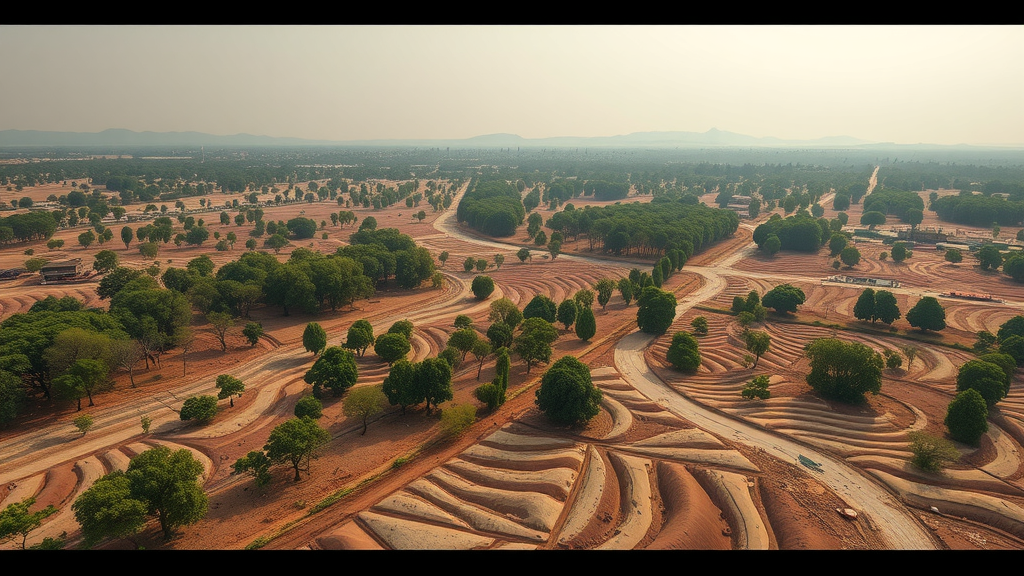
A new global analysis has revealed that the most destructive droughts are not simply the longest or the hottest, but those in which soil moisture deficits strike every layer of the soil column at once. The study, published in Nature Geoscience, combined multiple satellite, model-based and in situ soil moisture datasets spanning shallow surface soils to deep root zones, and found that when these vertically compound droughts occur, the natural buffering that normally protects ecosystems is eliminated. The findings carry sobering implications for carbon uptake in forests and croplands across much of the planet.
Soil moisture is not a single reservoir but a layered system. Water near the surface evaporates rapidly and responds almost immediately to rainfall deficits, while deeper layers hold reserves that plants tap during dry spells. In a typical drought, this stratification acts as insurance: shallow soils may desiccate, but deep moisture sustains roots through the lean period. The new research shows that this insurance is being increasingly withdrawn. When moisture deficits propagate downward and affect the entire soil profile simultaneously, ecosystems lose their vertical buffer and the damage to vegetation can escalate sharply.
The research team carried out what they describe as a multi-source, multilayer analysis, cross-validating datasets that capture moisture at different depths. This methodological advance matters because most previous drought assessments relied primarily on surface indicators, such as the top few centimetres of soil or indices derived from precipitation and temperature. Such indicators can miss deep-soil depletion entirely, underestimating the true stress experienced by ecosystems whose roots reach metres below the surface. By incorporating subsurface information, the study uncovered a class of drought events that conventional metrics largely overlook.
Central to the study is the concept of vertical hydrological buffering. Under normal conditions, water moves through the soil profile in response to gravity, capillarity and plant uptake, creating a redistribution system that smooths out short-term rainfall variability. Deep layers recharge during wet periods and slowly release stored water during dry ones. When droughts become vertically compound, this buffering mechanism collapses: surface layers are dry, so evaporation demand cannot be met; subsurface layers are dry, so roots cannot compensate; and the entire column is locked in deficit. The result is drought stress of a fundamentally different magnitude from that recorded by surface-only measures.
The analysis shows that these vertically compound droughts have intensified across much of the globe in recent decades. Regions that experienced them saw markedly stronger losses of vegetation productivity than areas affected by surface-only droughts of comparable severity. Forests and croplands emerge as particularly vulnerable. Deep-rooted forests depend on subsurface reserves during extended dry periods, and croplands, whose productivity is tied tightly to the water available within the root zone, suffer yield consequences when the entire profile dries out. For global carbon accounting, this is a worrying signal: diminished carbon uptake in forests during compound droughts weakens the terrestrial carbon sink precisely when atmospheric carbon dioxide is climbing.
The mechanistic links between layered soil moisture and ecosystem response are grounded in established land-atmosphere coupling theory. Soil moisture controls how much energy from solar radiation goes into evaporation versus heating the air. When moisture is plentiful, evaporation cools the surface; when it is depleted, more energy converts to sensible heat, raising air temperatures and vapour pressure deficits, which in turn forces plants to close their stomata and curtail photosynthesis. Vertically compound droughts thus feed a feedback loop: drier soils intensify atmospheric heat and dryness, which further stresses vegetation and dries the soil still more. By depleting all layers, these events extend and deepen the loop.
The study builds on a growing body of work on the vertical evolution of soil moisture drought. Recent research has classified soil drought across individual soil layers and reported that human activities can enhance subsurface drought development, while other studies have shown that vigorous vegetation growth in one season can exacerbate soil moisture drought in the next through trans-seasonal land-atmosphere interactions. Advances in observational capability have also been critical: machine-learning-based data fusion now produces high-resolution, seamless multilayer soil moisture estimates, and ambient seismic noise has been used to map large-scale deep soil moisture variations from ground vibrations. Together, these developments have made it possible to track drought not just across space and time, but down through the soil column.
The implications for drought monitoring and risk management are substantial. Indices built on surface conditions alone may declare a drought over when rainfall returns, even as deep moisture remains severely depleted, leaving ecosystems exposed to what the authors’ findings suggest can be amplified damage in subsequent stress events. Effective early-warning systems would need to incorporate subsurface measurements and model the depth profile of moisture, identifying when vertical compounding is occurring or imminent. For water resource managers and agricultural planners, the distinction between a shallow dry spell and a full-profile deficit is the difference between a transient inconvenience and a structural threat to yields and biomass.
Climate change amplifies the concern. Warmer temperatures increase evaporative demand, drawing moisture from the soil faster and pushing deficits deeper into the profile. More intense and irregular precipitation patterns reduce the frequency of the steady, soaking rains that recharge subsurface layers, favouring intense bursts that run off rather than infiltrate. The intensification of vertically compound droughts documented in the study may therefore be a signature of a shifting hydrological regime in which the deep-soil safety net that ecosystems have historically relied upon is progressively eroding. Hotter droughts, in effect, are becoming deeper droughts.
For the world’s forests, the stakes extend beyond the trees themselves. Forest carbon uptake represents a substantial share of humanity’s annual carbon budget, and declines in productivity during drought years measurably weaken the sink. If vertically compound droughts continue to intensify and expand, the study’s findings suggest that global models calibrated on surface drought indicators may systematically underestimate future carbon losses, biasing projections toward optimism. Similarly, cropland vulnerability assessments that ignore the depth dimension of drought risk may leave food production systems inadequately prepared for the full-profile deficits that the analysis identifies as especially damaging.
The researchers emphasise that their global analysis synthesises multiple independent data sources, lending robustness to the pattern they detect, though each dataset carries its own uncertainties in vertical resolution and depth coverage. Continued improvements in satellite missions, ground sensor networks and data assimilation methods are expected to sharpen the picture of how moisture deficits propagate through the soil. What is already clear is that drought science must look down as well as out: the vertical structure of soil moisture is not a technical detail but a first-order control on how severely droughts hit ecosystems. As the planet warms, the research warns, the simultaneous drying of every soil layer may become one of the defining hazards of the coming decades, silently stripping ecosystems of the subsurface reserves that have long sustained them through the driest times.
Subject of Research: The amplification of global ecosystem drought impacts by multilayer soil moisture deficits
Article Title: Multilayer soil moisture deficit amplifies drought impacts on global ecosystems
Article References: Multilayer soil moisture deficit amplifies drought impacts on global ecosystems. (2026). Nature Geoscience. https://doi.org/10.1038/s41561-026-02082-2
Image Credits: AI Generated
DOI: 10.1038/s41561-026-02082-2
Keywords: soil moisture, drought, vertically compound drought, hydrology, climate change, forests, croplands, carbon uptake, soil profile, land-atmosphere coupling, ecosystem productivity, Nature Geoscience
Cite Scienmag News
Violet Maxwell. (September 12, 2026). Vertically Compound Droughts Amplify Damage to Global Forests and Croplands. Scienmag. https://scienmag.com/vertically-compound-droughts-amplify-damage-to-global-forests-and-croplands/
Violet Maxwell. "Vertically Compound Droughts Amplify Damage to Global Forests and Croplands." Scienmag, 12 September 2026, https://scienmag.com/vertically-compound-droughts-amplify-damage-to-global-forests-and-croplands/. Accessed 12 September 2026.
Violet Maxwell. "Vertically Compound Droughts Amplify Damage to Global Forests and Croplands." Scienmag. September 12, 2026. https://scienmag.com/vertically-compound-droughts-amplify-damage-to-global-forests-and-croplands/


