


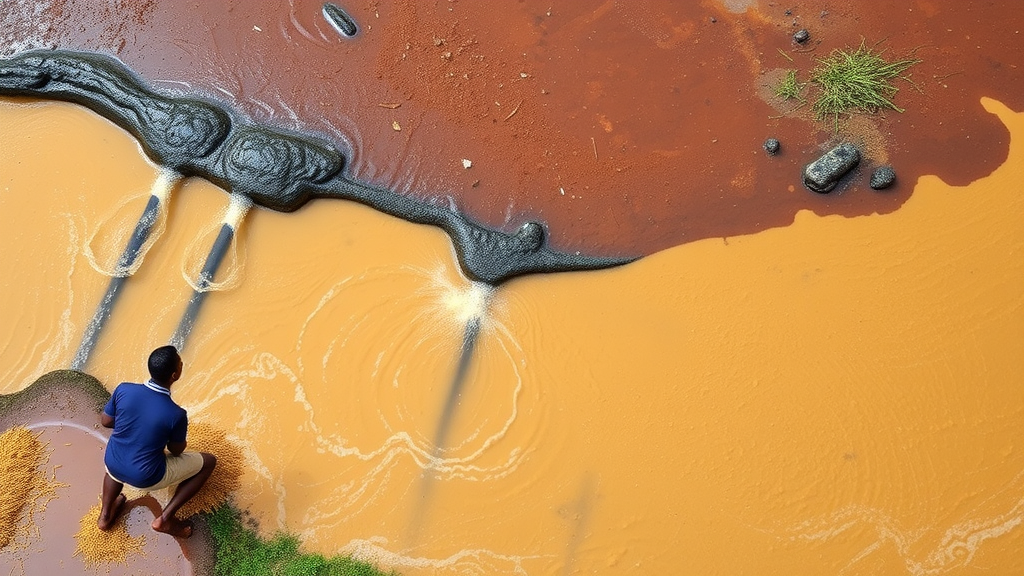
Industrial and municipal wastewater flowing untreated into rivers around Abakaliki, the capital of Ebonyi State in south-eastern Nigeria, has reached what researchers describe as a critical level of pollution, with lead, arsenic, cadmium and chromium far above international safety thresholds and dissolved oxygen so low that aerobic aquatic life cannot survive. A new study published in Discover Chemistry provides the most comprehensive characterisation to date of effluent across the metropolis, sampling twenty-nine representative discharge points spanning salt processing, lead-zinc mining, abattoirs, building-material markets, municipal drainage canals and relatively unpolluted control sites. The findings paint a picture of a freshwater system under simultaneous assault from toxic metals, organic overload and nutrient enrichment, with direct consequences for aquatic ecosystems, agriculture and the food supply of communities that depend on the Iyiokwu and Iyiudele Rivers for drinking water, irrigation and fishing.
The research team, led by O. F. Mbonu of Akanu Ibiam Federal Polytechnic together with O. N. Omaka and D. O. Igwe of Federal University Ndufu-Alike, collected samples using a stratified grab-sampling technique following ASTM D3370-18 protocols and the 24th edition of the American Public Health Association Standard Methods. Nine samples came from the Royal Salt processing area, which overlaps with a lead-zinc mining region, four each from abattoir discharge points, the Iyiudele River, municipal drainage canals and the building-material market area, and four from control locations upstream of industrial influence. Sampling locations were georeferenced with handheld GPS receivers in the WGS-84 datum, and samples were preserved in acid-washed high-density polyethylene bottles at approximately four degrees Celsius, with metal samples acidified to below pH 2 to prevent precipitation and adsorption losses before analysis.
Eighteen parameters were measured in total, combining classical titrimetric and spectrophotometric techniques with modern instrumental analysis. Temperature, pH, electrical conductivity and total dissolved solids were recorded in situ with a calibrated multi-parameter meter, while turbidity was determined nephelometrically. Dissolved oxygen was measured by Winkler iodometric titration, five-day biochemical oxygen demand by dark incubation at twenty degrees Celsius, and chemical oxygen demand by open-reflux dichromate digestion. Heavy metals were quantified by flame atomic absorption spectrophotometry with element-specific hollow cathode lamps, and arsenic by hydride-generation atomic absorption spectrometry for improved sensitivity. Calibration curves exceeded correlation coefficients of 0.995 for all metals, and spike-and-recovery experiments yielded recoveries of 94 to 98 percent with relative standard deviations below 5 percent, indicating that the analytical results are robust and defensible.
The results reveal contamination that is severe on nearly every metric. Turbidity averaged 66 nephelometric turbidity units, more than thirteen times the World Health Organization guideline of 5 NTU, reflecting suspended solids from quarrying, building-material runoff, mining and municipal waste. Although mean pH of 7.15 fell within acceptable limits, individual samples ranged from 4.7 to 9.6, and the acidic discharge at some sites is particularly dangerous because low pH increases the solubility, mobility and bioavailability of lead, cadmium and chromium. Dissolved oxygen collapsed to a hypoxic mean of 1.85 milligrams per litre, with some measurements as low as 0.5 milligrams per litre, far below the concentration needed to sustain healthy aerobic organisms. Biochemical oxygen demand averaged 88.5 milligrams per litre, roughly three times the WHO limit, corresponding to a contamination factor of 2.95, while chemical oxygen demand averaged 237 milligrams per litre.
Nutrient enrichment proved equally alarming. Total phosphate averaged 5.29 milligrams per litre, more than ten times the guideline value, and nitrate averaged 52.5 milligrams per litre, signalling a high risk of irreversible eutrophication in receiving water bodies such as the Iyiokwu River. The researchers observed a low nitrogen-to-phosphorus ratio at several locations, indicating a nitrogen-limited eutrophic system that favours nitrogen-fixing cyanobacteria. Blooms of these organisms can produce toxins that threaten both aquatic organisms and public health, adding a further layer of hazard to waters already burdened by metals and organic waste. Sulphate, ranging from 248 to 403 milligrams per litre, exceeded WHO guidance at most locations, likely reflecting mining effluent, industrial salts and geological weathering of the underlying rock formations.
The heavy-metal data are the study’s most consequential finding. Lead averaged 0.105 milligrams per litre, exceeding WHO and Standards Organisation of Nigeria limits more than tenfold, while arsenate averaged 0.07 milligrams per litre against a WHO limit of 0.01 milligrams per litre, with peak values of 0.11 milligrams per litre, more than seven times the threshold. Chromium ranged up to 0.17 milligrams per litre and cadmium also substantially exceeded guidance. Only zinc and copper remained largely within permissible limits, suggesting that their industrial inputs are comparatively modest. One-way analysis of variance confirmed significant spatial variation in contaminant plumes across the five discharge zones, linking the Royal Salt processing and mining zone to metal toxicity and abattoir discharge to organic hypoxia and oxygen depletion.
The geological context helps explain the metal signature. The Royal Salt area sits within lead-zinc mineralisation zones of the Asu River Group, whose sulfide-rich formations contain pyrite and arsenopyrite. Weathering and oxidation of these minerals generates acid mine drainage that leaches arsenic and lead into surface water and groundwater. Under the measured pH conditions, arsenic predominantly exists as arsenate, a persistent form, although organic-rich sediments may facilitate reductive transformation to arsenite, which is more toxic and mobile. Previous studies in Ebonyi State have documented elevated lead in groundwater around mining areas and arsenic accumulation in rice cultivated in contaminated paddy soils, underscoring that the contamination documented in effluent is already moving through the food chain rather than remaining confined to water.
The public health implications are stark. Lead is a non-essential metal with severe neurological, haematological, renal and developmental effects, and exposure in children causes irreversible neurodevelopmental impairment. Chronic arsenic exposure is associated with carcinogenicity, cardiovascular disease, skin lesions, neurological disorders and immunotoxicity. Cadmium is highly bioaccumulative and linked to kidney dysfunction, skeletal damage and endocrine disruption, while hexavalent chromium is carcinogenic and readily absorbed through skin. Communities that depend on the affected rivers for domestic use, irrigation, fishing and livestock are therefore exposed to chronic toxic risk, and the bioaccumulation of these metals in fish, sediment and crops threatens food security across the region. Reduced self-purification capacity caused by oxygen depletion further prolongs pollutant persistence in the ecosystem.
The authors frame their findings within the One Health framework, which recognises that environmental, animal and human health are inseparable. They argue that uncontrolled discharge of untreated effluent poses an immediate threat to this framework and call for urgent intervention through stricter enforcement of National Environmental Standards and Regulations Enforcement Agency discharge permits, continuous monitoring and sustainable wastewater treatment. Among the remediation options they recommend are low-cost adsorption technologies derived from local agricultural waste, including modified periwinkle-shell char and sawdust adsorbents, alongside phytoremediation, constructed wetlands and riparian-buffer restoration. These approaches are particularly relevant for resource-constrained regions where conventional treatment infrastructure is absent.
Beyond its immediate findings, the study establishes standardised, georeferenced baseline data intended to support future longitudinal research on aquatic toxicology, biomagnification of neurotoxic metals within the local food chain, pollution modelling and remediation strategy in south-eastern Nigeria. By integrating physicochemical characterisation, nutrient assessment and heavy-metal analysis across multiple industrial sectors within a single comparative framework, the work addresses a gap left by earlier studies that focused on isolated contaminants or single industries. As urbanisation and industrialisation accelerate across Sub-Saharan Africa, the Abakaliki case serves as a warning of what happens when wastewater infrastructure and environmental enforcement fail to keep pace, and a demonstration of how rigorous analytical chemistry can document the scale of the problem and guide the response.
Subject of Research: Physicochemical and heavy metal contamination of industrial and municipal effluent in Abakaliki, Ebonyi State, Nigeria, and its implications for aquatic ecosystem health and food security
Article Title: Assessment of physicochemical and metal characteristics of effluent in Ebonyi State, Nigeria, implications for aquatic ecosystem health and food security
Article References: Mbonu, O. F., Omaka, O. N., & Igwe, D. O. (2026). Assessment of physicochemical and metal characteristics of effluent in Ebonyi State, Nigeria, implications for aquatic ecosystem health and food security. Discover Chemistry, 3(1), Article 511. https://doi.org/10.1007/s44371-026-00969-y
Image Credits: AI Generated
DOI: 10.1007/s44371-026-00969-y
Keywords: water pollution, heavy metals, effluent, Ebonyi State, Nigeria, arsenic, lead contamination, eutrophication, dissolved oxygen, food security, One Health, atomic absorption spectrometry
Cite Scienmag News
Alan Morgan. (September 12, 2026). Toxic Effluent in Nigeria’s Ebonyi State Threatens Rivers, Rice and Food Security. Scienmag. https://scienmag.com/toxic-effluent-in-nigerias-ebonyi-state-threatens-rivers-rice-and-food-security/
Alan Morgan. "Toxic Effluent in Nigeria’s Ebonyi State Threatens Rivers, Rice and Food Security." Scienmag, 12 September 2026, https://scienmag.com/toxic-effluent-in-nigerias-ebonyi-state-threatens-rivers-rice-and-food-security/. Accessed 12 September 2026.
Alan Morgan. "Toxic Effluent in Nigeria’s Ebonyi State Threatens Rivers, Rice and Food Security." Scienmag. September 12, 2026. https://scienmag.com/toxic-effluent-in-nigerias-ebonyi-state-threatens-rivers-rice-and-food-security/

