


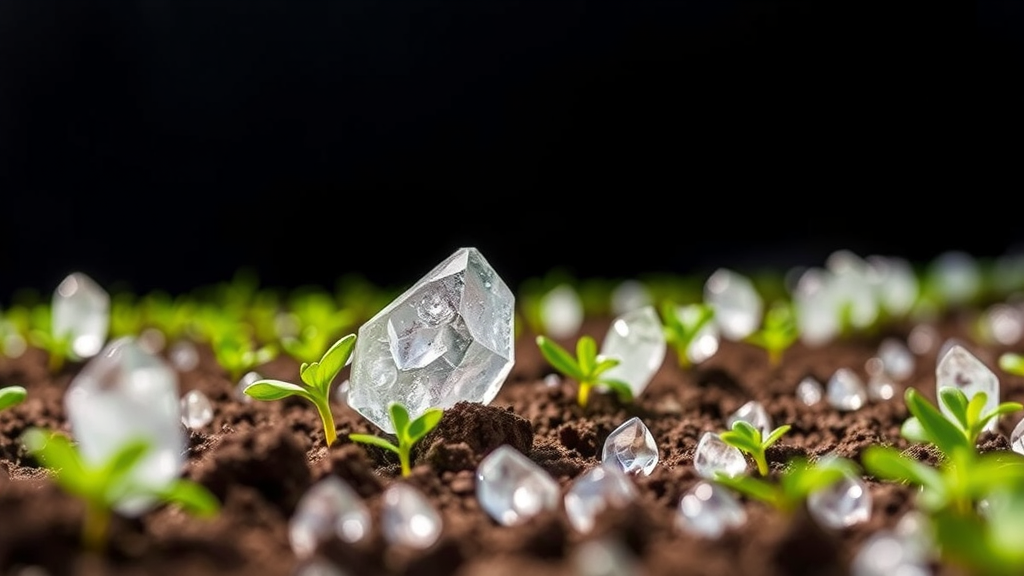
A new systematic review and meta-analysis has delivered the first quantitative verdict on one of agriculture’s most tantalizing nanomaterials: metal-organic frameworks, or MOFs, the ultra-porous crystalline compounds being repurposed as smart fertilizers. The analysis, published in BMC Agriculture, finds that MOF-based nanofertilizers significantly improve crop yield, nutrient uptake, kernel traits, and even pathogen suppression under controlled conditions. But the same analysis sounds a sobering alarm: the evidence base rests on just six studies, nearly all short-term greenhouse or laboratory experiments, and not a single one assessed the environmental fate of these materials in real fields.
The stakes could hardly be higher. Global food systems face the challenge of feeding a projected 10 billion people by 2050, yet current fertilizer practice is astonishingly wasteful. Between 40 and 80 percent of the millions of tons of fertilizer applied each year are lost to volatilization, leaching, and runoff, driving eutrophication, soil degradation, and groundwater contamination. Nutrient use efficiency remains dangerously low, typically 30 to 50 percent for nitrogen, 20 to 50 percent for phosphorus, and 35 to 50 percent for potassium. Farmers compensate by applying more, which amplifies both costs and environmental externalities. Any material that could lock nutrients into a slow-release scaffold tuned to plant demand would represent a genuine revolution.
Metal-organic frameworks are, in chemical terms, lattices of metal nodes—iron, zinc, zirconium, or copper—connected by organic linker molecules into three-dimensional networks with extraordinary internal surface area and programmable porosity. That architecture allows them to adsorb, carry, and release guest molecules on cue. In agriculture, researchers have loaded MOFs with nitrogen, phosphorus, potassium, and micronutrients, or with agrochemicals such as fungicides and the plant hormone abscisic acid, so that release is triggered by environmental stimuli like pH, moisture, or enzyme activity. Examples cited in the review include iron-based MOFs that boosted biomass in hydroponic beans by roughly 9.6 percent with lower fertilizer inputs, biodegradable oxalate-phosphate-amine MOFs that break down naturally in soil, and beta-cyclodextrin-derived MOF carbon that slowly delivers potassium to rice while simultaneously adsorbing herbicides.
To move beyond scattered anecdotal claims, the research team—led by Shelly Singh of the Patanjali Research Foundation and Banasthali Vidyapith, with Sourav Ghosh of the Centre for Human Genetics among the co-authors—registered a protocol with PROSPERO and followed PRISMA 2020 reporting standards. They searched PubMed, Scopus, Web of Science, ScienceDirect, and Google Scholar for controlled experiments published between 2015 and October 2025 that tested MOF formulations on cultivated plants and reported extractable data on yield, nutrient uptake, or toxicity. From 67 initial records, only six studies survived screening; five provided sufficient statistics for meta-analysis. Inter-reviewer agreement at full-text screening was high, with a Cohen’s kappa of 0.87, and study quality was rated with a modified Newcastle-Ottawa Scale, with four studies judged good and two fair.
The pooled results were striking, though uneven. Across five estimates, MOF treatments produced a standardized mean difference of 24.04 for nutrient uptake, encompassing ammonium and nitrate nitrogen, available phosphorus, and iron accumulation. Yield indices, drawn from rice experiments with Fe-based MOFs and polymer-MOF hybrids, showed a pooled effect of 3.65, while kernel-related attributes improved with a pooled effect of 1.99. Perhaps most eye-catching was pathogen inhibition: functionalized MOFs, including abscisic-acid-loaded MIL-100(Fe) that protects cotton against drought and azoxystrobin-loaded iron MOFs that suppress Phytophthora infestans, yielded a pooled effect of 13.34 with zero heterogeneity. Notably, no phytotoxicity, chlorosis, or growth suppression was reported at the doses tested, which ranged from 20 to 150 milligrams per liter in liquid applications to 2 to 3 grams per pot or soil unit.
Yet the authors are emphatic that these numbers demand caution. The nutrient uptake estimate was dominated by two nitrogen-specific results from a single 2019 study, each with standardized effects exceeding 50, and heterogeneity across studies was extreme—an I-squared of 93.1 percent and a between-study variance of 287.60. Leave-one-out sensitivity analysis showed that removing either of those two observations dramatically shrank both the pooled effect and the heterogeneity. In plain terms, the headline figure reflects context-specific responses to particular MOF chemistries, crops, and exposure durations rather than a stable, generalizable agronomic gain. For yield and kernel outcomes, only two studies contributed to each pooled estimate, making formal sensitivity analysis impossible and marking the findings as low-certainty, exploratory evidence.
The environmental picture is even thinner. None of the included studies measured how MOFs persist, degrade, or transform in soil—processes such as linker hydrolysis, metal-node transitions, complexation with organic matter, or secondary mineral formation. No study profiled soil microbial communities, measured enzyme activity, or tracked leaching, runoff, or vertical transport of MOF particles or their breakdown products toward groundwater. Because experiments lasted less than six months, chronic toxicity, bioaccumulation, and trophic transfer could not be assessed at all. The review also flags that conventional MOF synthesis relies on organic solvents, metal salts, and energy-intensive steps, and that no life-cycle or techno-economic analysis exists to support claims of large-scale sustainability.
Geographic concentration compounds the problem. Nearly all the studies came from China, with one from India, and crops tested were limited to wheat, rice, tomato, and cotton. The formulations examined—ZIF-8, MIL-100(Fe), UiO-66-family materials, MOF-biochar composites, and polymer hybrids—represent only a sliver of the vast MOF design space, and inconsistent characterization of particle size, crystallinity, and dissolution behavior hampers cross-study comparison. Extrapolating from iron- and zinc-based frameworks to the entire class of MOF fertilizers, the authors warn, is not scientifically justified at this stage.
What the review does establish is a roadmap. The authors call for multi-season field trials that capture realistic soil-plant-environment interactions, long-term monitoring of MOF persistence and metal-ligand release, soil-column leaching studies to trace exposure pathways to groundwater, and systematic assessment of soil microbiome responses. They also urge life-cycle assessment, green synthesis development, and techno-economic analysis to determine whether MOF fertilizers can be produced affordably and cleanly at agricultural scale. Until those gaps are filled, the verdict is a carefully hedged one: MOF-based nanofertilizers clearly deliver measurable agronomic benefits in the greenhouse and the laboratory, and their controlled-release chemistry aligns elegantly with sustainable development goals on hunger and responsible production—but their safety, scalability, and real-world performance remain, for now, an open question that only rigorous field ecology can answer.
Subject of Research: Agronomic efficacy and environmental safety of metal-organic framework-based nanofertilizers in agriculture
Article Title: Evaluating metal-organic framework-based fertilizers in agriculture: evidence from a systematic review and meta-analysis
Article References: Singh, S., Ghosh, S., Arya, V. P., Chakraborty, D., & Balkrishna, A. (2026). Evaluating metal-organic framework-based fertilizers in agriculture: evidence from a systematic review and meta-analysis. BMC Agriculture, 2(1), Article 23. https://doi.org/10.1186/s44399-026-00047-9
Image Credits: AI Generated
DOI: 10.1186/s44399-026-00047-9
Keywords: metal-organic frameworks, nanofertilizers, controlled nutrient release, crop yield, nutrient uptake, systematic review, meta-analysis, agricultural nanotechnology, environmental safety, soil health, sustainable agriculture, pathogen inhibition
Cite Scienmag News
Alan Morgan. (September 12, 2026). Nanoporous Crystal Fertilizers Boost Crops, But Safety Evidence Lags Behind. Scienmag. https://scienmag.com/nanoporous-crystal-fertilizers-boost-crops-but-safety-evidence-lags-behind/
Alan Morgan. "Nanoporous Crystal Fertilizers Boost Crops, But Safety Evidence Lags Behind." Scienmag, 12 September 2026, https://scienmag.com/nanoporous-crystal-fertilizers-boost-crops-but-safety-evidence-lags-behind/. Accessed 12 September 2026.
Alan Morgan. "Nanoporous Crystal Fertilizers Boost Crops, But Safety Evidence Lags Behind." Scienmag. September 12, 2026. https://scienmag.com/nanoporous-crystal-fertilizers-boost-crops-but-safety-evidence-lags-behind/


