


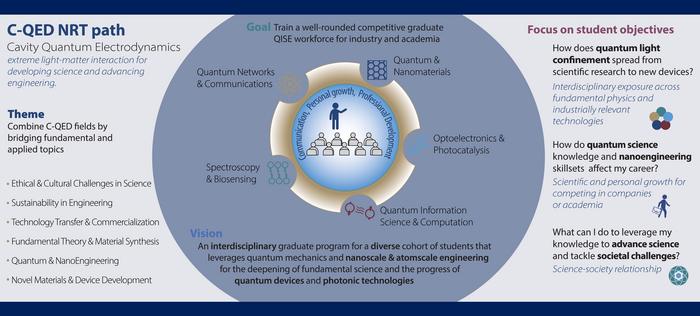
HOUSTON – (Aug. 29, 2024) – A research traineeship program developed by a team of Rice University faculty led by Junichiro Kono has received an award of $3 million over five years from the National Science Foundation (NSF) to equip a new generation of scientists and engineers with the skills needed to serve as leaders in quantum technology innovation.

Credit: (Image courtesy of Junichiro Kono/Rice University)
HOUSTON – (Aug. 29, 2024) – A research traineeship program developed by a team of Rice University faculty led by Junichiro Kono has received an award of $3 million over five years from the National Science Foundation (NSF) to equip a new generation of scientists and engineers with the skills needed to serve as leaders in quantum technology innovation.
The NSF Research Traineeship (NRT) Program is “designed to encourage the development and implementation of bold, new potentially transformative models for STEM graduate education training,” according to the agency website. The Rice NRT Program will provide interdisciplinary training to a total of 30 students (14 directly funded by the award) based on a co-advisory model that pairs each trainee with faculty mentors from different disciplines in natural sciences and engineering, combining expertise from quantum physics, optics and nanotechnology.
The traineeship aims to equip graduate students with the skills needed to tackle complex problems in the field of cavity quantum electrodynamics, which studies the unique light-matter interactions that occur in micro- and nanoscopic cavities.
“This field is critical for innovation in ultrahigh-performance computing, advanced materials and energy harvesting,” said Kono, Rice’s Karl F. Hasselmann Professor in Engineering, professor of electrical and computer engineering, physics and astronomy and materials science and nanoengineering and faculty director of the Smalley-Curl Institute (SCI); and Alessandro Alabastri, assistant professor of electrical and computer engineering and co-principal investigator of the project. “The program will impact the education of more than 150 Rice graduate students over the course of five years thanks to the wide range of planned activities, including new courses, internships and both personal and career development programs.”
Highlighting the promise of quantum science and technology to benefit society by enabling advances in clean energy, artificial intelligence and new materials, the United Nations issued a proclamation declaring 2025 as a “yearlong, worldwide initiative … aimed at increasing public awareness of the importance of quantum science and applications.” Kono said the proclamation provides a fitting context for the launch of the NRT Program at Rice.
“This program will cover both the basic science and the practical use of quantum technology,” Alabastri said. “The plan is to combine theory and experiments, leveraging advanced spectroscopic techniques and numerical modeling in order to understand the behavior of quantum materials interacting with photons in nanoscale volumes. Such understanding could serve to improve existing quantum devices and occasion insights into fundamental principles that could lay the foundation for entirely new technologies.”
Kono and Alabastri said the program’s interdisciplinary approach bridges quantum mechanics, photonics and materials science, aiming to push the boundaries of current knowledge and technology in these fields. A standout feature of the program is the co-mentorship model across natural sciences and engineering, which will be facilitated by the SCI.
“The strong interdisciplinary foundation of Rice’s Applied Physics Program (APP) inspired the proposal, and the university’s track record in collaboration was pivotal to its success,” said Kono and Alabastri, who is also chair of the APP committee. “We would like to thank participating faculty, whose commitment and support will be invaluable to ensuring this initiative makes an impactful contribution to workforce development in an area of national priority.”
Rigorous evaluation, diverse recruitment strategies and impact-oriented outreach further enhance the NRT’s innovation and inclusivity in preparing students for quantum technology careers. Taking a holistic approach, the traineeship includes professional development components such as workshops in communication and leadership and industry internships.
The NRT group at Rice coalesced thanks to a proposal put forth during a meeting of SCI’s Thematic Working Interest Group (TWIG) ⎯ a self-assembled collaboration of faculty from across multiple departments in the schools of natural sciences and engineering. Since 2021 when the SCI started convening TWIGs, institute faculty have held more than a dozen meetings, all with the purpose of nurturing crossdisciplinary innovation and turning it into funded projects.
TWIG will now become the newly established Rice Center for Cavity QED (RCCQ) led by Alabastri and Songtao Chen, the Texas Instruments Assistant Professor of Electrical and Computer Engineering and a key member of the NRT program. The RCCQ will drive the execution of the NRT.
Other Rice co-PIs on the program include Kaden Hazzard, associate professor of physics and astronomy, and Hanyu Zhu, assistant professor of materials science and nanoengineering and physics and astronomy. Core personnel of the program include Shengxi Huang, associate professor of electrical and computer engineering; Aditya Mohite, the William M. Rice Trustee Professor, professor of electrical and computer engineering and materials science and nanoengineering and faculty director of the Rice Engineering Initiative for Energy Transition and Sustainability; Emilia Morosan, professor of physics and astronomy and materials science and nanoengineering and director of the Rice Center for Quantum Materials; Kevin Slagle, assistant professor of electrical and computer engineering; Tracy Volz, director of the Activate Engineering Communication Program; and Carissa Zimmermann, director of the Center for Teaching Excellence.
-30-
This news release can be found online at news.rice.edu.
Follow Rice News and Media Relations via Twitter @RiceUNews.
Award information:
Project title: “NRT-QISE: Broad Research in Interdisciplinary Development for Groundbreaking
Engineering in Cavity Quantum Electrodynamics”
Award abstract number: 2346014
About Rice:
Located on a 300-acre forested campus in Houston, Rice University is consistently ranked among the nation’s top 20 universities by U.S. News & World Report. Rice has highly respected schools of architecture, business, continuing studies, engineering, humanities, music, natural sciences and social sciences and is home to the Baker Institute for Public Policy. With 4,574 undergraduates and 3,982 graduate students, Rice’s undergraduate student-to-faculty ratio is just under 6-to-1. Its residential college system builds close-knit communities and lifelong friendships, just one reason why Rice is ranked No. 1 for lots of race/class interaction, No. 2 for best-run colleges and No. 12 for quality of life by the Princeton Review. Rice is also rated as a best value among private universities by Kiplinger’s Personal Finance.
Cite Scienmag News
Alan Morgan. (August 29, 2024). Interdisciplinary Rice graduate program earns $3 million NSF grant. Scienmag. https://scienmag.com/interdisciplinary-rice-graduate-program-earns-3-million-nsf-grant/
Alan Morgan. "Interdisciplinary Rice graduate program earns $3 million NSF grant." Scienmag, 29 August 2024, https://scienmag.com/interdisciplinary-rice-graduate-program-earns-3-million-nsf-grant/. Accessed 5 September 2026.
Alan Morgan. "Interdisciplinary Rice graduate program earns $3 million NSF grant." Scienmag. August 29, 2024. https://scienmag.com/interdisciplinary-rice-graduate-program-earns-3-million-nsf-grant/

