


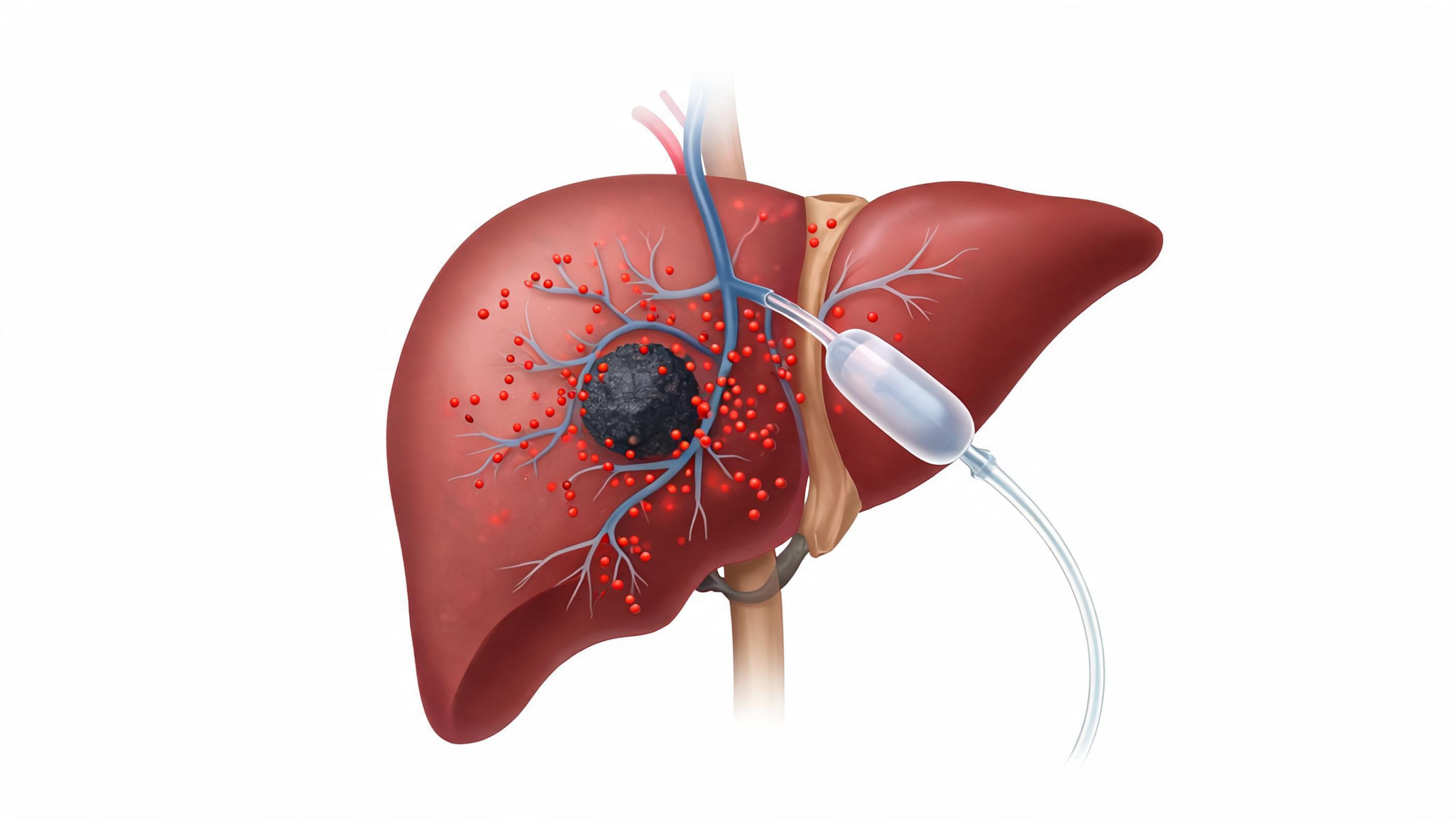
For patients with inoperable liver tumors, transarterial radioembolization offers a way to deliver lethal radiation doses directly into the vascular supply of malignancies while sparing healthy tissue. The technique depends on millions of microscopic radioactive spheres being carried by arterial blood flow into the tumor’s feeding vessels, and success hinges on a single question: how much of the injected activity lands in the tumor rather than in normal liver or, worse, elsewhere in the body. A new study from University Hospitals Leuven has now delivered a surprising answer to a question interventional radiologists have been debating for years, finding that a catheter technology widely promoted to improve targeting may actually make things worse, at least under the conditions tested.
The research, published in CVIR Oncology, examined whether balloon-occlusion microcatheters could improve tumor targeting during holmium-166 radioembolization. These devices carry a small inflatable balloon near their tip. When inflated inside a hepatic artery branch, the balloon temporarily halts blood flow beyond it, creating a zone of static flow arrest that proponents believe should push injected microspheres deeper into the tumor bed while preventing reflux back toward healthy liver. The idea has gained traction in transarterial chemoembolization, where several studies have reported better tumor control when the balloon is deployed. But rigorous, head-to-head evidence in radioembolization, where the physics of microsphere delivery matters just as much, has remained scarce.
What makes the Leuven study unusual, and scientifically valuable, is its within-patient design. Seven patients with unresectable primary liver tumors, six with hepatocellular carcinoma and one with hepatic angiosarcoma, each received two separate scout injections of holmium-166 microspheres at exactly the same arterial sites. The first scout dose, delivered during the standard work-up roughly two weeks before treatment, used a conventional end-hole catheter. The second, performed on the day of treatment, used an inflated balloon-occlusion catheter positioned at the identical location, with matching injection pressures, microsphere numbers, and imaging protocols. Because holmium-166 scouts and therapeutic doses use identical poly-L-lactic acid microspheres, the researchers could isolate the effect of the catheter itself with unusual precision, avoiding the confounding that arises when technetium-99m macroaggregated albumin, a particle with different size and shape characteristics, is used as a proxy.
After each scout injection, the team acquired single-photon emission computed tomography combined with CT to map exactly where the radioactive microspheres had settled. Their primary endpoint was the tumor-to-normal liver uptake ratio, a key measure of targeting quality that predicts whether a tumor receives a tumoricidal dose. The result ran counter to expectations. In six of the seven patients, the balloon catheter produced a lower tumor-to-normal liver uptake ratio than the conventional catheter. The median ratio fell from 3.1 with the conventional device to 1.7 with the balloon, a geometric mean ratio of 0.41. While this comparison did not reach conventional statistical significance with only seven pairs, the pattern was remarkably consistent, and a binomial test of the six-to-one split did reach significance.
Cone-beam CT scans told an equally sobering story. In six patients, the balloon catheter shrank the measured liver perfusion territory by between 7 and 60 percent compared with the conventional catheter. On its face, a tighter perfusion territory might sound like an improvement, suggesting more selective delivery. But in all six of those patients, the contracted territory no longer encompassed the entire tumor, leaving parts of the malignancy outside the treated zone. In one striking case, the balloon catheter actually raised the tumor-to-normal liver ratio while coverage of the tumor dropped to just 63 percent, a combination that could concentrate radiation in a fraction of the lesion while leaving the rest untreated. Because the balloon consistently produced lower targeting ratios or incomplete coverage, the treating physicians selected the conventional catheter for every therapeutic delivery.
Why would a device designed to improve targeting do the opposite? The researchers point to the distinctive hemodynamics of balloon occlusion. Unlike pressure-enabled drug delivery systems, which preserve forward flow through a one-way valve while blocking reflux, a balloon catheter creates abrupt static flow arrest and a pronounced pressure drop downstream of the balloon. The liver’s arterial anatomy is richly interconnected, with communicating arcades linking segments and even lobes. When the balloon cuts off flow at one branch, blood finds its way back into the occluded territory through these collaterals, and the redirected inflow can carry microspheres away from the intended target. Tumors situated at the boundary between adjacent vascular territories, so-called watershed tumors, are particularly vulnerable, because their arterial supply may come from more than one feeder artery and flow modulation at a single injection site leaves portions of the lesion poorly perfused.
The injection protocol may also have played a role. Holmium-166 scout doses at Leuven are delivered through a standardized low-pressure administration box designed to prevent overpressurization of the vial, a safety necessity for the radioactive microsphere system. That low-pressure regimen contrasts with balloon-assisted chemoembolization, where operators can push high injection pressures through a syringe mounted directly on the catheter, potentially overcoming watershed effects. Bench testing confirmed the balloon catheter’s pressure profile closely matched that of the conventional catheter, so the team attributes the lower targeting ratios not to injection mechanics but to genuine alterations in intrahepatic flow dynamics caused by the occluding balloon itself.
The study’s authors are careful about how far these conclusions travel. The trial was terminated early after seven patients when the QuiremScout and QuiremSpheres platform was discontinued, and all scout injections followed the same fixed order, meaning an order effect from the first microsphere injection, though unlikely given published concordance between scout and therapeutic distributions, cannot be fully excluded. The patient mix also included several watershed tumors that were never ideal balloon candidates, and one patient had an angiosarcoma, complicating flow analysis. The findings characterize holmium-166 scout distribution under a low-pressure protocol and may not extend to yttrium-90 platforms, alternative delivery systems permitting higher pressures, or dynamic antireflux devices, which preclinical work suggests could behave quite differently.
There is also a broader lesson about measurement. A tumor-to-normal liver uptake ratio on its own, the authors argue, is an incomplete yardstick, because a high ratio achieved at the cost of partial tumor coverage can be actively harmful. They propose judging targeting quality as a composite of the ratio, the completeness of tumor coverage, and the exposure of non-tumoral parenchyma, an approach made practical by dual-phase cone-beam CT, which can map arterial perfusion territories far more accurately than conventional anatomical segmentation. For now, the message for clinicians is one of caution rather than condemnation: the benefit of balloon-occlusion microcatheters in radioembolization cannot be assumed, and appears to depend heavily on each patient’s vascular anatomy. Larger, randomized studies with sequence inversion, ideally comparing across microsphere platforms, delivery systems, and injection pressures, will be needed to determine whether flow modulation earns a place in the radioembolization toolkit, or whether the humble end-hole catheter, in most patients, still delivers the best dose to the tumor.
Holmium-166 itself deserves attention when weighing these results. The isotope emits both beta particles for therapeutic effect and gamma photons at 81 keV, which is what allows the same scout injection used for planning to be imaged quantitatively on SPECT rather than merely serving as a rough surrogate. Yttrium-90, by contrast, produces almost no useful gamma signal, so planning scans with technetium-99m macroaggregated albumin must stand in for the therapeutic agent, introducing known discrepancies in particle size, density, and flow behavior. The Leuven team’s paired design exploits this holmium advantage: because scout and therapy microspheres are chemically and physically identical, the observed differences in distribution can be attributed to the catheter and the altered hemodynamics rather than to a mismatch between tracer and treatment.
The clinical stakes of targeting quality are considerable. Absorbed tumor dose is one of the strongest predictors of response in radioembolization, while inadvertent delivery of activity to non-tumoral liver parenchyma drives the risk of radioembolization-induced liver disease, a potentially serious decline in hepatic function that is especially concerning in patients with compromised liver reserve. A tumor-to-normal liver uptake ratio that drops from above three to below two, as observed in most patients here, implies a substantial shift of activity away from the malignancy, which could translate into lower tumoricidal doses and reduced treatment efficacy if such a distribution were used for therapy.
The study also illustrates a practical constraint of radioembolization logistics that is easy to overlook. Holmium-166 decays with a half-life of about 26 hours, and therapeutic activity must be manufactured and calibrated for a pre-specified treatment time. Because the balloon-occlusion scout was performed on the treatment day itself, the prescribed activity could not be recalculated from the alternative dosimetry, meaning the final delivery necessarily followed the conventional catheter plan. This timing structure, while a limitation for flexibility, is precisely what allowed the two work-ups to be compared within the same patient under otherwise matched conditions.
Finally, the findings add to a growing recognition that flow-modulating devices are not interchangeable. Static occlusion and dynamic antireflux systems alter intrahepatic pressure and flow in fundamentally different ways, and their effects may diverge across tumor types, vascular architectures, and injection protocols. Careful per-patient evaluation, rather than blanket adoption of any single device, remains the soundest approach.
Subject of Research: The effect of balloon-occlusion microcatheters on tumor targeting in holmium-166 transarterial radioembolization.
Article Title: Effect of balloon-occlusion microcatheters on tumor targeting in holmium-166 radioembolization: a within-patient comparative study
Article References: Bonne, L., Deroose, C. M., Deckers, W., Laenen, A., Terwinghe, C., Baete, K., Verslype, C., & Maleux, G. (2026). Effect of balloon-occlusion microcatheters on tumor targeting in holmium-166 radioembolization: a within-patient comparative study. CVIR Oncology, 2(1), Article 23. https://doi.org/10.1007/s44343-026-00056-0
Image Credits: AI Generated
DOI: 10.1007/s44343-026-00056-0
Keywords: radioembolization, holmium-166, balloon-occlusion catheter, tumor targeting, interventional radiology, liver cancer, hepatocellular carcinoma, SPECT/CT, cone-beam CT, transarterial radioembolization, microspheres, hemodynamics
Cite Scienmag News
Nathaniel Bowman. (September 10, 2026). Balloon Catheters Fail to Boost Tumor Targeting in Holmium-166 Radioembolization Trial. Scienmag. https://scienmag.com/balloon-catheters-fail-to-boost-tumor-targeting-in-holmium-166-radioembolization-trial/
Nathaniel Bowman. "Balloon Catheters Fail to Boost Tumor Targeting in Holmium-166 Radioembolization Trial." Scienmag, 10 September 2026, https://scienmag.com/balloon-catheters-fail-to-boost-tumor-targeting-in-holmium-166-radioembolization-trial/. Accessed 10 September 2026.
Nathaniel Bowman. "Balloon Catheters Fail to Boost Tumor Targeting in Holmium-166 Radioembolization Trial." Scienmag. September 10, 2026. https://scienmag.com/balloon-catheters-fail-to-boost-tumor-targeting-in-holmium-166-radioembolization-trial/


