


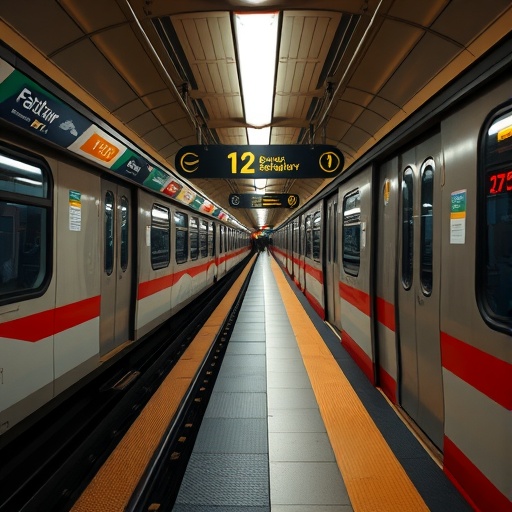
Every morning, millions of people around the world descend into subway stations, tap their fare cards, and trust that the trains will carry them to work, school, and home on time. Behind the scenes, transit operators wage a constant battle against uncertainty: knowing how many riders will flood a platform at eight o’clock tomorrow morning, where those riders are headed, and how long their journeys will take. A new study published in IEEE/CAA Journal of Automatica Sinica offers a strikingly effective answer to this challenge, introducing a forecasting model that predicts both passenger destinations and travel times a full day in advance—and does so by exploiting a deceptively simple insight about human behavior: we are creatures of habit.
The research, led by Professor S. Joe Qin of Lingnan University in Hong Kong, tackles a problem that has long frustrated transportation scientists. Most existing forecasting tools focus narrowly on predicting passenger volume at individual stations—essentially counting how many people will enter or exit a given location. While useful, such approaches miss the richer structure of subway travel. They fail to capture where riders originate, where they are going, and how long their trips take, which means they cannot represent the network as an interconnected system. That gap matters enormously for operations, because congestion at one station is rarely an isolated event; it ripples through the network as delayed trains arrive late at downstream platforms.
Part of the difficulty is fundamentally a data problem. When a passenger taps into a subway station, the system records the entry, but the destination remains unknown until that passenger taps out—which may happen tens of minutes later, after the rider has already boarded a train, transferred lines, and traveled several kilometers. A model that waited for exit data would always be looking at the past. To forecast destinations one day ahead, a model must infer them before riders even begin their journeys, relying on patterns rather than real-time observations of completed trips.
The other part of the difficulty is a modeling problem. Many popular forecasting methods, including classical time-series techniques such as ARIMA and SARIMA and a variety of neural network approaches, consider only limited temporal scales—typically the passenger flows of the preceding hours. They rarely explore how rider behavior repeats across hours, days, and weeks simultaneously, and they often ignore the correlations between stations, even though commuting patterns bind stations together in strong, predictable ways. A residential station empties out in the morning precisely because a business district fills up; treating the two in isolation discards half the story.
Qin’s team addressed both shortcomings with a framework built around what they call the travel-time distribution and destinations (TDD) matrix. Rather than predicting a single aggregate number—say, 5,000 passengers leaving Station A—the TDD matrix decomposes that flow into its components: the proportion of passengers traveling from each origin station to every possible destination, paired with the expected travel times for each of those origin-destination pairs. In essence, the model produces a probabilistic map of tomorrow’s journeys for every station in the network, specifying not just how many people will move, but where they will go and when they will arrive.
To build this model, the researchers analyzed years of real data from the Shenzhen subway system in China, drawing on fare card records from 2013 and 2019. The analysis revealed a remarkable degree of regularity in rider behavior. A passenger’s activity on any given day closely resembles the same day of the previous week, and weekdays closely resemble other weekdays. “By quantifying multi-time-scale similarities across weeks, days, and time intervals, we unveil the underlying mechanisms of passengers’ travel patterns, revealing predictable and repetitive mobility behavior,” Qin explains. This layered structure—daily rhythms nested within weekly cycles, and weekly cycles nested within seasonal trends—forms the mathematical backbone of the forecasting approach.
Armed with these multi-time-scale patterns, the model uses data from past days and past weeks to project tomorrow’s travel patterns for each station. Crucially, the day-ahead forecast is not meant to stand alone. Once combined with real-time counts of riders entering stations, the model can estimate how many passengers will exit at each destination and at what times, effectively closing the loop between prediction and observation. An operator watching tomorrow’s forecast can anticipate that a particular interchange will experience a surge of transfers at 8:30 a.m., for example, and adjust train frequency or staffing accordingly before the crowd materializes.
The performance results are compelling. When benchmarked against widely used forecasting methods—including ARIMA and SARIMA models and neural network-based approaches—the TDD model outperformed its competitors for the large majority of stations studied, cutting prediction error by roughly 10 percent on average. The advantage was most pronounced at stations exhibiting high levels of regularity, such as commuter working centers and residential hubs. “The TDD model exhibits a significant advantage over the benchmark methods for stations that exhibit a high level of regularity, such as common commuter working and residential centers,” Qin notes. “These stations generate high volumes of passengers especially during rush hours and therefore it is important to obtain accurate predictions for them.” In other words, the model excels precisely where accuracy matters most: the crowded nodes where congestion risk is greatest.
The implications extend well beyond academic benchmarks. Subway operators could deploy TDD-based forecasting to plan train schedules proactively rather than reacting to overcrowding after it occurs. A control center that knows, a day in advance, that a residential line will funnel an unusually large share of riders toward a financial district during the morning peak can add services, adjust headways, or prepare crowd-management measures before platforms become dangerous. Congestion prevention, rather than congestion response, becomes an operational possibility. During events, holidays, or service disruptions—situations where ridership patterns shift but still echo past behavior—the framework offers a structured way to anticipate demand rather than guess at it.
Equally significant is the model’s practical accessibility. It relies entirely on data that subway systems already collect through existing fare card systems. No new sensors, no additional infrastructure, no costly hardware upgrades are required. For rapidly growing metro networks in cities across Asia, Latin America, and Africa—where subway expansion is outpacing the sophistication of management tools—this low barrier to adoption could prove decisive. The same mathematical machinery, the researchers suggest, could extend to other mobility systems with recurring travel patterns, from bus networks to bike-share programs.
The study arrives at a moment when urban transit systems face mounting pressure. Subway networks ease road congestion and reduce carbon emissions, but as cities grow denser, the cost of operational misjudgment rises. A platform that cannot absorb its morning surge becomes a safety hazard; a misallocated fleet compounds delays across an entire line. Forecasting tools like the TDD model transform the subway from a reactive system into a predictive one, and in doing so they illustrate a broader theme in modern data science: the most powerful predictions often come not from ever-larger neural networks, but from carefully quantifying the rhythms that human behavior already contains.
For the millions of riders who will tap through the gates of Shenzhen and cities like it tomorrow morning, the forecast will be invisible. But if their trains run a little more smoothly, their platforms a little less packed, the quiet mathematics of repetition—captured in a matrix, projected one day ahead—will have done its work.
Cite Scienmag News
Courtney Benton. (September 10, 2026). Predicting subway passenger destinations and travel times a day ahead. Scienmag. https://scienmag.com/predicting-subway-passenger-destinations-and-travel-times-a-day-ahead/
Courtney Benton. "Predicting subway passenger destinations and travel times a day ahead." Scienmag, 10 September 2026, https://scienmag.com/predicting-subway-passenger-destinations-and-travel-times-a-day-ahead/. Accessed 10 September 2026.
Courtney Benton. "Predicting subway passenger destinations and travel times a day ahead." Scienmag. September 10, 2026. https://scienmag.com/predicting-subway-passenger-destinations-and-travel-times-a-day-ahead/


