


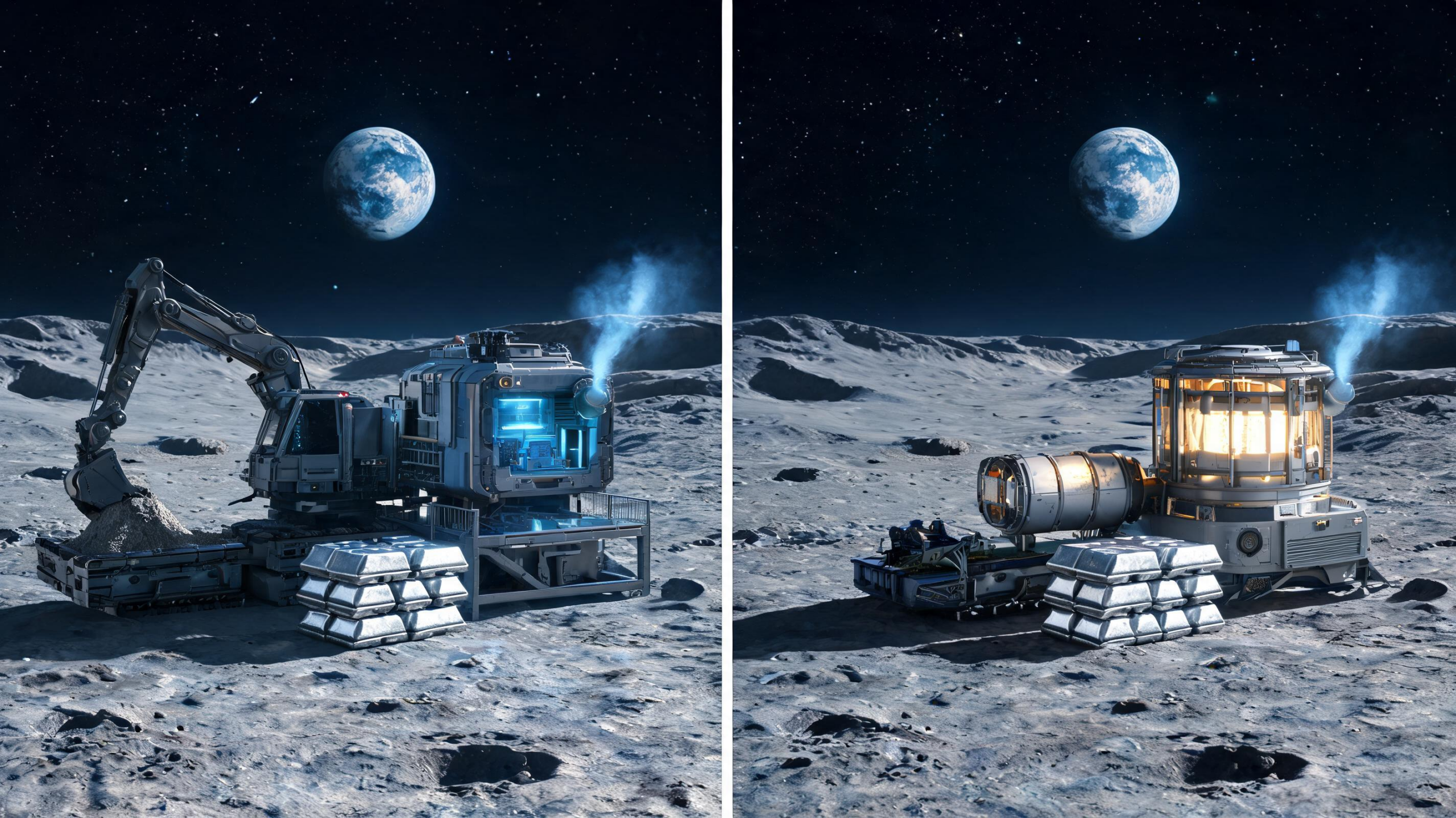
The dream of a permanent human presence on the Moon has always collided with a brutal logistical reality: every kilogram of oxygen, metal, or equipment launched from Earth costs a fortune in rocket propellant and payload capacity. Now, a new review and thermodynamic analysis published in the journal Space and Planetary Resources takes one of the most detailed looks yet at how future lunar settlers could break that dependency by mining the Moon itself. The study, led by Jacob N. Ortega and Frank D. Han of Missouri University of Science and Technology together with Benjamin Rupp of NASA’s Marshall Space Flight Center, compares three leading extraction technologies for pulling aluminum and oxygen out of lunar soil, and its verdict may reshape how agencies plan the first true off-world industrial base.
The raw material in question is lunar regolith, the powdery, shattered blanket of rock that covers the Moon’s surface. Forged by billions of years of micrometeoroid impacts and space weathering, regolith is a complex mixture of silicate minerals and metal oxides, including silicon dioxide, aluminum oxide, calcium oxide, iron oxide, titanium dioxide, and magnesium oxide. Locked inside these oxides are exactly the elements a lunar base needs most: oxygen for breathing and rocket propellant, and metals for construction, fabrication, and power infrastructure. But the chemistry is unforgiving. These elements are bound tightly in mineral matrices, and liberating them demands either extreme heat or aggressive electrochemical processing. The Moon’s own environment compounds the challenge, offering high vacuum, reduced gravity, abrasive dust, and a fourteen-day night that strains any power system.
Where you dig matters enormously. The dark volcanic plains of the lunar maria are enriched in iron, titanium, and magnesium, making them attractive for processes that target those oxides. The brighter highlands, by contrast, are dominated by anorthosite, a rock built largely from the aluminum- and calcium-rich feldspar anorthite. Because aluminum is prized for structural applications, electrical conductors, and recyclability, the research team focused its comparison on anorthite as a representative highlands feedstock, giving all three extraction methods an identical starting material so that differences in performance could be attributed to the processes themselves rather than to geochemistry.
The first contender is carbothermal reduction, or CTR, a high-temperature chemical process that uses carbon, typically as graphite or methane, to strip oxygen from metal oxides. In theory, certain oxides can be reduced near 850 degrees Celsius, but practical operation generally demands temperatures above 1500 degrees Celsius, where partial melting of the feedstock improves reactant mobility and conversion. CTR splits into two regimes: a solid-gas pathway below roughly 1200 degrees Celsius with slower kinetics and incomplete conversion, and a molten-phase pathway above about 1400 degrees Celsius that delivers more extensive reduction. The process is especially attractive for silicon and iron production from iron-rich mare regolith, and it pairs naturally with concentrated solar thermal heating, reducing the demand for electrical power. Its Achilles heel is carbon. The Moon has essentially none, so large-scale CTR would require either constant resupply from Earth or in-situ carbon production, both of which add logistical complexity. Carbon can also react with silicon products to form silicon carbide, threatening both product purity and reactor longevity. Prior studies of carbothermal reduction on lunar regolith report oxygen yields of only 2.4 to 7.9 percent of the feedstock mass, corresponding to just 5.4 to 17.5 percent of the total available oxygen.
The second contender is molten salt electrolysis, or MSE, an electrochemical approach in which metal oxides are reduced inside a molten salt electrolyte, most commonly calcium chloride. Operating at a comparatively moderate 800 to 1000 degrees Celsius, MSE follows the logic of the FFC Cambridge process, in which oxygen ions are pulled directly out of solid oxides. Metal cations migrate to the cathode and deposit as metal, while oxygen gas evolves at the anode. The study highlights a lunar-adapted configuration called LISAP-MSE, for Lunar In-Situ Aluminum Production via Molten Salt Electrolysis, which first leaches anorthite with hydrochloric acid, thermally decomposes the resulting aluminum chloride hydrate into alumina, and then electrolytically reduces that alumina to metallic aluminum and oxygen. The calcium chloride electrolyte may even be derivable from processed regolith itself. MSE’s great strength is selectivity: because only electrochemically active oxides are reduced, beneficiation steps such as acid leaching, flotation, or magnetic separation can be used upstream to boost feedstock quality and deliver high-purity metals. The trade-offs are system complexity, slower oxygen production rates, and the need to manage electrode degradation and electrolyte stability over long durations in a dusty environment.
The third contender, molten regolith electrolysis, or MRE, is the most direct of all. Rather than beneficiating feedstock or adding an electrolyte, MRE simply melts raw regolith above roughly 1300 degrees Celsius, where the silicate melt becomes ionically conductive, and applies an electric potential across it. Metal cations such as iron, titanium, silicon, aluminum, and calcium are reduced at the cathode into mixed alloys, while oxygen streams off at the anode. This brute-force simplicity makes MRE appealing for early-stage missions where mass efficiency matters and oxygen is the priority, and it can in principle process the complete range of oxides present in lunar soil. But the same extreme temperatures impose severe engineering burdens: refractory containment materials must resist corrosion by molten silicate, electrodes must survive repeated thermal cycling and oxidation, and continuous power delivery is essential to keep the melt conductive and the reaction progressing.
To compare the three fairly, the researchers built a rigorous thermodynamic framework using temperature-adjusted enthalpy, entropy, and Gibbs free energy, drawing on NIST thermochemical data supplemented by specialized datasets for anorthite, steam, and graphitic carbon, whose high-temperature heat capacities required alternative formulations. Each process was modeled as complete conversion of anorthite to its products, establishing an upper-bound theoretical limit for aluminum and oxygen extraction. The results were normalized per kilogram of aluminum and oxygen produced, allowing a direct, first-principles comparison of inherent energy requirements at each process’s realistic operating temperature.
The verdict was unambiguous. All three processes are endothermic and require external energy input, but LISAP-MSE posted the lowest enthalpy and Gibbs free energy values of the three, making it the most energetically efficient route to simultaneous aluminum and oxygen production under the study’s assumptions. CTR landed in the middle, with higher thermal demands compounded by its consumable carbon feedstock and logistical overhead. MRE fared worst on energy, displaying the highest enthalpy and Gibbs free energy values, a reflection of the enormous cost of maintaining a fully molten silicate phase and driving electrochemistry within it. Notably, none of the reactions were thermodynamically spontaneous at the evaluated temperatures and one bar pressure, confirming that all of these processes will depend on sustained external heating and electrical power. The authors caution, however, that the ranking is framework-dependent: if bulk oxygen were the dominant goal, or if iron- and titanium-rich mare regolith were the feedstock, CTR and MRE could climb back up the rankings, and hydrogen reduction, excluded from this comparison, might also become attractive.
Perhaps the study’s most consequential insight is that the three technologies are not competitors at all, but natural partners. CTR and MRE share similar high-temperature operating conditions and produce high-throughput oxygen along with mixed-metal alloys of limited purity, while MSE operates cooler and refines selectively. The researchers sketch integrated architectures in which calcium aluminate byproducts from CTR and MRE are fed into an MSE module as beneficiated feedstock, yielding a high-purity calcium-aluminum alloy that then acts as a metallothermic reducing agent to liberate additional silicon and iron from leftover oxides, with the reformed calcium aluminates looping back to regenerate the alloy and release more oxygen. A second synergy uses the MSE-produced alloy as a pre-treatment for MRE, preferentially displacing iron, magnesium, and titanium from the melt to leave a silicon-enriched mixture that electrolyzes more cleanly. On the infrastructure side, the authors map out a phased concept of operations: deploy modular reactors with imported spares, pilot CTR or MRE for early oxygen, integrate autonomous excavation and hauling at rates of at least 2.54 kilograms of regolith per hour for a modest 10,000-kilogram-per-year oxygen plant, then scale up MSE modules as aluminum demand for construction and shielding grows. Power infrastructure must reach tens to hundreds of kilowatts, with nuclear fission surface power flagged as the most practical near-term backbone, supplemented by solar arrays during the lunar day. Autonomy will be essential given communication delays, and dust mitigation, through sealed pneumatic transfer, dust-tolerant seals, and electrodynamic dust shields, will decide whether reactors survive the abrasive lunar surface. The team’s recommendations for future research center on three fronts: materials durability in molten environments, continuous autonomous feedstock handling, and system-level integration of thermal, electrical, and mass flows. The message is clear: no single process can carry a lunar economy alone, and the first self-sustaining Moon base will be built on the clever coupling of all of them.
Subject of Research: Comparative thermodynamic analysis of carbothermal reduction, molten salt electrolysis, and molten regolith electrolysis for extracting aluminum and oxygen from lunar regolith
Article Title: A review and analysis of extraction methods for aluminum and oxygen from lunar regolith
Article References: Ortega, J. N., Rupp, B., & Han, F. D. (2026). A review and analysis of extraction methods for aluminum and oxygen from lunar regolith. Space and Planetary Resources, 2(1), Article 5. https://doi.org/10.1007/s44461-026-00010-1
Image Credits: AI Generated
DOI: 10.1007/s44461-026-00010-1
Keywords: lunar regolith, in-situ resource utilization, aluminum extraction, oxygen production, carbothermal reduction, molten salt electrolysis, molten regolith electrolysis, anorthite, lunar ISRU, space resources, thermodynamics, Moon base
Cite Scienmag News
Grant Pearson. (September 10, 2026). Moon Mining Showdown: Which Process Wins for Lunar Aluminum and Oxygen? Scienmag. https://scienmag.com/moon-mining-showdown-which-process-wins-for-lunar-aluminum-and-oxygen/
Grant Pearson. "Moon Mining Showdown: Which Process Wins for Lunar Aluminum and Oxygen?" Scienmag, 10 September 2026, https://scienmag.com/moon-mining-showdown-which-process-wins-for-lunar-aluminum-and-oxygen/. Accessed 10 September 2026.
Grant Pearson. "Moon Mining Showdown: Which Process Wins for Lunar Aluminum and Oxygen?" Scienmag. September 10, 2026. https://scienmag.com/moon-mining-showdown-which-process-wins-for-lunar-aluminum-and-oxygen/


