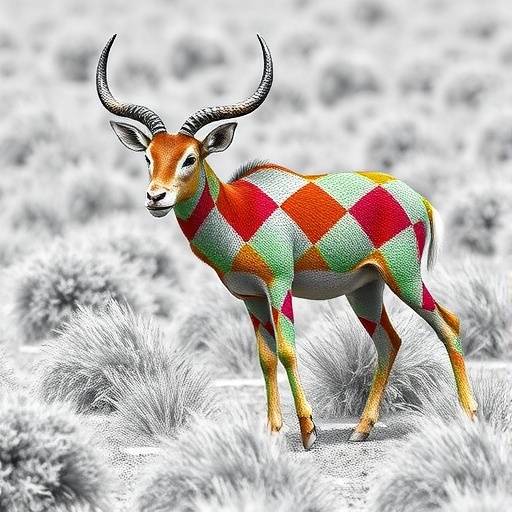
Deep in the mountainous borderlands where China, India, Myanmar, and Bangladesh meet, a semi-domesticated bovine known as the Gayal (Bos frontalis) has roamed for centuries, occupying a strange middle ground between wild cattle and household livestock. Now, one of the most comprehensive genomic studies of this enigmatic species has revealed just how genetically fragile and evolutionarily distinct it truly is. A research team led by Ruiyang Li, Xiaodong Wang, Yuan Zhang, and colleagues at Guizhou University in Guiyang, China, has carried out a genome-wide assessment of Gayal genetic diversity and population structure using whole-genome resequencing, publishing their findings in the journal BMC Genomics. The study not only confirms that the Gayal is a singular branch on the bovine family tree, more closely allied to wild cattle than to the domesticated breeds that graze alongside it, but also sounds an urgent alarm about the species’ shrinking genetic inheritance.
The Gayal, sometimes called the mithun, occupies a unique ecological and cultural niche. It is neither fully domesticated nor wholly wild, and for generations it has been woven into the social fabric of the hill peoples of Northeast India, Bhutan, Bangladesh, and southwestern China, where it serves as a ceremonial animal, a source of meat, and even a form of currency in traditional exchanges. Despite this cultural importance, the species has long been difficult to classify. Its origins, its relationship to gaur, banteng, and common cattle, and the extent to which interbreeding and isolation have shaped its genome have all remained contested questions. The new study tackles these questions directly, and the answers carry significant implications for the future of the animal itself.
To build their dataset, the researchers performed whole-genome resequencing on 30 Gayal individuals, capturing variants across the entire genome rather than relying on targeted markers. They then joined these data with 69 publicly available genomes representing 18 domestic and wild bovine populations, creating a combined panel that spans a remarkable slice of bovine diversity. By jointly analyzing nearly a hundred genomes, the team could place the Gayal in a precise comparative context, asking whether its genetic signals resembled those of local Yunnan cattle, of wild species such as the gaur, or of something entirely its own. The sequencing and variant discovery followed a unified single-nucleotide polymorphism calling pipeline, ensuring that variants were identified with consistent quality thresholds across all samples, a critical step when pooling data from different sequencing projects.
The results on genetic diversity were unambiguous and, in places, sobering. Three independent metrics — nucleotide diversity, heterozygosity, and inbreeding coefficients derived from runs of homozygosity — all pointed in the same direction: the Gayal carries markedly reduced genomic variation compared with other cattle populations. Nucleotide diversity measures the average number of differences per site between two individuals, and low values signal a shallow pool of raw genetic raw material on which future adaptation can draw. Heterozygosity, the proportion of sites where the two copies of a chromosome differ, tells a similar story. Most telling were the runs of homozygosity, long continuous stretches of DNA in which both chromosomes carry identical variants — a genomic signature that accumulates when parents share common ancestors. The Gayal’s genome is littered with these runs, and the resulting ROH-based inbreeding coefficients painted a picture of a species that has experienced sustained, systematic inbreeding over generations.
Patterns of linkage disequilibrium reinforced this conclusion. Linkage disequilibrium describes the non-random association of variants at nearby positions in the genome, and its decay over distance reflects how quickly recombination has scrambled haplotypes across generations. In the Gayal, these correlations persist over longer stretches than expected, a hallmark of historical inbreeding and small effective population size. When fewer individuals contribute to each generation, recombination has less opportunity to break down inherited haplotype blocks, and the genome retains long tracts of shared ancestry. For conservation geneticists, this is a familiar and worrying signature: the genetic cost of small populations is not abstract but written directly into the DNA, and it tends to compound over time as related individuals mate and deleterious recessive variants surface in homozygous form.
Perhaps the most consequential finding concerns the species’ evolutionary identity. Principal component analysis, phylogenetic reconstruction, and ADMIXTURE-based clustering — three of the standard pillars of population structure inference — converged on a single result: the Gayal forms its own distinct genetic cluster. It is not simply a population of local Yunnan cattle that has drifted apart, nor is it a hybrid swarm of domestic and wild lineages. Instead, it sits closer to wild bovines than to domestic cattle, a relationship consistent with the idea that the Gayal descends largely from the wild gaur through an independent domestication pathway rather than from the aurochs-derived lineage that gave rise to taurine and indicine cattle. The authors describe this as new genomic evidence for the independent evolutionary origin of the Gayal, a conclusion that elevates the species from a regional curiosity to a lineage with its own unique evolutionary trajectory and, therefore, its own irreplaceable gene pool.
Beyond ancestry, the team conducted genome-wide selection scans to identify regions of the genome that have been shaped by the pressures of semi-domestication, local adaptation, and natural selection in the species’ highland habitat. These scans detected multiple strong selective sweeps — genomic regions where variation has been sharply reduced because a favorable variant swept rapidly through the population, dragging nearby variants along with it. Within and near these swept regions, the researchers identified a set of compelling candidate genes tied to traits that matter enormously for any livestock species. Genes associated with immune function, including TRIM77, RASGRP1, and API5, emerged from the analysis, suggesting that pathogen pressure in the Gayal’s mountainous environment has left a detectable imprint on its genome. TRIM-family genes are known components of innate antiviral defense, while RASGRP1 plays a role in T-cell receptor signaling, linking the Gayal’s immune genome to the adaptive immune response.
Other candidate genes point to traits of direct economic and biological interest. A cluster of genes — CLDN18, NAALAD2, DZIP1L, and RAB3C — is associated with meat quality and production, an unsurprising target of selection in an animal prized for its meat across its cultural range. CLDN18 encodes a tight junction protein expressed in the gastric epithelium, with known relevance to digestive physiology, while NAALAD2 and DZIP1L have been implicated in tissue development and metabolic processes in prior studies of livestock. A single gene linked to reproduction, PDE4D, also surfaced among the candidates. Phosphodiesterases regulate intracellular signaling pathways, including those governing reproductive physiology, and PDE4D’s presence in the sweep list hints at selection on fertility traits — a trait of particular concern in a species already constrained by small population numbers. The researchers note that several of these genes were uniquely detected in the Gayal compared with other bovine populations examined in the study, underscoring the species’ distinct biological character.
The conservation implications of the study are stark. A semi-domesticated species that lives in loose association with human communities is vulnerable to a particularly insidious form of genetic erosion: small isolated herds, limited breeding management, and occasional crossbreeding with domestic cattle can each chip away at the genome, and the effects accumulate silently over generations. The study’s finding that Gayal genomic diversity is already markedly reduced — combined with clear evidence of historical inbreeding — means that the species has less evolutionary slack to absorb future challenges, whether emerging diseases, climate-driven habitat shifts, or the continued expansion of agriculture into its native range. The authors argue that the data provide a theoretical foundation for conservation and utilization efforts, and that genomic information of this kind should directly inform breeding strategies designed to preserve what remains of the Gayal’s genetic inheritance.
The practical pathway forward, the researchers suggest, lies in using the newly identified candidate genes and genomic regions as a basis for functional validation and managed breeding programs. Knowing which genes underpin immunity, meat quality, and reproduction in the Gayal allows conservationists to identify individuals carrying valuable and complementary genetic variants, and to design pairings that minimize inbreeding while retaining adaptive diversity. Germplasm management — the collection and storage of genetic material such as semen, embryos, or cell lines — offers another avenue for securing the species’ genetic future against catastrophic loss. And because the Gayal represents an independent domestication event from a wild ancestor, its gene pool may contain alleles lost from mainstream cattle breeds, making it a resource not only for its own preservation but potentially for the broader genetic improvement of cattle in challenging environments.
There is also a scientific dividend that extends beyond the Gayal itself. Whole-genome resequencing of this scale, applied to a rare and understudied species, demonstrates the power of combining newly generated data with publicly available genomes to resolve questions of ancestry, population history, and adaptation without the need for prohibitively expensive sampling campaigns. The study’s joint analysis framework — unified SNP calling, diversity estimation, ROH-based inbreeding assessment, linkage disequilibrium profiling, and multi-method structure inference — offers a replicable template for conservation genomics of other neglected livestock and semi-wild species around the world, many of which face similar pressures of small population size, unmanaged breeding, and genetic dilution through crossbreeding.
The study was conducted under protocols approved by the Animal Protection and Utilization Committee at Guizhou University and funded by the National Key Research and Development Program of China. For now, the Gayal continues to wander the forested slopes of its native highlands, oblivious to the genetic ledger its genome has revealed. But that ledger tells a clear story: a species that is evolutionarily unique, biologically distinctive, and dangerously close to the genetic margins. Whether the Gayal’s next chapters are written by careful conservation or by slow genetic erosion will depend, in large part, on how quickly its custodians act on the evidence now written in its DNA.
Cite Scienmag News
Juliet Wilcox. (September 10, 2026). Whole-genome resequencing reveals genetic diversity and structure in Gayal. Scienmag. https://scienmag.com/whole-genome-resequencing-reveals-genetic-diversity-and-structure-in-gayal/
Juliet Wilcox. "Whole-genome resequencing reveals genetic diversity and structure in Gayal." Scienmag, 10 September 2026, https://scienmag.com/whole-genome-resequencing-reveals-genetic-diversity-and-structure-in-gayal/. Accessed 10 September 2026.
Juliet Wilcox. "Whole-genome resequencing reveals genetic diversity and structure in Gayal." Scienmag. September 10, 2026. https://scienmag.com/whole-genome-resequencing-reveals-genetic-diversity-and-structure-in-gayal/