


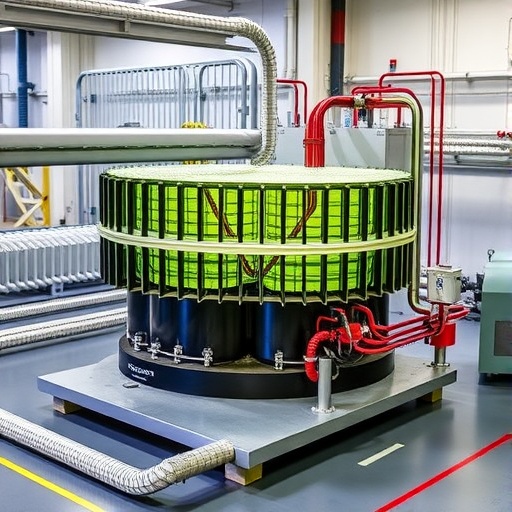
In an era when cities worldwide are grappling with water scarcity, rising energy costs and increasingly stringent environmental regulations, the question of how to treat municipal wastewater efficiently has never been more pressing. Membrane bioreactors, which combine biological treatment with membrane filtration, have long been hailed as one of the most promising answers, capable of producing high-quality effluent in a compact footprint. Yet their Achilles heel has always been the same: membranes foul, and keeping them clean traditionally requires massive amounts of air scouring that drives energy consumption to prohibitive levels. Now, a team of Chinese engineers and environmental scientists has demonstrated, at full engineering scale, that a radically different approach—shaking the membranes instead of blasting them with air—can deliver exceptional treatment performance while slashing energy use by up to 82 percent.
The study, published in the journal Engineering Environment, presents a comprehensive 20-month evaluation of a 75,000 cubic meter per day anaerobic-anoxic-oxic-anoxic system equipped with a vibrating membrane bioreactor, abbreviated AAOA-VMBR, treating real municipal wastewater. Led by Shujuan Che of Beijing OriginWater Membrane Technology Co., Ltd. and Weichen Lin of Tsinghua University’s School of Environment, with corresponding author Xia Huang of Tsinghua University, the research represents one of the largest and longest-running validations of vibrating membrane technology ever conducted. Unlike laboratory pilots or bench-scale prototypes, this system processes wastewater at a scale comparable to a mid-sized city’s daily flow, making its results directly relevant to utilities and engineers planning the next generation of treatment plants.
The core innovation lies in how the system controls membrane fouling. In conventional membrane bioreactors, fine-bubble aeration is continuously pumped beneath the membrane modules, creating turbulent upflow that scrapes biomass and particulates off membrane surfaces. This aeration typically accounts for a large share of a plant’s total energy budget, often rivaling or exceeding the energy used for biological treatment itself. The vibrating membrane bioreactor replaces this brute-force approach with mechanical reciprocation: the membrane modules are physically oscillated back and forth in the mixed liquor, generating controlled shear at the membrane surface that dislodges accumulating foulants. Because moving water past a membrane mechanically is far more energy-efficient than compressing and releasing vast volumes of air, the energy penalty of fouling control drops dramatically.
The numbers from the 20-month campaign are striking. The vibrating membrane system sustained a stable permeate flux of 16.5 liters per square meter per hour, commonly expressed as LMH, while the average transmembrane pressure rose at a mere 0.045 kilopascals per day—an extraordinarily slow fouling rate for a full-scale installation. Even more impressive, the specific energy devoted to membrane fouling control fell as low as 0.035 kilowatt-hours per cubic meter of treated water. Compared with conventional aerated membrane bioreactors, that figure represents a 65 to 82 percent reduction in the energy consumed purely to keep the membranes clean. For plant operators, whose electricity bills can run into millions of dollars annually, the implications are substantial: fouling control, long the Achilles heel of membrane technology, could cease to be the dominant energy sink.
Fouling is not merely an economic nuisance; it is the fundamental barrier that has limited membrane bioreactor adoption worldwide. When suspended solids, extracellular polymeric substances and microbial cells deposit on membrane surfaces, they form acake layer that restricts permeate flow and forces operators to increase transmembrane pressure or resort to chemical cleaning, both of which degrade membranes over time and add operational complexity. Decades of research, dating back to foundational work on fouling mechanisms in the early 2000s, have explored countless mitigation strategies—air sparging, backwashing, chemical cleaning, surface modification and hydrodynamic optimization. Mechanical vibration offers a fundamentally different physics: rather than relying on bubbles to create shear, it imposes direct, periodic displacement on the membrane itself, producing oscillatory flow and shear reversal that prevent stable foulant layers from forming. The Chinese team’s results suggest this physics translates convincingly to engineering scale.
Critically, the study did not stop at water quality and energy metrics. Because vibrating an industrial-scale membrane module involves substantial moving machinery, the researchers subjected the equipment to structural stress analysis, confirming that all critical components of the large-scale vibrating apparatus operated within safe stress limits over the prolonged monitoring period. This mechanical validation is a crucial piece of the puzzle: laboratory-scale vibrating membranes are easy to build, but scaling up reciprocating mechanisms to handle tens of thousands of cubic meters per day raises genuine engineering questions about fatigue, vibration transmission, bearing life and structural integrity. The demonstration that the full-scale equipment remained mechanically reliable throughout two years of continuous operation removes a major barrier to commercial confidence.
Equally important is what the system achieved biologically. The AAOA configuration—anaerobic, anoxic, oxic, followed by a second anoxic zone before the vibrating membrane tank—was designed to foster a specialized microbial community capable of simultaneous nitrogen and phosphorus removal. Over the monitoring period, the plant consistently removed more than 95 percent of chemical oxygen demand, more than 95 percent of ammonia nitrogen and more than 95 percent of total phosphorus, alongside 87 percent removal of total nitrogen. These are exceptional figures for a full-scale municipal facility, particularly for nitrogen, which is notoriously difficult to remove completely because it requires the orchestrated interplay of multiple microbial metabolisms across different redox zones.
The microbial key to this performance appears to be the enrichment of denitrifying phosphate-accumulating organisms, or DPAOs, within the sludge community. These remarkable bacteria can store volatile fatty acids anaerobically, then—in the same anoxic phase—use nitrate or nitrite as an electron acceptor to uptake phosphate while simultaneously reducing nitrogen oxides to nitrogen gas. In conventional enhanced biological phosphorus removal, phosphate-accumulating organisms typically require separate aerobic and anoxic stages, and the carbon substrate in municipal wastewater is often insufficient to support both full phosphorus uptake and complete denitrification. By cultivating DPAOs that perform both jobs using the same carbon, the AAOA-VMBR process effectively stretches limited influent carbon further, achieving simultaneous removal of two pollutants that normally compete for the same resources. This symbiotic strategy, previously demonstrated at pilot scale in other configurations, has now been proven sustainable over 20 months of real-world operation.
Of course, no technology is without its imperfections, and the study is candid about one significant challenge: spatial heterogeneity in foulant deposition. Even with mechanical vibration, the analysis revealed that fouling was not uniform across the membrane modules—some regions accumulated foulants faster than others, creating localized hotspots of resistance. This unevenness matters because it means parts of the membrane area are underutilized while others are over-stressed, ultimately limiting the total effective flux and potentially shortening membrane life in the worst-affected zones. The researchers attribute this to imperfect hydrodynamics within the membrane tank, where flow patterns induced by the reciprocating motion may not distribute shear uniformly across every membrane sheet. Addressing this will require optimized module geometry, refined vibration frequencies and amplitudes, and potentially computational fluid dynamics modeling to design tank internals that homogenize the shear field—challenges the team flags as priorities for future designs.
The broader context makes this work especially timely. Global urban water demand is projected to rise sharply in the coming decades, and an increasing number of cities are turning to advanced wastewater treatment not merely to meet discharge permits but to enable water reuse. Membrane bioreactors are central to that vision because their effluent quality is high enough to feed directly into reverse osmosis or other polishing steps for potable reuse. However, the energy intensity of conventional MBRs has been a persistent obstacle, particularly in developing economies where electricity costs are high and budgets are constrained. If vibrating MBR technology can consistently deliver the energy savings observed in this study while maintaining comparable or better effluent quality, it could dramatically widen the economic envelope for membrane-based treatment worldwide.
The study also builds on a growing body of international research into reciprocating membrane systems. Previous work by researchers in Singapore and South Korea demonstrated at pilot scale that low-frequency reciprocating motion can control biofouling while resisting the development of shear-tolerant biofilm communities, and other groups have explored combining membrane reciprocation with quorum quenching—a biological anti-fouling technique that disrupts bacterial cell-to-cell signaling—to achieve even greater fouling suppression. What distinguishes the new study is its scale and duration: operating a 75,000 cubic meter per day facility for nearly two years provides a depth of operational data, including seasonal variation, shock loads and long-term drift, that no pilot study can match. It transforms vibrating MBR from an intriguing laboratory concept into a validated, utility-ready technology.
Looking forward, the implications extend beyond municipal wastewater. The same mechanical fouling-control principle could be applied to anaerobic membrane bioreactors, industrial effluent treatment, resource recovery systems and even forward-osmosis or membrane distillation processes where energy constraints are similarly severe. The successful structural validation of large-scale vibrating equipment also opens the door to retrofitting existing treatment plants, where the compact footprint of MBR systems is already a major advantage. As Xia Huang and colleagues note, the combination of high pollutant removal, dramatic energy savings and demonstrated mechanical reliability positions the AAOA-VMBR as a genuinely sustainable platform for the water infrastructure of the coming decades. With urban water scarcity intensifying globally and climate commitments demanding lower-carbon treatment processes, technologies that decouple treatment performance from energy consumption are no longer a luxury—they are a necessity. This study provides the strongest engineering-scale evidence yet that vibrating membrane bioreactors can meet that challenge.
Cite Scienmag News
Denise Maddox. (September 10, 2026). Engineering-scale anaerobic-anoxic-oxic-anaerobic-vibrating MBR shows stable long-term performance. Scienmag. https://scienmag.com/engineering-scale-anaerobic-anoxic-oxic-anaerobic-vibrating-mbr-shows-stable-long-term-performance/
Denise Maddox. "Engineering-scale anaerobic-anoxic-oxic-anaerobic-vibrating MBR shows stable long-term performance." Scienmag, 10 September 2026, https://scienmag.com/engineering-scale-anaerobic-anoxic-oxic-anaerobic-vibrating-mbr-shows-stable-long-term-performance/. Accessed 10 September 2026.
Denise Maddox. "Engineering-scale anaerobic-anoxic-oxic-anaerobic-vibrating MBR shows stable long-term performance." Scienmag. September 10, 2026. https://scienmag.com/engineering-scale-anaerobic-anoxic-oxic-anaerobic-vibrating-mbr-shows-stable-long-term-performance/


