


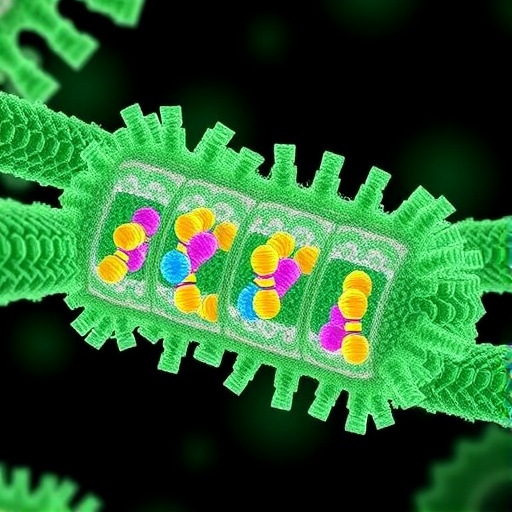
Golgi-associated plant pathogenesis-related protein 1, or GAPR-1, has long been known as a small, peripheral membrane protein that sits on the cytosolic face of the Golgi complex and physically interacts with beclin 1, a central regulator of autophagy. What has remained unclear is how a protein without a transmembrane anchor manages to organize itself on a lipid surface in a way that supports the formation of larger protein assemblies. A new study published in Cellular and Molecular Life Sciences provides a striking answer: the orientation of GAPR-1 at the membrane, controlled by a specific set of positively charged amino acids and by its fatty acid anchor, determines whether the protein can oligomerize into biomolecular condensates and engage beclin 1. The work, led by Ziying Shen and J. Bernd Helms of Utrecht University together with Robin A. Corey and Phillip J. Stansfeld in the United Kingdom, reveals an unexpected role for protein myristoylation as a regulator of how membrane-docked proteins move and present themselves.
GAPR-1 belongs to the CAP superfamily of proteins and is attached to the Golgi membrane through two features: an N-myristoyl group, a 14-carbon fatty acid chain chemically linked to the protein’s N-terminus, and a patch of ionic interactions with negatively charged lipids. To dissect how these features govern membrane binding, the team turned to molecular dynamics simulations, an approach that models every atom of a protein and a lipid bilayer over time and allows researchers to observe how the two interact at a level of detail inaccessible to most experimental techniques. The simulations revealed something subtle but consequential. When GAPR-1 docked onto a negatively charged lipid bilayer, it did not settle randomly. Instead, it adopted a preferred orientation, one stabilized by two specific lysine residues, at positions 7 and 33 of the amino acid sequence, which reach down and engage the acidic headgroups of the membrane.
That observation raised an obvious experimental question: if the orientation matters, what happens when it is disrupted? The researchers answered this by substituting the two lysines with glutamine, a mutation that preserves the overall size of the residues but removes their positive charge. In silico, the substitution changed the preferred membrane orientation of GAPR-1, confirming that the electrostatic contacts made by Lys7 and Lys33 are not incidental but are the structural determinants of how the protein positions itself at the membrane surface. The simulations also uncovered a second layer of control. When the myristoyl group was deleted from the model, GAPR-1 remained docked to the lipid bilayer, held there by its ionic interactions, but it lost its preferred orientation and began to wander across the membrane surface. The fatty acid anchor, in other words, does more than tether the protein to the membrane; it constrains the dynamics of the protein at that surface, limiting its motional freedom and locking in a defined posture.
To test whether this computational picture held up in living cells, the team moved to Saccharomyces cerevisiae, baker’s yeast, a workhorse organism for studying protein myristoylation and membrane association. They expressed a mutant version of GAPR-1 in which Lys7 was replaced by glutamine, designated [K7Q]GAPR-1. The result was twofold and unexpected. First, the mutation prevented the protein from being myristoylated at all, indicating that the positive charge at position 7 is somehow required for the enzymatic attachment of the fatty acid chain to the N-terminus. Second, even the fraction of protein that reached the membrane was severely impaired in its ability to form condensates, the dense clusters of oligomerized protein that wild-type GAPR-1 assembles on membrane surfaces.
Condensate formation was also blocked by a more direct intervention: mutating glycine at position 2, the residue that carries the myristoyl group, to alanine, a change that abolishes myristoylation by design. This established a clear causal chain running from the fatty acid anchor, through membrane orientation, to the assembly of higher-order protein structures on the Golgi surface. But the two mutants were not equivalent in every respect, and the difference between them proved to be the most biologically revealing finding of the study. While [G2A]GAPR-1, which lacks the myristoyl group but retains Lys7, could still interact with beclin 1 when co-expressed in yeast cells, [K7Q]GAPR-1 could not. The lysine-to-glutamine substitution had destroyed the protein’s capacity for hetero-oligomerization with its autophagy partner, independent of its myristoylation status.
The functional consequences of that lost interaction were confirmed in human cells. Beclin 1 is a core component of the autophagy initiation machinery, and GAPR-1 is known to interfere with beclin 1-dependent autophagy when overexpressed. When the researchers expressed the [K7Q] mutant in human cells, it failed to modulate autophagy in the way that the wild-type protein does, demonstrating that the membrane orientation defect translates directly into a loss of cellular function rather than being merely a biophysical curiosity. Taken together, the data show that GAPR-1 requires a defined orientation at the membrane to control both its homo-oligomerization into condensates and its hetero-oligomerization with beclin 1, and that this orientation is produced by the joint action of a charged residue and a lipid anchor.
Perhaps the most far-reaching implication of the study concerns myristoylation itself. N-myristoylation is one of the most common lipid modifications in eukaryotic cells, decorating hundreds of proteins involved in signaling, membrane trafficking, and cancer biology. The classical view assigns the myristoyl group a straightforward role as a hydrophobic anchor that increases membrane affinity. This study proposes something qualitatively different: by constraining the rotational and translational dynamics of a docked protein, myristoylation determines which protein orientations are accessible and which are favored. The authors suggest that this regulatory function, in which the fatty acid acts as a kind of orientational gimbal rather than a simple tether, may be relevant across the entire myristoylated proteome, adding a new dimension to how lipid modifications shape protein behavior at membranes.
The work also connects to a broader and rapidly growing area of cell biology: biomolecular condensates. These membraneless assemblies, formed by phase separation of proteins and nucleic acids, have been implicated in everything from gene regulation to neurodegenerative disease, and the machine-learning-suggested subject classification of the article places it squarely in the territory of biomolecular phase separation. By showing that a specific membrane orientation is a prerequisite for GAPR-1 condensate formation, the study adds membranes themselves, and the precise geometry of protein-membrane contacts, to the list of factors that determine where and how condensates assemble in cells.
Technically, the study is a showcase of how modern computational and experimental methods can be interlocked. The molecular dynamics simulations, run on the ARCHER2 and Sulis supercomputing facilities through the UK’s HECBioSim consortium, identified the orientation-defining residues and the dynamic role of the myristoyl group; mass spectrometry confirmed the myristoylation defects in the mutants; and fluorescence microscopy in yeast and human cells linked the structural findings to condensate formation, beclin 1 binding, and autophagy regulation. The paper, which was published as an open-access article and shared early under Springer Nature’s accelerated publication model, was supported by the China Scholarship Council, Wellcome, and UK research councils.
For researchers studying autophagy, the results offer a concrete mechanistic handle on how GAPR-1 influences beclin 1, a protein whose dysregulation is implicated in cancer and neurodegeneration. For the wider membrane biology community, the study reframes a familiar lipid modification as a director of molecular choreography, ensuring that proteins arriving at a membrane surface do not merely stick, but arrive facing the right way to do their jobs.
Cite Scienmag News
Drew Townsend. (September 10, 2026). Membrane orientation drives GAPR-1 oligomerization enabling beclin 1 interaction. Scienmag. https://scienmag.com/membrane-orientation-drives-gapr-1-oligomerization-enabling-beclin-1-interaction/
Drew Townsend. "Membrane orientation drives GAPR-1 oligomerization enabling beclin 1 interaction." Scienmag, 10 September 2026, https://scienmag.com/membrane-orientation-drives-gapr-1-oligomerization-enabling-beclin-1-interaction/. Accessed 10 September 2026.
Drew Townsend. "Membrane orientation drives GAPR-1 oligomerization enabling beclin 1 interaction." Scienmag. September 10, 2026. https://scienmag.com/membrane-orientation-drives-gapr-1-oligomerization-enabling-beclin-1-interaction/


