


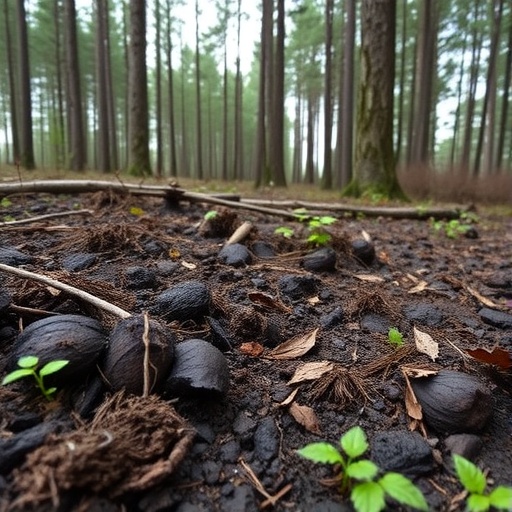
Two years after lightning ignited one of the largest wildfires in modern Swedish history, scientists have traced how the blaze and the logging operations that followed rewired the microscopic engines of the forest floor, with consequences for how much carbon boreal soils store and how quickly forests recover. In a study published in the journal Biogeochemistry, researchers led by Margarida Soares of Lund University measured the growth rates of bacteria, saprotrophic fungi and ectomycorrhizal fungi in soils scorched at low and high severity, in soils left undisturbed, and in areas where surviving or dead trees had been salvage-logged. Their findings reveal a striking underground reorganization: fire and logging suppress bacterial and mycorrhizal activity while handing the ecological advantage to saprotrophic decomposer fungi, yet the anticipated surge in carbon dioxide release from soil organic matter never materializes.
The team worked at the site of the Ljusdal fire, which burned nearly 9,000 hectares of forest in central Sweden in July 2018. The landscape is dominated by Scots pine plantations on Podzol soils, with a mean annual air temperature of 2.7 degrees Celsius and annual precipitation of 648 millimeters. Five research sites were established within three kilometers of one another, all at roughly 225 meters above sea level: an unburnt mature forest serving as a control, a low-severity burn where trees survived, a high-severity burn where trees died, and two salvage-logged areas, one cut from each burn category. Sampling began in June 2020, two years after the fire, and continued monthly through September across four randomly placed plots per treatment. Fire severity was defined by whether the fire killed the trees, a distinction that matters enormously for the soil organisms that depend on living roots.
The methodological core of the study lies in its direct measurement of who is growing in the soil, rather than mere inventories of which organisms are present. Bacterial growth was quantified by tracking the incorporation of radioactively labeled methyl-thymidine into newly synthesized DNA over short incubations performed at the exact temperatures recorded in the field. Saprotrophic fungal growth was estimated with the acetate-in-ergosterol technique, in which radiolabeled acetate is incorporated into ergosterol, a signature fungal membrane lipid, and then separated and quantified by high-performance liquid chromatography. Ectomycorrhizal growth posed a different challenge because these fungi live in symbiosis with tree roots. The researchers solved this by burying fine mesh bags filled with acid-washed quartz sand, sized to admit fungal hyphae but exclude roots, and leaving them in the ground for the entire 112-day growing season. The ergosterol that accumulated inside the bags provided an integrated measure of mycorrhizal production. Respiration was measured by sealing soil in glass vials and quantifying carbon dioxide accumulation by gas chromatography.
The results paint a coherent picture of disturbance-driven reorganization. Cumulative microbial respiration fell by roughly 34 percent after low-severity fire and 48 percent after high-severity fire compared with the unburnt control, and logging delivered a further blow: respiration in the salvage-logged low-severity site was significantly lower than in its unlogged counterpart. Bacterial growth, which depends heavily on the sugary exudates that living roots pump into soil, declined after fire and dropped again after tree removal, tracking the 38 to 44 percent reduction in soil water content that followed burning and an even steeper 52 percent decline where low-severity burned forest was logged. Fire had dried and heated the soils, and the physical disruption of logging compounded these stresses. Saprotrophic fungi, by contrast, flourished where severity was highest, nearly doubling their cumulative growth in the high-severity burn relative to the unburnt forest.
The most dramatic shifts emerged in the balance between fungal guilds. Ectomycorrhizal fungi, the symbiotic partners that supply trees with nitrogen and phosphorus in exchange for photosynthetic carbon, saw their growth reduced by about 20 percent after low-severity fire and 59 percent after high-severity fire. But salvage-logging proved even more consequential for these fungi: cutting live trees after a low-severity fire cut mycorrhizal growth by nearly a third and, crucially, more than tripled the ratio of saprotrophic to ectomycorrhizal activity compared with leaving the trees standing. In these logged low-severity soils, the community tipped from bacterial dominance to saprotrophic fungal dominance, a threshold crossing not observed in any other treatment. The explanation follows classic ecological theory. Ectomycorrhizal fungi typically outcompete saprotrophs for nitrogen in boreal soils, suppressing decomposition in what is known as the Gadgil effect. When fire and logging sever the flow of root carbon that sustains the mycorrhizal guild, the competitive brake is released and free-living decomposers expand into the vacated niche.
What makes the findings scientifically provocative is what did not happen next. Ecologists might expect that a surge in saprotrophic activity would accelerate the breakdown of soil organic matter and increase carbon losses to the atmosphere. Instead, the stimulated saprotrophs produced no measurable rise in soil organic matter decomposition. The authors attribute this decoupling to the nature of the post-fire environment: combustion chemically restructures organic matter into more recalcitrant, pyrogenic forms that resist rapid degradation, and the parched soils constrain microbial metabolism regardless of which guild holds sway. Fire-altered organic matter, rich in aromatic compounds, may simply be too transformed for the decomposer community to process quickly, even in greater numbers.
Carbon use efficiency, the proportion of consumed carbon that microbes invest in building new biomass rather than burning off as respiration, told its own subtle story. Seasonal values ranged from 0.03 to 0.62 and peaked in June across all unlogged sites. A Random Forest model fitted to twelve soil and climate variables identified soil organic matter content as the strongest predictor of seasonal variation in carbon use efficiency, followed by soil water content and temperature, with depleted soils forcing microbes to divert more energy toward maintenance. Yet despite fire and logging reshuffling the microbial guilds, cumulative carbon use efficiency over the growing season remained statistically unchanged across all treatments. The community, it appears, compensated: decomposer groups adapted to resource scarcity maintained the overall balance between growth and respiration, leaving the microbial contribution to soil carbon storage apparently intact over the study window.
To place their laboratory measurements in an ecosystem context, the researchers scaled their rates to grams of carbon per square meter. In the unburnt forest, cumulative microbial respiration reached 118 grams of carbon per square meter over the growing season, while mycorrhizal production added about 4 grams and saprotrophic growth about 2 grams. Compared with independent measurements of total soil respiration of roughly 288 grams of carbon per square meter at the same site, microbial respiration accounted for about 41 percent of the total, a figure consistent with the broader literature and one that validates the upscaling approach. The mycorrhizal production estimate also fell squarely within the range reported for Swedish boreal forests, lending credibility to the mesh bag technique.
The implications extend beyond carbon arithmetic. Ectomycorrhizal fungi are essential for tree regeneration in nitrogen-limited boreal forests, and previous work suggests these communities can take 15 to 18 years to fully re-establish after severe disturbance. Salvage-logging, a practice widely applied in Sweden to reduce fire risk, prevent pest outbreaks and prepare sites for replanting, may therefore inadvertently prolong the recovery of the very symbioses that young trees need to thrive. The authors note that the logging effects on bacterial and mycorrhizal dynamics appeared predictable regardless of fire severity, suggesting forest managers may be able to anticipate the underground consequences of post-fire harvesting decisions. Meanwhile, the suppression of microbial respiration, while seemingly good news for carbon retention, reflects a stressed and desiccated system rather than a healthy carbon sink, and longer-term measurements will be needed to determine whether recovering vegetation eventually restores carbon inputs faster than decomposition can erode soil stocks.
The study also carries a methodological lesson. Because wildfires are unpredictable natural events, the treatments could not be replicated across multiple burned sites, a limitation the authors acknowledge openly. Yet they argue, as fire ecologists have before them, that opportunities to learn from natural experiments should not be forgone simply because classical replication is impossible. Their site captures conditions representative of a large fraction of Fennoscandian Scots pine forests, where decades of fire suppression ended abruptly with the record blazes of 2014 and 2018 and where climate projections foresee more frequent and severe fires. Given how little research on fire effects has been conducted outside North America, where stand-replacing crown fires and different tree adaptations prevail, the Swedish findings fill a genuine gap in understanding how Fennoscandian soils, their microbes and their carbon respond when fire returns to a landscape long managed to exclude it.
Cite Scienmag News
Morgan Morrow. (September 9, 2026). Wildfire and management reshape soil microbes and carbon in Swedish boreal forest. Scienmag. https://scienmag.com/wildfire-and-management-reshape-soil-microbes-and-carbon-in-swedish-boreal-forest/
Morgan Morrow. "Wildfire and management reshape soil microbes and carbon in Swedish boreal forest." Scienmag, 9 September 2026, https://scienmag.com/wildfire-and-management-reshape-soil-microbes-and-carbon-in-swedish-boreal-forest/. Accessed 9 September 2026.
Morgan Morrow. "Wildfire and management reshape soil microbes and carbon in Swedish boreal forest." Scienmag. September 9, 2026. https://scienmag.com/wildfire-and-management-reshape-soil-microbes-and-carbon-in-swedish-boreal-forest/


