


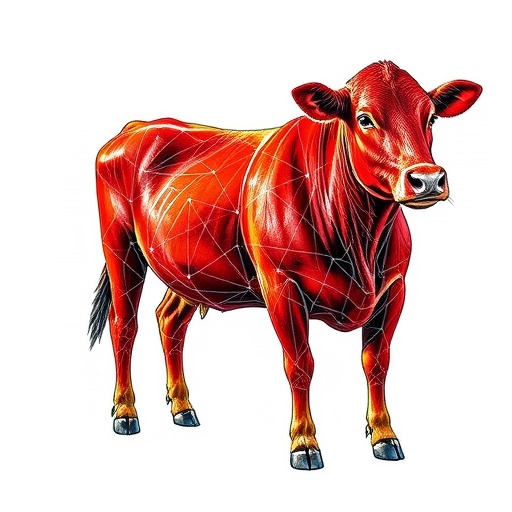
Why does a ribeye taste different from a rump even when both come from the same animal, raised on the same farm and slaughtered on the same day? A new multi-omics study of Pingliang Red cattle, a celebrated Chinese breed often compared to Japanese Wagyu, has mapped the molecular machinery behind that question in unprecedented detail. By integrating quantitative proteomics with untargeted metabolomics, a research team led by Jiawei Lu and Lupei Zhang has identified the proteins, metabolites and biochemical pathways that distinguish three commercially valuable cuts—topside, striploin and clod—and has pinpointed two hub molecules, the nucleoside diphosphate kinase NME1 and the myosin heavy chain MYH7, as central regulators of the differences. The work, published in Food Chemistry: X, offers the beef industry a molecular roadmap for precision processing, product grading and marker-assisted breeding.
Pingliang Red cattle, bred in Gansu Province in northwest China, are prized for their tender muscle, abundant intramuscular fat and high myoglobin content, with marbling scores exceeding 4.5. Previous studies had shown that the breed accumulates unusually high levels of flavor precursor amino acids, oleic acid, linoleic acid and inosine monophosphate compared with Qinchuan and Simmental cattle. What remained unknown was why, within a single carcass, the topside from the hind limb, the striploin from the loin, and the clod from the shoulder deliver such divergent eating experiences. Conventional quality metrics alone could not explain it, and earlier research had concentrated on breed, diet and rumen microbiota rather than on the intrinsic biochemistry of individual cuts.
The team collected samples from six three-year-old male Pingliang Red bulls averaging 530 kilograms in body weight at a local slaughterhouse in Pingliang. Crucially, all three cuts were taken from each of the same six animals, eliminating between-animal variation as a confounding factor. Standard quality measurements—pH, cooking loss, Warner-Bratzler shear force, water holding capacity and CIE color coordinates—were recorded alongside the molecular profiling. The phenotypic data revealed a deceptively quiet picture: topside had a significantly higher ultimate pH (5.80 versus 5.62 for striploin) and a higher yellowness value than clod, but cooking loss, shear force and water holding capacity did not differ significantly among the three muscles. Whatever drives the sensory differences between these cuts, it operates below the surface of classical meat science.
That deeper layer came into view through metabolomics. Using ultra-performance liquid chromatography coupled to an Orbitrap Exploris 480 mass spectrometer operating in both positive and negative electrospray ionization modes, the researchers profiled small molecules extracted from frozen muscle tissue. Partial least squares discriminant analysis separated the three cuts cleanly along the first two components, confirming that each muscle carries a distinct metabolic fingerprint. Pairwise comparisons uncovered 32 differential metabolites between topside and clod, 54 between striploin and clod, and 69 between topside and striploin—dominated by nucleotides, amino acids and their derivatives. Topside accumulated uridine, UDP-N-acetylgalactosamine and violacein relative to striploin, while striploin was enriched in N-eicosapentaenoyl tyrosine and phytosphingosine relative to clod.
Pathway enrichment analysis translated these compound lists into biochemical narratives. Metabolites differing between clod and topside mapped onto purine metabolism, nucleotide metabolism and steroid hormone biosynthesis. Between striploin and topside, the affected pathways included arachidonic acid metabolism and glycine, serine and threonine metabolism—amino acid routes with well-established links to flavor, tenderness and nutritional value. Between striploin and clod, the dominant terms were glycerophospholipid metabolism, taurine and hypotaurine metabolism and sulfur metabolism. Glycerophospholipids are particularly consequential: as major components of cell membranes, they are hydrolyzed and oxidized after slaughter and during cooking to yield aldehydes, ketones and other volatile compounds that constitute the characteristic aroma of cooked beef. Differential abundance of species such as PS(18:0/20:4) indicates that membrane lipid composition and turnover are tissue-specific, directly shaping lipid-derived flavor in each cut.
Purine metabolism tells an equally important story about taste. ATP and its degradation products—ADP, inosine monophosphate and inosine—are the principal taste-active nucleotides responsible for umami in cooked meat. The pronounced enrichment of purine pathway metabolites across the three cuts suggests that each muscle runs post-mortem energy metabolism and nucleotide recycling at a different rate, generating distinct umami intensities after cooking. Correlation network analysis anchored these relationships around a handful of central metabolites: ADP linked energy-related pathways including oxidative phosphorylation, thermogenesis and FoxO signaling between clod and topside, while PS(18:0/20:4), 6-ketoprostaglandin F1α and L-threonine connected lipid, eicosanoid and amino acid modules between striploin and the other two cuts. In effect, a small set of hub metabolites integrates the entire metabolic divergence.
To trace these metabolic differences back to their protein-level origins, the team deployed data-independent acquisition proteomics on an Orbit Astral mass spectrometer, processing the raw data in Spectronaut with a false discovery rate below one percent and label-free quantification via the MaxLFQ algorithm. The PLS-DA model again resolved the three muscles, and the pairwise comparisons yielded 214 differentially expressed proteins between topside and striploin, 239 between clod and striploin, and 140 between topside and clod. Gene Ontology and KEGG enrichment showed these proteins clustered in cyclic nucleotide transport, acetyl-CoA metabolism, lysine degradation, retinol metabolism, triglyceride biosynthesis, cAMP and cGMP-PKG signaling, pyrimidine and purine metabolism, the p53 pathway, cholesterol metabolism and autophagy—an unusually broad functional spread that underscores how many cellular systems contribute to meat quality.
Protein-protein interaction networks built on the STRING database distilled this complexity into interpretable modules, and two hub proteins emerged. The first, NME1, sits at the center of a nucleotide-metabolism network, interacting with adenylate kinase 4 (AK4), ribonucleotide reductase regulatory subunit M1 (RRM1), mitochondrial elongation factor GFM1 and MTIF2, along with cytosolic and mitochondrial ribosomal proteins. NME1 catalyzes the interconversion of nucleoside triphosphates and maintains intracellular energy homeostasis, so its differential abundance plausibly explains why the three cuts exhibit distinct nucleotide turnover and energy states—and why the metabolomics data flagged purine metabolism so prominently. A second module in the network centered on mitochondrial respiratory chain components such as COX15, COX7C and UQCR10 and the tricarboxylic acid cycle enzyme DLST, pointing to differences in oxidative capacity and redox balance among the muscles.
The second hub, MYH7—the myosin heavy chain isoform characteristic of slow oxidative muscle fibers—anchored a contractile-and-structure module alongside tropomyosin TPM2, the calcium pump ATP2A1 and the calcium-buffering protein calsequestrin CASQ2, with additional connections to the signaling protein ANXA5 and extracellular matrix components such as SMAD3, FBN1 and FLNA. Because fiber type composition governs tenderness, oxygen consumption, glycolytic rate and ultimate pH, differential expression of MYH7 and its interaction partners offers a mechanistic explanation for the subtle textural and color differences observed among the cuts. Notably, the higher pH of topside is consistent with a weaker glycolytic capacity, reduced post-mortem lactate accumulation and a lower susceptibility to pale, soft, exudative meat defects—a finding that carries direct commercial implications for water retention and flavor stability.
Taken together, the integrated data trace a complete molecular chain from gene-product expression to terminal metabolite accumulation. Energy metabolism, amino acid turnover and lipid biosynthesis jointly reshape the post-mortem biochemistry of each muscle: topside’s elevated pH and yellowness reflect dampened glycolysis and active lipid metabolism, while striploin and clod diverge mainly in their amino acid and nucleotide profiles, generating differentiated flavor trajectories. NME1 and MYH7 act as the linchpins connecting upstream protein expression to downstream metabolite signatures, providing candidate molecular markers for the traits that matter most to butchers, processors and consumers.
The authors are careful to frame these biomolecules as preliminary candidates requiring systematic validation. Their planned next steps include expanding the sample population, verifying core proteins with parallel reaction monitoring proteomics and RT-qPCR, and screening single nucleotide polymorphisms in NME1 and MYH7 for population-level association studies that could feed directly into molecular-assisted breeding programs. If those efforts succeed, the era in which a Wagyu-grade Chinese beef carcass can be partitioned, graded and optimized cut by cut on molecular evidence may be closer than anyone expected—and the humble question of why one steak tastes different from another will have been answered all the way down to the nucleotide.
Cite Scienmag News
William Thompson. (September 9, 2026). Multi-omics reveals molecular basis of meat quality variation in Red cattle muscles. Scienmag. https://scienmag.com/multi-omics-reveals-molecular-basis-of-meat-quality-variation-in-red-cattle-muscles/
William Thompson. "Multi-omics reveals molecular basis of meat quality variation in Red cattle muscles." Scienmag, 9 September 2026, https://scienmag.com/multi-omics-reveals-molecular-basis-of-meat-quality-variation-in-red-cattle-muscles/. Accessed 9 September 2026.
William Thompson. "Multi-omics reveals molecular basis of meat quality variation in Red cattle muscles." Scienmag. September 9, 2026. https://scienmag.com/multi-omics-reveals-molecular-basis-of-meat-quality-variation-in-red-cattle-muscles/


