


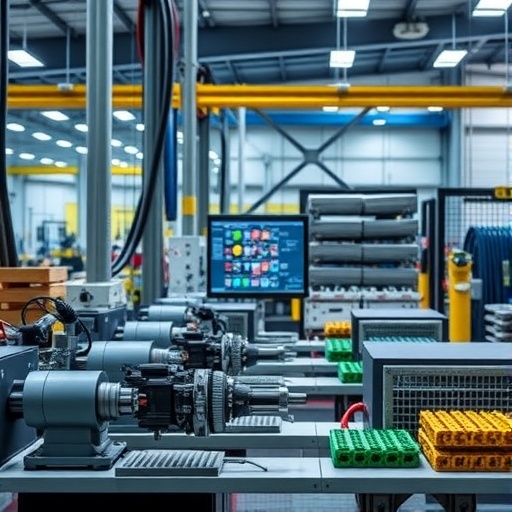
More than 350 leaders from industry, government and the research community converged on the Department of Energy’s Oak Ridge National Laboratory in Tennessee for Materials and Manufacturing Innovation Days, a two-day working forum known as M2IND that placed manufacturers squarely in the driver’s seat of the national research agenda. Held on August 19 and 20, the event was deliberately structured around a simple but powerful premise: rather than presenting finished laboratory results to a passive audience, Oak Ridge and its Manufacturing Demonstration Facility invited industry to describe, in frank and sometimes uncomfortable detail, the barriers that keep advanced manufacturing technologies stranded between demonstration and deployment. Across panel discussions, technology exhibits and a rapid succession of partnership announcements, the same themes surfaced again and again — brittle supply chains, scarce critical materials, slow and expensive qualification processes, and the urgent need to weave digital engineering, artificial intelligence, robotics and automation into the fabric of American production.
Ryan Dehoff, director of the Manufacturing Demonstration Facility, framed the gathering’s philosophy plainly. “We want to make sure we have input from industry to help guide our research and ensure that the work at Oak Ridge and the Manufacturing Demonstration Facility is valuable to U.S. manufacturers and takes into account the supply chains needed to commercialize new technologies,” he said. That orientation matters because the Manufacturing Demonstration Facility, supported by DOE’s Advanced Materials and Manufacturing Technologies Office, operates as a nationwide consortium intended to catalyze the transformation of U.S. manufacturing rather than simply publish papers. The forum drew participation from four DOE offices — Advanced Materials and Manufacturing Technologies, Building Technologies, Hydropower and Hydrokinetic, and Nuclear Energy — along with the Department of War’s Office of Industrial Base Resilience and organizations spanning nuclear energy, hydropower, oil and gas, critical materials, defense and technology development.
The candid exchanges produced a remarkably consistent diagnosis of what ails domestic manufacturing. Participants identified limited domestic capacity for producing large castings and forgings, the foundational components of reactors, turbines and heavy infrastructure. They flagged lead times for specialized components that can stretch into years or decades — one hydropower industry participant noted that lead times for major components extend a decade or more, a timeline that threatens the viability of entire energy projects. Compounding these structural weaknesses is a persistent shortage of workers skilled in manufacturing, automation and digital tools, along with inconsistent data formats that hamper communication across supply chains. Perhaps most corrosive of all, attendees described qualification and certification requirements that can delay adoption indefinitely even after a technology has been convincingly demonstrated, a gap between proof and practice that consumes years of engineering effort and capital. “M2IND has brought folks together across the spectrum who have different reasons for being here and bring a different point of view but ultimately are aligned around the idea that there’s urgency to accelerate our domestic manufacturing capabilities,” said Kiley Naas, vice president of the public sector at Rescale.
Among the most visually striking displays at the forum were two large structures that dramatized how additive manufacturing could relieve some of the nation’s most constrained supply chains. The first was a glass-fiber-reinforced polymer mockup of an impact limiter for spent nuclear fuel transportation, produced in collaboration with the University of Maine. Impact limiters are massive energy-absorbing structures attached to both ends of a shipping cask to protect it in an accident; traditionally fabricated from wood, they can span twelve feet and weigh many thousands of pounds. By 3D printing the mockup with glass-fiber-reinforced polymer, researchers at the Manufacturing Demonstration Facility are exploring whether new materials and new manufacturing approaches can decouple this critical nuclear infrastructure component from legacy supply chains that offer little flexibility.
The second structure tackled an even more fundamental challenge: the closed steel pressure vessel, that iconic bottleneck component of the nuclear industry. Using MedUSA, a large-scale wire-arc additive manufacturing system that coordinates three robotic arms working in concert, facility researchers produced a closed steel pressure vessel measuring three by five feet, complete with complex domed geometry that would demand exceptional skill and enormous machinery to forge conventionally. Reactor vessels are traditionally made through large-scale forging and welding, processes constrained by the nation’s limited domestic capacity and by the dwindling number of suppliers capable of executing them. The wire-arc printed vessel is not itself a certified component; future research will focus explicitly on qualifying the part for nuclear service. But it offers a compelling test case for whether additive manufacturing can provide an alternate route to large components — a route that trades heroic forging capacity for programmed deposition and robotic precision.
Establishing a manufacturing route, forum participants stressed, is only half the battle. The harder half is proving, with defensible evidence, that the component will perform as intended over decades of service in demanding environments such as a reactor core or a high-pressure hydropower penstock. The path to that confidence runs through process monitoring, defect detection and digital engineering: documenting exactly how a component is made, tracking quality continuously throughout production, and generating the dense streams of data that support qualification and performance confidence. To examine whether such digital qualification methods are truly portable, Oak Ridge and Idaho National Laboratory announced a laboratory-directed research and development collaboration during the forum. By aligning manufacturing parameters, running comparable builds and sharing results, the two laboratories will test whether sensing, data and qualification approaches remain reliable when a component moves between different manufacturing systems and different facilities — a crucial test for any qualification framework that hopes to serve a distributed national manufacturing base.
The forum also served as a launchpad for commercial partnerships designed to carry laboratory capabilities directly into factories. New cooperative research and development agreements were announced with DMG MORI Federal Services and Lincoln Electric, each pairing Oak Ridge research strengths with established routes to market. The agreement with DMG MORI combines the laboratory’s advanced manufacturing, modeling, sensing and artificial intelligence capabilities with the company’s machine tool technologies, aiming to advance machining, additive manufacturing and intelligent digital production systems so that laboratory innovations reach factory floors faster. The Lincoln Electric collaboration focuses on large-scale wire-arc additive manufacturing, with three concrete objectives: improving process reliability, accelerating qualification, and strengthening the domestic capability to manufacture critical components for energy infrastructure — the same components whose decade-long lead times alarmed hydropower participants.
Technology licensing provided a parallel path from laboratory bench to industrial deployment. Chattanooga-based Branch Technology licensed an Oak Ridge-developed plant-based insulation foam during the event. Designed for use in building envelope panels alongside lightweight 3D-printed structures, the foam can be poured into wall panels to insulate buildings, cutting heat loss and offering an affordable insulation option made from abundant, domestically available materials — a small but meaningful contribution to supply chain resilience in the construction sector. The forum also highlighted an Oak Ridge hybrid manufacturing process licensed to the A.J. Tuck Company, which combines 3D printing with electroforming to produce complex hot isostatic pressing cans, the sealed containers used to form high-performance metal parts from powder under simultaneous heat and pressure. The process could streamline production of critical components for energy and defense applications while reducing reliance on the constrained supply chains that currently gate access to such parts.
Two memoranda of understanding broadened the forum’s partnership reach still further. The first brings Oak Ridge together with SLB to explore research opportunities in energy storage, critical minerals, advanced industrial processes and additive manufacturing, connecting laboratory expertise to one of the world’s major energy technology companies. The second pairs the laboratory with Kairos Power and other partners in an initial twelve-month phase to explore new manufacturing and construction methods and workforce development for advanced nuclear reactors through the Nuclear Center for Advanced Manufacturing and Precast, known as NuCAMP. The initiative reflects a growing recognition that next-generation reactors will not merely need new components — they will need entirely new construction paradigms and a workforce trained to deliver them. “What we are seeing here today, with all the industry that’s here, is the deployment of knowledge that has been created here into the manufacturing base of the United States, and that is good for all of us,” said Leo Christodoulou, chief technology officer for Autonomous Resource Corporation.
Beyond the deal-making, M2IND marked a generational milestone: ten years of Innovation Crossroads, Oak Ridge’s lab-embedded entrepreneurship program that embeds early-stage founders within the laboratory to accelerate their path from research insight to venture-backed product. The forum welcomed the program’s tenth cohort of science and technology founders, a class of entrepreneurs who will spend the coming years translating laboratory capability into commercial reality. A student poster competition gave early-career researchers a rare opportunity to debate their work directly with industry and laboratory leaders, planting the seeds of the collaborations — and careers — that future forums will celebrate. Taken together, the gathering sketched a coherent strategy for American manufacturing: align national laboratory research with industrial priorities from the outset, attack qualification bottlenecks with data and digital engineering, print and license the components that legacy supply chains cannot deliver, and cultivate the people and startups who will carry the work forward. The deployment of knowledge, as Christodoulou observed, has begun — and its beneficiaries will extend well beyond the laboratory gates.
Keywords
advanced manufacturing, Oak Ridge National Laboratory, Manufacturing Demonstration Facility, additive manufacturing, wire-arc additive manufacturing, nuclear energy components, supply chain resilience, technology qualification, industrial partnerships, digital engineering, Innovation Crossroads, M2IND
Cite Scienmag News
Denise Maddox. (September 8, 2026). M2IND spotlights manufacturing hurdles facing modern industry. Scienmag. https://scienmag.com/m2ind-spotlights-manufacturing-hurdles-facing-modern-industry/
Denise Maddox. "M2IND spotlights manufacturing hurdles facing modern industry." Scienmag, 8 September 2026, https://scienmag.com/m2ind-spotlights-manufacturing-hurdles-facing-modern-industry/. Accessed 8 September 2026.
Denise Maddox. "M2IND spotlights manufacturing hurdles facing modern industry." Scienmag. September 8, 2026. https://scienmag.com/m2ind-spotlights-manufacturing-hurdles-facing-modern-industry/


