


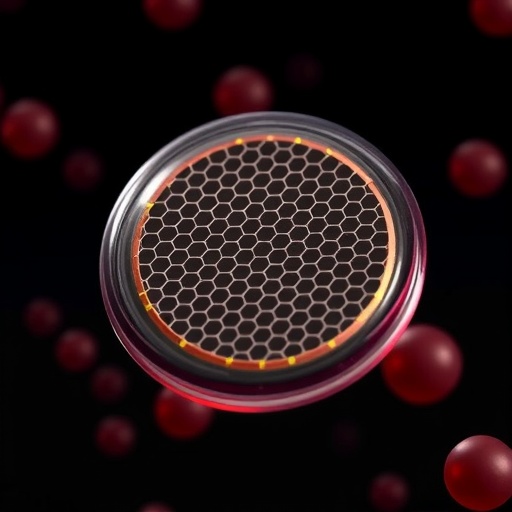
A team of Romanian researchers has developed a disposable, stamp-sized electrochemical platform capable of distinguishing between the two mirror-image forms of lysine directly in whole blood, achieving detection limits as low as a single attomole per litre. The work, described in the Journal of Materials Science, could pave the way for rapid, point-of-care profiling of amino acid chirality in cancer diagnostics, where the balance between left- and right-handed amino acid enantiomers is increasingly recognized as a meaningful biochemical signal.
The platform, built by Ergün Yukmel Rasit, Raluca-Ioana Stefan-van Staden and Damaris-Cristina Gheorghe, relies on a so-called stochastic sensor constructed from a graphene–copper composite modified with α-cyclodextrin. Stochastic sensing is a distinct analytical paradigm: rather than producing a steady, averaged signal proportional to concentration, the device monitors the discrete interactions of individual analyte molecules with molecular-scale pores and binding sites on the electrode surface. Each interaction generates a characteristic current spike, and the statistical distribution of spike durations and amplitudes encodes both the identity and the quantity of the molecules present. This architecture allows the sensor to disentangle multiple species within the same sample, which is precisely what is needed when L-lysine and D-lysine must be resolved inside the complicated electrochemical matrix of whole blood.
The choice of materials is central to the sensor’s selectivity. Graphene provides an atomically thin, highly conductive two-dimensional scaffold with an enormous surface-to-volume ratio, ensuring that even vanishingly small numbers of adsorbed molecules produce measurable changes in electron transfer across the interface. Copper atoms incorporated into the composite act as additional coordination and redox centres, while α-cyclodextrin, a cyclic sugar ring with a hydrophobic cavity and hydrophilic rim, functions as the chiral recognition element. Because the cavity of α-cyclodextrin is itself asymmetric, it accommodates the two enantiomers of lysine with different binding geometries and different residence times. Those differences translate into distinct stochastic signatures in the recorded current traces, allowing the platform to quantify L- and D-lysine separately without any prior chemical separation of the sample.
The performance figures reported by the team are striking. For L-lysine, the working concentration range spans from 1.00×10⁻¹⁶ to 1.00×10⁻⁴ mol L⁻¹, with a sensitivity of 4.87×10¹³ mol L⁻¹ and a limit of determination of 1.00×10⁻¹⁶ mol L⁻¹, equivalent to 100 attomolar concentration. For D-lysine, the platform operates between 1.00×10⁻¹⁴ and 1.00×10⁻⁸ mol L⁻¹, with a sensitivity of 1.19×10¹⁰ mol L⁻¹ and a limit of determination of 1.00×10⁻¹⁴ mol L⁻¹. To place these numbers in perspective, conventional chiral analysis of amino acids is typically performed by liquid chromatography coupled to high-resolution tandem mass spectrometry, often after derivatization with chiral reagents and extensive sample cleanup. Such workflows consume time, expensive instrumentation and specialist personnel. The new platform, by contrast, delivers enantioselective readouts directly in undiluted whole blood, with recovery tests demonstrating values above 99.00 percent for both enantiomers regardless of the ratio in which they occur in the sample.
That recovery figure carries particular weight analytically. Enantiomeric ratios in biological fluids can shift dramatically in disease, so a sensor must remain accurate whether one form dominates or the two are nearly equal. Recovery values exceeding 99 percent across varying enantiomeric compositions indicate that the α-cyclodextrin recognition layer does not saturate preferentially, nor does the blood matrix suppress one signature while amplifying the other. It also suggests that fouling by proteins, cells and endogenous electroactive species, the usual bane of electrochemical measurements in raw blood, does not meaningfully degrade the stochastic response over the assay window.
The clinical motivation behind the work lies in the emerging field of chiral metabolomics. Lysine is an essential amino acid, meaning the human body cannot synthesize it and must obtain it from the diet. Beyond its structural role in proteins, lysine is a principal substrate for post-translational modifications, most notably acetylation and methylation of histones and transcription factors, processes that regulate gene expression and are frequently dysregulated in malignancy. Altered lysine acetylation patterns have been identified as both prognostic biomarkers and therapeutic targets in a range of cancers, and the enzymatic machinery that writes, reads and erases these marks is now a major focus of drug development. Changes in lysine availability and metabolism could therefore feed directly into the epigenetic state of a tumour cell.
Lung cancer is the specific disease context the researchers highlight. Case-control studies in non-small cell lung cancer have documented shifts in serum amino acid levels, suggesting that metabolic rewiring leaves detectable fingerprints in the circulation. At the same time, growing attention is being paid to D-amino acids, long dismissed as biologically irrelevant in humans but now implicated in signalling, immune modulation and, according to recent reviews, cancer diagnosis and therapy. Because the two enantiomers of an amino acid are chemically identical in every respect except handedness, they behave identically in standard assays and can only be told apart by chiral methods. A sensor that reads out the L-to-D ratio rapidly and cheaply could reveal metabolomic signatures invisible to conventional amino acid panels.
The Bucharest team has a track record in this area. Stefan-van Staden’s group previously reported enantioselective stochastic platforms for cysteine as a candidate marker in early breast cancer diagnosis, and for leucine and arginine in the context of lung cancer metabolomics, as well as three-dimensional stochastic sensor arrays for fast screening of whole blood and brain tissue in brain cancer. The new lysine platform extends that programme by combining chiral recognition with a two-dimensional, disposable format, an arrangement intended to make each measurement inexpensive enough for single-use clinical deployment, eliminating cross-contamination between samples and the need for electrode regeneration.
The technical design also reflects a deliberate trade-off. Traditional enantioseparation by liquid chromatography depends on chiral stationary phases, often cellulose- or amylose-based selectors, whose mechanistic principles have been refined over decades but which remain confined to centralized laboratories. Stochastic sensors approach the problem differently: the chiral selector is immobilized on the electrode itself, and discrimination occurs in the time domain of the current signal rather than in the spatial domain of a chromatogram. This collapses sample preparation, separation and detection into a single step and makes the measurement compatible with small volumes of finger-prick blood. The disposable nature of the platform means the sensing surface, including its graphene–copper composite and cyclodextrin layer, is engineered to be produced inexpensively and discarded after one assay.
Translational questions remain before such devices reach the clinic. Stochastic sensing requires careful statistical analysis of current-time traces, and the algorithms that assign signatures to specific enantiomers must be validated across large, diverse patient cohorts in which medications, diet and comorbidities all perturb the amino acid background. The extremely low limits of determination reported here were established under controlled conditions; demonstrating reproducibility across manufacturing batches of disposable platforms, and correlating lysine enantiomer ratios with confirmed lung cancer diagnoses in blinded studies, are the logical next steps. The work was supported by Romania’s Nucleus Program under the National Plan for Research, Development and Innovation 2022–2027, project PN 23 27 03 01.
Even so, the study adds a compelling datapoint to a broader movement in bioanalytical chemistry: the shift of sophisticated molecular measurements out of the core facility and onto cheap, single-use chips. Other groups have recently pursued molecularly imprinted electrochemical sensors for lysine in blood, fluorescent nanosensors that distinguish lysine enantiomers in dairy products, and metal-organic-framework-based probes for leukemia biomarkers. What distinguishes the new platform is its demonstrated ability to perform full enantioanalysis inside whole blood, the most demanding and clinically convenient of biological matrices, at concentrations fifteen orders of magnitude below molar. If subsequent clinical validation sustains that performance, the humble α-cyclodextrin ring, sitting on a graphene–copper film no thicker than a few atomic layers, could become a routine window into the chiral chemistry of cancer.
For researchers in metabolomics, the platform offers an immediate practical benefit: the ability to ask whether the L-to-D lysine ratio in a patient’s blood carries diagnostic or prognostic information, without first building a chromatography pipeline to answer the question. For clinicians, it sketches a future in which a single drop of blood, applied to a disposable strip, returns a chiral metabolite profile in minutes. Between those two horizons lies the familiar path of validation studies, regulatory review and manufacturing scale-up, but the analytical foundation, exquisite sensitivity, enantioselectivity and matrix tolerance in one disposable device, has now been laid.
Cite Scienmag News
Neil Sanderson. (September 8, 2026). Disposable graphene–copper sensor enables lysine enantiomer detection in whole blood. Scienmag. https://scienmag.com/disposable-graphene-copper-sensor-enables-lysine-enantiomer-detection-in-whole-blood/
Neil Sanderson. "Disposable graphene–copper sensor enables lysine enantiomer detection in whole blood." Scienmag, 8 September 2026, https://scienmag.com/disposable-graphene-copper-sensor-enables-lysine-enantiomer-detection-in-whole-blood/. Accessed 8 September 2026.
Neil Sanderson. "Disposable graphene–copper sensor enables lysine enantiomer detection in whole blood." Scienmag. September 8, 2026. https://scienmag.com/disposable-graphene-copper-sensor-enables-lysine-enantiomer-detection-in-whole-blood/


