


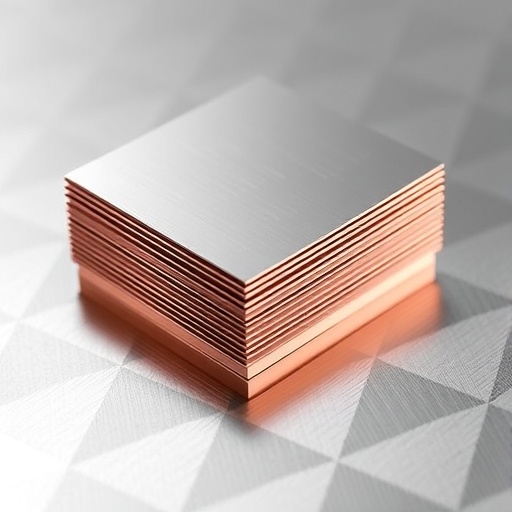
In a development that could reshape how engineers join lightweight metals for batteries, aerospace structures and power electronics, a team of researchers in Ukraine has shown that the microscopic architecture of alternating aluminum and copper layers can be tuned to dramatically accelerate the formation of intermetallic compounds while simultaneously boosting hardness and stiffness to remarkable levels. The study, published in Applied Nanoscience, reveals that by simply shrinking the modulation period—the combined thickness of one aluminum layer and one copper layer—in multilayer foils, the kinetics of solid-state phase formation speed up considerably, and the resulting material can reach a microhardness of up to 7 gigapascals and a Young’s modulus of up to 190 gigapascals. The work offers a practical recipe for designing reactive multilayer foils that act both as chemical intermediaries in diffusion bonding and as structural materials in their own right.
The research was carried out by Sergiy Polishchuk, Yana Matvienko, Mykola Skoryk, Iryna Zahorulko and Oleh Molebnyi of the G.V. Kurdyumov Institute for Metal Physics of the National Academy of Sciences of Ukraine, together with Anatolii Ustinov, Serhii Demchenkov and Oleksandr Kremenchutskyi of the E. O. Paton Electric Welding Institute. Their central question was deceptively simple: how do the overall chemical composition of an aluminum–copper multilayer and the scale of its layered architecture govern the speed, sequence and energetics of the phase transformations that occur when the foil is heated? The answer matters because aluminum–copper joints are ubiquitous in electrical contacts, wire bonds, current collectors and bimetallic transition pieces, and the brittle intermetallic phases that form at these interfaces are both the glue that holds the joint together and, in excessive amounts, the source of its failure.
The team produced their multilayer foils by electron-beam physical vapor deposition, a technique that allows alternating layers of aluminum and copper to be built up with precise control over individual layer thicknesses. Two overall compositions were investigated: Al–30 atomic percent copper and Al–60 atomic percent copper, spanning the aluminum-rich and copper-rich sides of the binary system. Within each composition, foils were fabricated with different modulation periods, meaning different sums of one aluminum layer plus one copper layer. This systematic variation allowed the researchers to decouple the effect of chemistry from the effect of layer geometry, isolating how the diffusion distance between reacting layers influences the rate at which new intermetallic phases nucleate and grow.
To track the transformations, the researchers deployed a battery of complementary analytical techniques. X-ray diffraction identified which crystalline phases appeared at each stage of heating, scanning electron microscopy revealed the evolving microstructure of the layered foils, and differential scanning calorimetry measured the heat released or absorbed as reactions proceeded. In addition, resistometry—continuous monitoring of the foils’ electrical resistance during heating—provided a sensitive, real-time indicator of the transformation progress, since the formation of intermetallic compounds substantially alters electrical conductivity. Together, these methods established that the primary reactions take place across a temperature window of roughly 130 to 350 degrees Celsius, with enthalpy changes for the reactions ranging from 160.7 to 312.5 joules per gram, values that quantify the substantial chemical energy stored in these layered, unreacted structures.
A key analytical advance in the study was the application of isoconversional Friedman analysis to the calorimetric data. Unlike classical single-heating-rate methods such as the Kissinger analysis, the Friedman approach evaluates the activation energy at each extent of conversion across multiple heating rates, without forcing the data into a predefined kinetic model. The results were unambiguous: the transformation is not a single-step process with a fixed activation barrier. Instead, the effective activation energy varies systematically with the extent of conversion, revealing a multi-step reaction sequence in which different processes dominate at different stages. This finding carries practical weight, because it means that simplistic kinetic models—still common in the literature on reactive multilayers—can mispredict how these foils will behave during industrial thermal processing, where heating rates and temperature profiles differ widely from laboratory conditions.
The primary phases to emerge from the solid-state reaction were Al2Cu and Al4Cu9, the two classical intermetallic compounds of the aluminum–copper system that bracket the composition range studied. The researchers found that decreasing the modulation period—the geometric refinement of the layered structure—consistently accelerated phase formation. The explanation lies in diffusion length scales: when aluminum and copper layers are thinner, atoms need to travel shorter distances to encounter the opposing species, and the density of interfaces at which nucleation can occur is correspondingly higher. This architectural lever, requiring no change in chemistry at all, proved powerful enough to substantially shift the onset and rate of intermetallic formation, echoing the thin-film growth kinetics framework established decades ago by researchers such as Gösele and Tu, who showed that compound formation in thin films often follows rules distinct from those governing bulk diffusion couples.
Equally striking were the mechanical consequences. As the intermetallic phases formed and the modulation period decreased, microhardness climbed to values as high as 7 gigapascals—several times harder than either constituent metal alone—while Young’s modulus reached up to 190 gigapascals, approaching the stiffness of steel. These gains come from a combination of factors: the intrinsic hardness and stiffness of the intermetallic phases themselves, the fine grain and interface densities characteristic of multilayered structures, and the restriction of dislocation motion by the dense network of phase boundaries. The trade-off, the study notes, is a reduction in ductility, a well-known characteristic of intermetallic-rich materials. For applications where stiffness, hardness and dimensional stability at elevated temperature outweigh the need for extensive plastic deformation—such as diffusion bonding interlayers, wear-resistant coatings and certain structural composites—the hardening may be a welcome feature rather than a drawback.
The broader context of the work extends to some of the most pressing engineering challenges of the moment. Aluminum–copper intermetallics are central to the reliability of electrical contacts and wire bonds, where their growth during service at moderate temperatures can lead to embrittlement and void formation, and they are equally pivotal in the opposite role: as intentionally formed compounds that bond dissimilar metals in solid-state joining. In battery manufacturing, multilayer aluminum–copper foil stacks are being explored for current collectors and bipolar solid-state battery designs, where controlled intermetallic formation could enable joints that are both electrically conductive and mechanically robust. The Ukrainian team’s demonstration that modulation period is a controllable knob for tuning both reaction kinetics and mechanical properties provides a quantitative design principle for these applications, replacing trial-and-error annealing schedules with composition- and geometry-informed process windows.
The methodology also demonstrates the value of combining resistometry with calorimetry and diffraction. Electrical resistance is exquisitely sensitive to the disappearance of pure metal layers and the appearance of intermetallic phases, and its continuous measurement during heating captured kinetic information that complements the thermal signals from differential scanning calorimetry. By cross-referencing resistance changes with the phase identification from X-ray diffraction and microstructural imaging, the researchers could assign specific reaction steps to specific temperature ranges and construct a coherent picture of the sequential transformation pathway—from initial interdiffusion at the aluminum–copper interfaces, through nucleation and growth of the primary intermetallics, to their subsequent evolution as the reaction consumes the remaining elemental layers.
What emerges from the study is a coherent design philosophy for reactive multilayer systems. The overall composition determines which equilibrium phases can ultimately form and in what proportions; the modulation period determines how quickly and at what temperatures those phases appear; and the modulation-period-dependent activation landscape determines how sensitive the process is to heating rate. The measured enthalpies of reaction, ranging up to 312.5 joules per gram, also hint at self-sustaining reaction possibilities: if ignition can be triggered locally, the heat released by intermetallic formation can propagate the reaction through the foil, a principle exploited in reactive bonding foils used for soldering and brazing without external heat sources. The new kinetic data provide the foundation for predicting whether a given foil composition and geometry will react explosively, gradually or not at all under a given thermal stimulus.
For a field that has spent four decades cataloguing which phase forms first in aluminum–copper thin films—often Al4Cu9 or Al2Cu depending on deposition conditions, grain size and impurities—this study adds a unifying quantitative framework grounded in isoconversional kinetics and systematic geometric variation. It shows that the same chemistry can yield vastly different effective behaviors depending on architectural scale, and it gives materials designers a way to exploit rather than merely tolerate that dependence. As demand grows for reliable aluminum–copper joints in electrified transport and power electronics, the ability to program the speed and extent of intermetallic formation into the very structure of a foil may prove one of the quiet but consequential advances in modern materials engineering.
Cite Scienmag News
Denise Maddox. (September 8, 2026). Layer spacing tunes phase formation and strength in aluminum-copper multilayer foils. Scienmag. https://scienmag.com/layer-spacing-tunes-phase-formation-and-strength-in-aluminum-copper-multilayer-foils/
Denise Maddox. "Layer spacing tunes phase formation and strength in aluminum-copper multilayer foils." Scienmag, 8 September 2026, https://scienmag.com/layer-spacing-tunes-phase-formation-and-strength-in-aluminum-copper-multilayer-foils/. Accessed 8 September 2026.
Denise Maddox. "Layer spacing tunes phase formation and strength in aluminum-copper multilayer foils." Scienmag. September 8, 2026. https://scienmag.com/layer-spacing-tunes-phase-formation-and-strength-in-aluminum-copper-multilayer-foils/


