


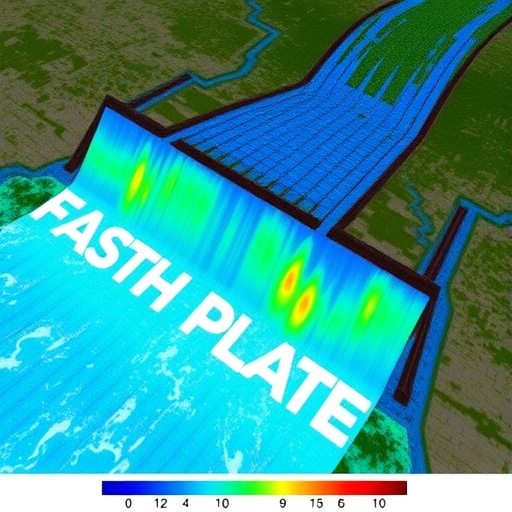
In the flood-prone delta lands of Odisha, India, where the Mahanadi, Brahmani, and Baitarani rivers converge on the Bay of Bengal, a team of hydrologists has demonstrated that a computationally lightweight forecasting framework—originally developed for radar-driven flash flood warnings in the United States—can deliver skillful streamflow predictions without any satellite rainfall data at all. The new study, published in Water Resources Management, applies the Ensemble Framework For Flash Flood Forecasting, known as EF5, to India’s Kendrapara district, an area where steep upstream terrain feeds rapid-onset floods into densely populated lowland communities. The research, led by Abhisek Mishra and Abinash Sahoo of OUTR Bhubaneswar alongside colleagues at NIT Srinagar, universities in Iraq, and King Fahd University of Petroleum and Minerals in Saudi Arabia, offers a practical template for early warning in data-scarce river basins, and its findings carry implications far beyond the Indian east coast.
Flash floods are among the deadliest of hydrological hazards because they unfold on timescales that outpace human response. In Kendrapara, the confluence of three major river systems, combined with a mountainous upstream catchment, means that heavy rainfall in the hills can translate into dangerous downstream flooding within hours. Traditional forecasting approaches often rely on satellite-based precipitation estimates or radar data, neither of which is reliably available in many developing regions. The EF5 framework, first described by Flamig and colleagues in Geoscientific Model Development, was designed to circumvent such dependencies by coupling rainfall-runoff generation with a gridded, ensemble-based structure that can operate on precipitation inputs from a variety of sources, including ground-based gauge networks. That flexibility is precisely what attracted the research team to test it in a basin where gauge data may be the only dependable observation stream.
The study’s central methodological question was deceptively simple: how much does the choice of spatial interpolation scheme—the mathematical technique used to convert scattered rain gauge readings into a continuous rainfall field—matter to the quality of the resulting flood forecast? To answer it, the researchers ran the EF5 model using three distinct interpolation methods: inverse distance weighting (IDW), Kriging, and spline interpolation. IDW, the simplest of the three, estimates rainfall at any unsampled point as a weighted average of nearby gauges, with weights falling off as a function of distance. Kriging, a geostatistical method, models the spatial correlation structure of the rainfall field explicitly and uses that structure to produce statistically optimal estimates along with measures of uncertainty. Spline interpolation, by contrast, fits smooth mathematical surfaces—thin flexible sheets, in effect—through the observed gauge values, producing rainfall fields that are continuous and differentiable across the domain.
The performance of each configuration was benchmarked against four of the most widely used machine learning models in contemporary hydrology: Support Vector Machines, Random Forests, Gradient Boosting Machines, and Long Short-Term Memory (LSTM) networks. These data-driven approaches, which learn mapping functions directly from historical input-output pairs rather than solving physics-based equations, have become standard comparators in hydrological modeling studies. LSTM networks in particular, with their gated memory cells capable of retaining information over long sequences, have shown strong performance in capturing the temporal dynamics of river flow. The comparison was designed to establish whether the physically structured EF5 framework could hold its own against these flexible learners when driven by the same rainfall inputs.
The evaluation relied on two canonical metrics of hydrological model skill. The Nash-Sutcliffe efficiency, or NSE, measures the ratio of the squared error of predictions to the variance of the observations; a value of 1 indicates a perfect match, 0 indicates performance no better than the observed mean, and negative values indicate a model worse than that trivial baseline. Pearson’s correlation coefficient (PCC) captures the linear association between simulated and observed flows, ranging from −1 to +1. Together, these statistics provide complementary views of forecast quality—NSE penalizes magnitude errors while PCC rewards correct timing and shape of the hydrograph.
The results were striking. Across validation, the EF5 model routinely achieved NSE and PCC values exceeding 0.82, a level of skill generally regarded as very good for operational streamflow forecasting. Spline interpolation emerged as the clear winner, with both NSE and PCC rising above 0.9—remarkable figures for a small, complex mountainous basin. Inverse Distance Weighting came in second, with values hovering around 0.8, still respectable for operational use. Kriging, perhaps counterintuitively given its statistical sophistication, performed the worst, with NSE and PCC values ranging from roughly 0.4 to 0.6. The finding challenges an assumption sometimes made in hydrology that more elaborate geostatistical methods automatically translate into better rainfall inputs. In small catchments with sparse gauge networks, Kriging’s reliance on an estimated spatial correlation structure may introduce instability, whereas splines’ smoothness constraint appears to act as a regularizer, suppressing unrealistic oscillations in the interpolated rainfall field.
Equally consequential were the study’s findings on forecast lead time—the interval between when a prediction is issued and when the predicted flow is expected to occur. The researchers systematically varied the lead and lag lengths of the forecasts and found a pronounced degradation of skill as lead time increased. At short lead times, PCC and NSE comfortably exceeded 0.8, meaning the model could reliably anticipate imminent flow peaks. But as the projection horizon lengthened, accuracy collapsed rapidly, with correlation values approaching zero and in some configurations turning negative. This behavior reflects a fundamental property of hydrological systems: beyond the memory embedded in the current state of soil moisture and channel storage, future flows are governed by rainfall that has not yet fallen and cannot be inferred from past observations alone. The practical lesson for forecasters in Kendrapara is that the framework provides its most trustworthy guidance within the first few hours of a flood event—precisely the window in which flash flood warnings save lives.
The machine learning benchmarks served to contextualize these results rather than to dethrone the physics-based framework. While the individual comparative statistics for SVM, RF, GBM, and LSTM are detailed in the full paper, the headline conclusion is that EF5’s performance during validation was strong enough to demonstrate that a relatively simple, ensemble-based hydrological model can match the practical demands of flood warning in this setting. That matters for real-world deployment: EF5 requires fewer data streams, less computational overhead, and less parameter tuning than deep learning approaches, which typically demand long, high-quality training records that small basins rarely possess. For agencies in Odisha and comparable regions, the difference between a model that needs years of curated training data and one that runs on gauge rainfall is the difference between an aspirational tool and an operational one.
The authors are careful to frame their work as a foundation rather than a finished system. They note that despite the EF5 framework’s simplicity and demonstrated validity in Kendrapara’s small mountainous basins, further research and verification are required to improve flood prediction skills in the region. Limitations inherent to the study include the sparsity of the gauge network, the challenge of capturing localized convective storms, and the sensitivity of results to interpolation choices—an issue the study deliberately foregrounds rather than obscures. Future work, they suggest, should focus on refining the interpolation inputs, extending the verification record, and exploring ways to extend useful lead times, perhaps by coupling the framework with quantitative precipitation forecasts from numerical weather prediction models.
The broader significance of the study lies in its demonstration that flash flood early warning does not require the most advanced technology available—only the most appropriate. As climate change intensifies extreme rainfall events across South Asia and beyond, and as flash floods increasingly threaten communities in mountainous and river-confluence terrain, the demand for accessible, gauge-driven forecasting systems will only grow. By systematically quantifying how interpolation methods and lead times shape forecast skill in a genuinely vulnerable district, this research provides both a practical warning system blueprint for Kendrapara and a transferable methodology for the many other river basins worldwide where satellites are scarce, rivers are fast, and communities live on the flood line.
For emergency managers in the Mahanadi-Brahmani-Baitarani delta, the immediate takeaway is concrete: a spline-interpolated, gauge-driven EF5 system can deliver correlations above 0.9 for imminent flood conditions, providing reliable guidance within the critical first hours of an event. For the international hydrological community, the message is equally clear—when evaluating flash flood frameworks, the humble choice of how to spread rain gauge data across a landscape may matter as much as the sophistication of the model that consumes it. In the race between rising water and human response, the study suggests, simple tools thoughtfully configured can be the most powerful ones.
Cite Scienmag News
Violet Maxwell. (September 8, 2026). EF5-based flash flood forecasting improved through ensemble interpolation methods. Scienmag. https://scienmag.com/ef5-based-flash-flood-forecasting-improved-through-ensemble-interpolation-methods/
Violet Maxwell. "EF5-based flash flood forecasting improved through ensemble interpolation methods." Scienmag, 8 September 2026, https://scienmag.com/ef5-based-flash-flood-forecasting-improved-through-ensemble-interpolation-methods/. Accessed 8 September 2026.
Violet Maxwell. "EF5-based flash flood forecasting improved through ensemble interpolation methods." Scienmag. September 8, 2026. https://scienmag.com/ef5-based-flash-flood-forecasting-improved-through-ensemble-interpolation-methods/


