


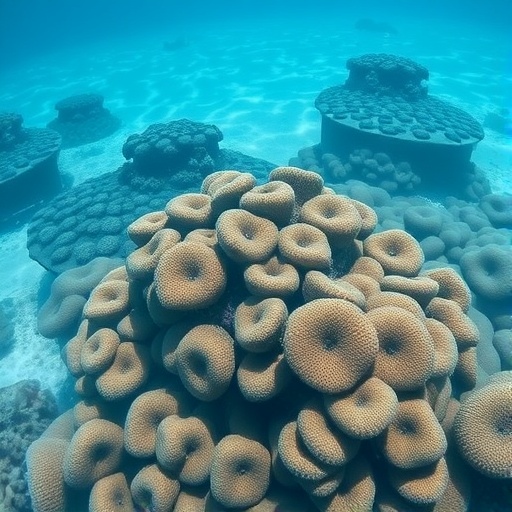
The reefs surrounding Tutuila, the largest island of American Samoa, had long been regarded as quietly resilient. Although the region experienced repeated coral bleaching episodes over the past decade as ocean temperatures climbed, the island’s forereefs consistently showed remarkably little bleaching-induced mortality, defying a global pattern of decline. A new study published in the journal Coral Reefs reveals that this apparent stability came to an abrupt end during the fourth Global Coral Bleaching Event, when a threatened coral species suffered a dramatic and size-dependent surge in tissue loss that has alarmed researchers and conservation managers alike.
The research, led by Kira Turnham of the Cooperative Institute for Marine and Atmospheric Research at the University of Hawaiʻi together with colleagues from NOAA’s Pacific Islands Fisheries Science Center, draws on a decade of survey data collected between 2015 and 2025. The team focused on Isopora crateriformis, a scleractinian coral listed as threatened under the U.S. Endangered Species Act. The species can be locally abundant across Samoan reefs, forming dense thickets that provide structural complexity and habitat for reef fishes, which makes its condition a meaningful indicator of overall reef health.
The numbers tell a stark story. Before 2024, partial mortality—the fraction of a colony’s living tissue that has died while the remainder survives—averaged roughly 8 percent across surveyed colonies, a level that had remained stable across all previous survey years. When the team returned to the water in 2025, after the fourth Global Coral Bleaching Event had swept through the region, that figure had tripled to 30 percent. In other words, nearly a third of the living tissue across the population had been lost, even though the surveys were conducted well after the peak of the heat stress had passed.
What makes the finding especially instructive is its dependence on colony size. Small colonies, the analysis showed, remained essentially unchanged, with partial mortality staying at pre-event levels. Medium colonies, by contrast, saw an 18 percent increase in the extent of tissue loss, while large colonies—the reproductive heavyweights of the population—experienced a staggering 46 percent increase. This pattern of size-dependent damage carries serious demographic consequences, because large colonies contribute disproportionately to egg production and population persistence. Their disproportionate loss threatens not only the current abundance of the species but its capacity to recover in the years ahead.
To establish that the 2024 heat wave was indeed the culprit, the researchers coupled their biological surveys with satellite-derived sea surface temperature data at one-kilometer resolution. They quantified heat stress using standard metrics that accumulate how far temperatures exceed the local bleaching threshold over time, and found a clear relationship: the extent of partial mortality in medium and large colonies increased with the severity and duration of thermal exposure at each site. Cumulative heat stress during the event was higher and persisted longer than any previous record in this region, exceeding the conditions that had accompanied earlier bleaching episodes to which the forereefs had largely shrugged off. The spatial correlation between heat load and tissue loss strongly implicates the global bleaching event as the driving force behind the observed decline.
The physical mechanisms connecting heat stress to tissue death are well understood in principle. When water temperatures rise beyond a coral’s tolerance, the symbiotic algae living within the coral’s tissues—dinoflagellates of the family Symbiodiniaceae—begin to malfunction, producing reactive oxygen species that damage both partners. The coral expels its algae in the process known as bleaching, leaving itself colorless and energy-starved. If temperatures drop quickly, corals can recover by reacquiring symbionts, but prolonged stress depletes lipid reserves, impairs immune function, and leaves colonies vulnerable to tissue necrosis, disease, and predation. Large colonies appear particularly exposed, possibly because of their greater biomass demands, boundary-layer effects that limit mass transfer of oxygen and gases across colony surfaces, and the sheer surface area of tissue at risk.
One of the study’s most consequential contributions is methodological. Because the team was unable to conduct quantitative observations during the peak of the stress event itself—a common reality in remote Pacific fieldwork—they turned to partial mortality measured afterward as a proxy for bleaching impact. Their results demonstrate that this retrospective measure can effectively quantify the footprint of a bleaching event when real-time monitoring is impossible. Partial mortality, long recognized by coral demographers as a key process shaping colony growth, fission, and fecundity, now gains an additional role as a practical forensic tool for assessing climate impacts after the fact. This matters enormously for protected-species management, where agencies need defensible estimates of harm to trigger and calibrate conservation responses.
Indeed, the study carries particular legal and management weight. Isopora crateriformis is one of the Indo-Pacific reef-building corals listed as threatened under the Endangered Species Act following NOAA’s 2014 listing determination, and this work represents the first peer-reviewed assessment of climate-related impacts on an ESA-listed coral in the Pacific. Under the Act, managers are required to base recovery planning and regulatory decisions on the best available science, and precise, spatially resolved estimates of event-driven mortality provide exactly that. The data also feed into recovery status reviews that evaluate whether listing classifications remain appropriate.
Equally significant is the spatial pattern the researchers uncovered. Heat stress was not uniform around Tutuila; satellite data revealed pronounced variation in cumulative thermal exposure from one side of the island to the other. The condition of the I. crateriformis population tracked this mosaic, with colonies in cooler, less-stressed zones faring markedly better than those exposed to extreme heat accumulation. This geography of damage suggests that potential spatial refuges exist—areas where local oceanographic conditions, such as water flow, depth, cloud cover, or internal waves, moderate thermal extremes. Identifying and protecting such refugia has become a central strategy in coral conservation, since these sites may serve as arks of genetic diversity and larval supply for a warming future. Previous work in American Samoa and elsewhere in the Pacific has highlighted how thermally tolerant symbiont combinations and high-frequency temperature variability can buffer corals, and the new findings reinforce the idea that reef-scale oceanography shapes survival in predictable ways.
The broader context is sobering. The fourth Global Coral Bleaching Event, which began in 2023 and intensified through 2024, has affected reefs on a scale unmatched in the observational record, touching coral ecosystems from the Great Barrier Reef to the Caribbean to the central Pacific. Earlier events, such as those of 1998, 2010, and 2015–2017, revealed that even reefs with a history of thermal exposure and apparent acclimatization are not immune when heat stress reaches unprecedented duration and intensity. American Samoa’s forereefs had seemed to embody a hopeful narrative of resilience, hosting corals with thermally resistant algal symbionts and recovering from moderate stress events such as the one documented at nearby Swains Island in recent years. The 2024 event shattered that narrative, showing that resilience has limits when cumulative heat stress breaks historical bounds.
For the scientists involved, the message is twofold. First, the trajectory from stability to decline at Tutuila demonstrates that no reef, however resilient its history, can be assumed safe from accelerating ocean warming. Second, the tools of careful demographic monitoring—tracking individual colonies, measuring partial mortality, and linking biological outcomes to satellite-derived thermal exposure—can convert even post-event surveys into actionable science. The study’s data and analysis scripts have been made publicly available through GitHub and archived with NOAA’s National Centers for Environmental Information, ensuring that managers, modelers, and fellow researchers can build on the findings. As global bleaching events shift from rare catastrophes toward near-annual disturbances, such longitudinal records will be indispensable for distinguishing genuine refuges from false hope, and for giving threatened species like Isopora crateriformis their best chance of persisting through the century ahead.
Cite Scienmag News
Violet Maxwell. (September 7, 2026). Coral disease triples in American Samoa after 2024 bleaching event. Scienmag. https://scienmag.com/coral-disease-triples-in-american-samoa-after-2024-bleaching-event/
Violet Maxwell. "Coral disease triples in American Samoa after 2024 bleaching event." Scienmag, 7 September 2026, https://scienmag.com/coral-disease-triples-in-american-samoa-after-2024-bleaching-event/. Accessed 7 September 2026.
Violet Maxwell. "Coral disease triples in American Samoa after 2024 bleaching event." Scienmag. September 7, 2026. https://scienmag.com/coral-disease-triples-in-american-samoa-after-2024-bleaching-event/


