


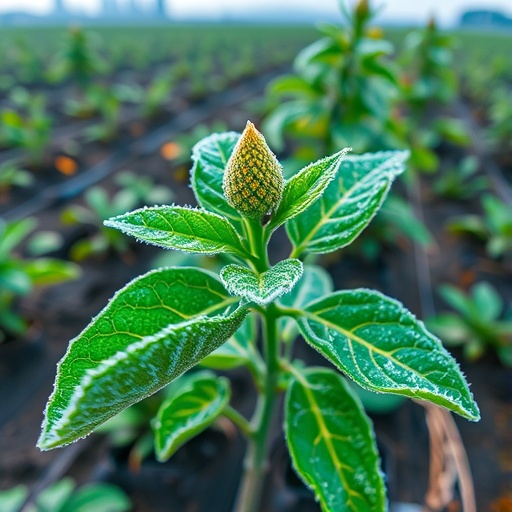
Every year, plant diseases destroy a staggering share of the world’s crops, and the farmers who suffer most are precisely those with the least access to expert diagnosis. For nearly a decade, the promise of smartphone-based disease detection has tantalized agricultural technologists: point your camera at a sick leaf, and an algorithm names the disease. On the standard laboratory benchmark, called PlantVillage, this promise looks gloriously fulfilled. Convolutional neural networks trained on its 54,306 neatly photographed, uniformly backdropped leaves routinely exceed 99 percent accuracy, a level of performance that would suggest the problem is essentially solved. Now a team of researchers in Vietnam, publishing in the journal Smart Agricultural Technology, has delivered a sobering and ultimately hopeful reassessment of that success story, showing that the same models collapse catastrophically in real farm fields, and that a surprising fix lies in an artificial intelligence that was never taught anything about plants at all.
The problem, the researchers explain, is what happens when laboratory-trained classifiers meet the messy real world. A laboratory image isolates a single flattened leaf under even lighting against a clean background. A photograph taken in an actual field contains cluttered vegetation, harsh and shifting illumination, motion blur, occlusion, and overlapping leaves at unpredictable angles and scales. When classifiers trained on PlantVillage are tested on field imagery from a dataset called PlantDoc, accuracy can fall to a third of its laboratory value. The most influential explanation has been the “background bias” hypothesis: because PlantVillage’s backgrounds are homogeneous and correlated with disease labels, a network has every incentive to latch onto this spurious but highly predictive cue rather than the actual symptoms of disease. The evidence for this shortcut learning is striking. One prior study showed that a classifier restricted to as few as eight background pixels still reaches 49 percent accuracy on PlantVillage, proof that non-leaf pixels alone are strongly predictive in the laboratory distribution.
If the background is the shortcut, the field of agricultural machine learning has long assumed, then suppressing it should restore field performance. Researchers have tried three broad strategies: directly segmenting or masking backgrounds, aggressively augmenting training images to simulate field conditions, and treating the laboratory-to-field shift as a domain adaptation problem to be corrected during training or at test time. Yet, as the new study documents, these interventions have closed only a small part of the gap. Background removal, heavy augmentation, and test-time adaptation each tend to move cross-dataset accuracy by a few points at most, and some trades robustness to one distribution shift for fragility to another. This pattern of persistently limited returns led the team to a provocative reframing: the background pixels are a symptom rather than the cause. The real bottleneck is the representation a laboratory-trained network learns, one that entangles the disease signal with laboratory-specific texture and context. Rather than repairing a representation specialized for laboratory images, the team asked whether one that was never specialized to them is already robust enough to transfer.
Enter DINOv2, a so-called foundation model built by Meta AI researchers and now put to a new purpose. Foundation models are trained by self-supervision on web-scale image collections, in this case 142 million curated images, with no human-provided task labels at any stage. DINOv2 is a vision transformer trained through self-distillation, a technique in which a student network learns to match the outputs of a teacher network on different crops of the same image. Two properties make such a model appealing for plant disease recognition. First, having never been exposed to the laboratory shortcut, it has no reason to encode it. Second, its features lean heavily on object shape rather than local texture, a bias long associated with robustness to out-of-distribution data in the computer vision literature. The team tested the simplest possible recipe: freeze the backbone entirely, extract its features from a leaf photograph, and train only a thin linear classifier on top, using PlantVillage labels alone. Nothing in the backbone is updated, and the model never sees a single field label, making the protocol leakage-free by construction. Any transfer observed is a property of the pretrained representation, not of sneaky adaptation to the target domain.
The results were dramatic. A frozen DINOv2 linear probe reached 51.1 percent, plus or minus 0.7, on PlantDoc field images, a 23.4 percentage-point improvement over a conventional EfficientNet-B0 network trained conventionally on laboratory data, using zero field information. The gain was confirmed with formal statistical hypothesis testing, including exact per-image McNemar tests across multiple random seeds with file-level reproducibility. Perhaps more striking was what happened when the researchers tried to improve on the frozen features by adapting the backbone. Full fine-tuning on laboratory data was decisively harmful, degrading the representation’s field robustness and erasing most of the transfer advantage. Adaptation through low-rank updates, the popular technique known as LoRA, produced a small, directionally positive but statistically inconclusive penalty relative to freezing. Weight-space interpolation between the frozen and fine-tuned models offered no robustness benefit whatsoever. The practical recipe, the authors conclude, is blunt: keep the backbone frozen, or at most adapt it with low-rank updates, and never fine-tune it fully on laboratory data.
To test whether the advantage was an accident of one dataset, the team replicated the experiment on a second field collection, the Plant Pathology 2021 dataset of 11,310 apple leaf images. There, a clear two-tier structure emerged. Shape-biased models, MobileViT and DINOv2, achieved 45 to 58 percent accuracy on the full 27-class task, while pure convolutional networks collapsed far lower: MobileNetV3 managed just 13.6 percent and EfficientNet-B0 an erratic 24.2 percent, with seed-to-seed swings from 9 to 38 percent. The CNNs were prone to a particularly telling failure, confusing a field apple leaf for a leaf of an entirely different crop. On both accuracy and macro-F1, the tier separation between shape-biased and texture-biased architectures was robust and metric-independent, though the researchers carefully note that the finer ordering between DINOv2 and MobileViT depends on which metric one prefers, and they decline to claim the foundation model is uniformly best. On a restricted three-way apple-disease task, all models clustered between 58 and 67 percent, showing that the architectural gap concentrates precisely where cross-crop confusion is possible, which is to say, in the conditions growers actually face.
The most intellectually satisfying contribution of the study may be its explanation of why the foundation model wins. Rather than relying on a vague appeal to shape bias, the researchers derived an exact mathematical decomposition of field accuracy. For any field image, correct classification into the full 27-class space can be split into two factors: the probability that the model keeps the image within the correct crop taxon at all, and the probability that, having done so, it names the right disease within that taxon. The team calls the first factor “taxonomic retention” and verified, to numerical precision, that the identity holds pointwise for every model tested. The decomposition reveals that the foundation model’s advantage lies overwhelmingly in taxonomic retention: where conventional CNNs mistake apple leaves for the leaves of other crops, the frozen foundation model keeps them in the right crop and then succeeds or fails at the finer disease discrimination. Shape reliance emerged as a coarser correlate of this retention, but the retention metric ranks models more cleanly than any direct shape-bias measurement.
The deployment question, critical for low-resource agriculture where growers use phones and edge devices rather than data-center GPUs, received its own systematic treatment. The team distilled the frozen foundation model’s knowledge into compact student networks suitable for on-device inference, using both logits-based and feature-based distillation, with teacher assistants and shuffling of students and teachers to prevent over-specialization. Distillation helped, but the gains proved dataset-dependent, and the authors recommend treating it as a secondary optimization rather than a core part of the recipe. The primary, transferable prescription remains the same across their experiments: the frozen pretrained features carry the robustness, and the job of the practitioner is to preserve rather than modify them.
The broader implications ripple well beyond plant pathology. The study is a vivid, agriculturally grounded instance of a lesson now reverberating through machine learning: that representations learned through self-supervision on enormous, diverse data can outperform specialized models on exactly the shifts that break the specialists, even with a frozen backbone and a handful of linear layers. For the millions of smallholder farmers in low-resource regions, the gap between a 24 percent and a 58 percent field accuracy is the difference between a gimmick and a tool. The research also carries a caution for the countless published models boasting 99 percent on PlantVillage: that number, taken at face value, measures conformity to a laboratory shortcut as much as disease expertise. As climate stress intensifies plant disease pressure worldwide, the ability to diagnose a sick crop from a single photo taken in an uneven, weed-choked field may become one of the most consequential applications of artificial intelligence in food security, and this study suggests the path forward runs through general-purpose intelligence rather than narrow specialization. The frozen model, it turns out, sees the leaf the way a farmer does: whole, in context, and unfazed by the mess.
Cite Scienmag News
Alan Morgan. (September 7, 2026). Frozen AI features enable robust plant disease detection from lab to field. Scienmag. https://scienmag.com/frozen-ai-features-enable-robust-plant-disease-detection-from-lab-to-field/
Alan Morgan. "Frozen AI features enable robust plant disease detection from lab to field." Scienmag, 7 September 2026, https://scienmag.com/frozen-ai-features-enable-robust-plant-disease-detection-from-lab-to-field/. Accessed 7 September 2026.
Alan Morgan. "Frozen AI features enable robust plant disease detection from lab to field." Scienmag. September 7, 2026. https://scienmag.com/frozen-ai-features-enable-robust-plant-disease-detection-from-lab-to-field/


