


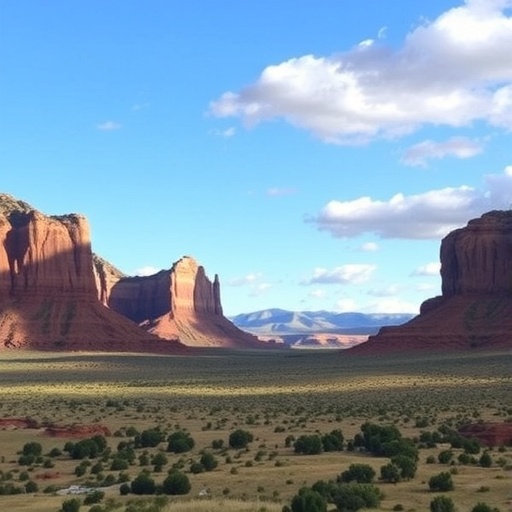
The Geological Society of America, one of the world’s largest and most influential professional organizations for the earth sciences, has issued a formal statement opposing the significant reductions to Bears Ears and Grand Staircase–Escalante National Monuments, delivering a pointed warning that shrinking these protected landscapes would inflict irreversible damage on some of the most scientifically valuable geological records on the continent. In an announcement issued from its Boulder, Colorado headquarters, the society positioned itself alongside scientists, educators, and Tribal Nations who have repeatedly called for the continued protection of the two Utah monuments, whose reduced boundaries remain the subject of ongoing federal litigation.
At the heart of the society’s argument is a deceptively simple scientific principle: context matters. Both monuments, the organization emphasizes, were originally delineated not as arbitrary parcels of land but as geologically coherent landscapes, where the boundaries were drawn to preserve the spatial continuity essential for reading Earth’s history the way one reads a book. Remove chapters from the middle of that book, geologists argue, and the remaining pages lose much of their meaning. The exposed rock sequences in these monuments do not merely document ancient environments in isolation; they preserve the relationships between layers, the transitions between time periods, and the physical evidence of the enormous forces that shaped the Colorado Plateau over hundreds of millions of years.
Grand Staircase–Escalante National Monument, designated in 1996, is perhaps the most dramatic illustration of this principle. The monument takes its name from the vast sequence of cliffs and terraces—the Grand Staircase itself—that steps progressively through roughly two billion years of layered sedimentary rock, from the ancient Vishnu Schist at the base of the Grand Canyon region up through the pastel-hued strata of Bryce Canyon’s rim. Across this landscape, geologists can trace the interplay of dramatic uplift and erosion that has raised the entire Colorado Plateau by thousands of feet while rivers carved away at it, exposing layer after layer of rock that records shifting seas, migrating shorelines, evolving river systems, and the rise and fall of entire ecosystems.
Within the monument, the Kaiparowits Plateau has emerged as an internationally celebrated destination for paleontological research. The Late Cretaceous rocks of the Kaiparowits Formation preserve an extraordinarily rich record of dinosaurs and other organisms that lived on a portion of the ancient continent of Laramidia, a landmass isolated from the rest of North America by a seaway that bisected the continent more than 75 million years ago. Discoveries from this region—including previously unknown species of horned dinosaurs, duck-billed dinosaurs, and tyrannosaurs—have fundamentally reshaped scientific understanding of how dinosaur ecosystems were structured and how they evolved during the final chapters of the Mesozoic Era. Researchers have consistently emphasized that this record is valuable precisely because the rocks remain intact, exposed, and embedded within a landscape whose geological relationships have not been fragmented.
Bears Ears National Monument, designated in 2016 and notable for being established at the request of a coalition of five Tribal Nations, tells an even deeper story in geological time. The monument’s deeply eroded terrain on the Colorado Plateau preserves more than 300 million years of Earth history, but its scientific crown jewel is what geologists consider one of the finest continuous records anywhere in the world of the Triassic–Jurassic transition. This interval, roughly 201 million years ago, marks one of the five greatest mass extinctions in Earth’s history—an event triggered by massive volcanic eruptions associated with the breakup of the supercontinent Pangaea that eliminated perhaps three-quarters of all species on the planet. The sequences of rock in Bears Ears capture this pivotal moment with a continuity that allows scientists to study how ecosystems collapsed, recovered, and reorganized, offering essential baseline knowledge for understanding how life responds to global environmental upheaval.
The Geological Society’s statement also makes an explicit connection between the monuments’ geology and their celebrated archaeological heritage. Bears Ears contains tens of thousands of cultural sites, including cliff dwellings, kivas, and rock art panels that testify to ancestral Puebloan and other Indigenous communities. But these human records, the society notes, are physically anchored to the landscape itself. Ancient peoples built their dwellings from local stone, sheltered beneath the same overhanging sandstone ledges, and followed water sources whose existence was dictated by the underlying geology. Understanding the archaeological record therefore requires understanding the geological setting that made human habitation possible—and that setting, like the rock record itself, is legible only when the landscape remains whole. Fragmenting the monument, scientists argue, inevitably fragments this interwoven record of geological and human history.
The statement is notable for the way it anticipates and directly addresses the most common economic argument for reducing the monuments: access to mineral and energy resources. Rather than dismissing resource development outright, the Geological Society of America affirms that it recognizes the national importance of mineral resources and the central role that geoscientists themselves play in their responsible development. But, the society argues, responsible development cannot mean sacrificing irreplaceable scientific and geoheritage resources to irreversible damage. Mineral deposits, however valuable, are quantifiable and recoverable in other locations; the fossil localities, stratigraphic sections, and geological exposures within these monuments, once destroyed by roads, mining operations, or off-road vehicle activity, can never be restored to their scientific state. The statement effectively reframes the debate as one not of science versus economy, but of short-term extraction versus permanent loss of a shared national and scientific inheritance.
The reductions to both monuments have been among the most contentious public-lands decisions in modern American history. Bears Ears was reduced by approximately 85 percent, and Grand Staircase–Escalante by roughly half, opening former monument lands to potential mining, drilling, and other development. Those reductions have been challenged in federal court by a coalition of plaintiffs that has included Tribal Nations, conservation organizations, and scientific societies, and the legal battles have repeatedly underscored questions about presidential authority under the Antiquities Act of 1906—the statute that authorizes presidents to protect objects of historic and scientific interest on federal lands. The Geological Society’s statement directly acknowledges this ongoing litigation, noting that the reductions remain contested in the courts, and the society’s intervention adds significant scientific weight to those proceedings.
Beyond the legal and political dimensions, the society’s statement is also a defense of the practice of field science itself. Both monuments function as living laboratories where generations of geologists and paleontologists have been trained—where students learn to read rock exposures, reconstruct ancient landscapes, and test hypotheses against the physical evidence preserved in stone. Grand Staircase–Escalante alone has yielded hundreds of new fossil species, many of them discovered through systematic fieldwork that depends on access to broad, intact tracts of land. The society emphasizes that these landscapes support ongoing scientific discoveries even today, and that cutting their boundaries would undermine not only current research but the training of future generations of geoscientists who will need such natural laboratories to confront emerging questions about climate change, evolution, and deep-Earth processes.
The organization closes its statement with an unambiguous call: the monuments’ boundaries should be restored, and their long-term stewardship should reflect the irreplaceable scientific and cultural value of these landscapes. The Geological Society of America, with more than 18,000 members in over 100 countries and publisher of the top-ranked journal Geology, speaks with considerable authority on questions of geological significance. Its formal opposition signals that the scientific community regards these monuments not as contested political terrain but as essential instruments of knowledge—irreplaceable archives of more than 300 million years of Earth history, and landscapes whose full meaning, like the rock layers that compose them, can only be understood when they are preserved intact.
Cite Scienmag News
Violet Maxwell. (September 5, 2026). GSA opposes shrinking Bears Ears and Grand Staircase-Escalante monuments. Scienmag. https://scienmag.com/gsa-opposes-shrinking-bears-ears-and-grand-staircase-escalante-monuments/
Violet Maxwell. "GSA opposes shrinking Bears Ears and Grand Staircase-Escalante monuments." Scienmag, 5 September 2026, https://scienmag.com/gsa-opposes-shrinking-bears-ears-and-grand-staircase-escalante-monuments/. Accessed 5 September 2026.
Violet Maxwell. "GSA opposes shrinking Bears Ears and Grand Staircase-Escalante monuments." Scienmag. September 5, 2026. https://scienmag.com/gsa-opposes-shrinking-bears-ears-and-grand-staircase-escalante-monuments/


